

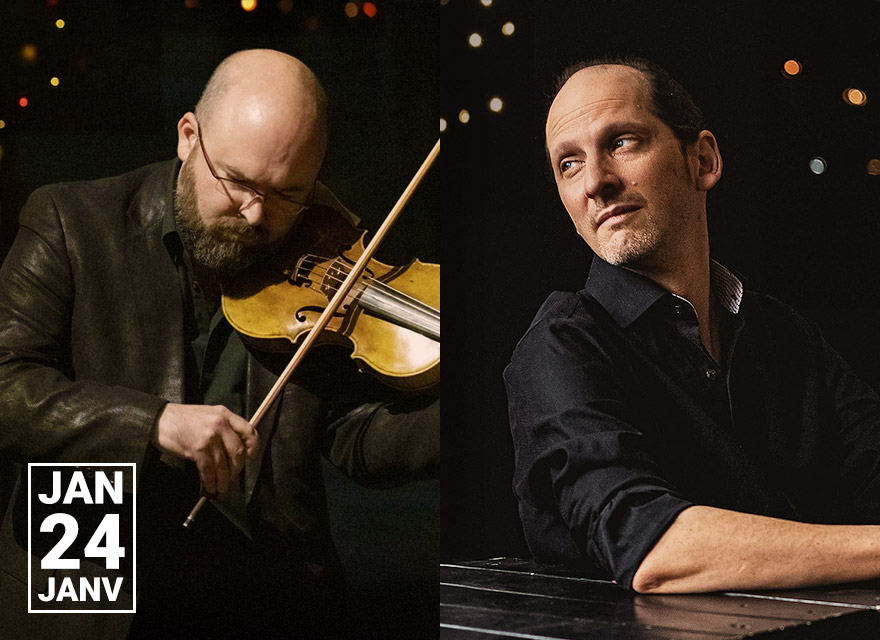
Mark Fewer & Mathieu Gaudet
SATURDAY, JANUARY 24, 2026 • 7:30PM
STAGE AT ST. ANDREWS • 6036 COBURG RD
HALIFAX, NOVA SCOTIA
WHEELCHAIR ACCESSIBLE
About this Concert
Pianist Mathieu Gaudet and violinist Mark Fewer come together for a captivating program that spans two centuries of musical brilliance. With a deep connection to Beethoven’s "Spring Sonata," Gaudet and Fewer infuse it with a lively vibrancy, intertwining lyrical beauty with dynamic energy. Canadian composer Chris Paul Harman’s "After Clementi" offers a bold, contemporary reimagining of classical forms, pushing boundaries and exploring new textures, and George Enescu’s "Romanian Folk Style Sonata" weaves evocative melodies and intricate harmonies, immersing listeners in the rich landscape of Eastern European folk traditions. The program includes the world premiere of Mathieu Gaudet’s “Prelude, Ballad and Dance,” featuring a contrapuntal Prelude, a Ballad inspired by Newfoundland folk music, and an energetic Dance. A Juno Award-winner, Fewer brings expressive depth and fearless versatility to every performance, while Gaudet's nuanced playing adds clarity and warmth. Known for his extensive repertoire and innovative artistry, Gaudet’s performance is complemented by Fewer’s genre-defying violin mastery, with over 200 works premiered throughout his career. Together, they deliver a performance that celebrates the fusion of tradition and innovation, blending virtuosity, emotion, and creativity in a truly dynamic experience. Season Sponsor: Nice Moves / Red Door Realty.
This performance is made possible with the generous support of Laura Jantek.
ARTISTS: Mark Fewer, violin; Mathieu Gaudet, piano
MAIN STAGE CONCERTS SERIES
About the Program
Chris Paul Harman (born 1970)
After Clementi
Chris Paul Harman was born and grew up in Toronto. While he studied piano, classical guitar, cello and electronic music, he was largely self-taught as a composer. Nevertheless, he was a finalist in the CBC Radio National Competition for Young Composers in 1986 - at age fifteen, the youngest finalist ever. Four years later, his composition, Iridescence, was awarded the Grand Prize in that same competition, making him the competition’s youngest ever Grand Prize winner. Iridescence also won first prize in the under-30 category in the International Rostrum of Composers in Paris in 1991. He was the first Canadian to win this prize. He subsequently received commissions from the CBC, the National Arts Centre and the Toronto and Winnipeg Symphonies. His pieces have been commissioned and performed across Canada, in Britain, Japan, Korea, Brazil and the Netherlands. His compositions cover a wide range of genres including orchestral, vocal, choral, chamber and solo piano. While composing, Harman continued his studies, completing his PhD in Composition from the University of Birmingham in 2012. Since 2014, he has been a Professor of Composition at McGill University.
As a composer, Harman is noted for his boldly original forms and his eerie refashioning of familiar musical material. His recent piece, composed in 2022, After Clementi, for example, takes the music of Muzio Clementi, the Italian born piano virtuoso and composer known as the “Father of the Piano”, and recreates the elegance and spirit of Clementi’s piano sonatas in a set of three short pieces.
Ludwig van Beethoven (1770-1827)
Sonata for Piano and Violin No. 5 in F Major, Opus 24
Allegro
Adagio molto espressivo
Scherzo: Allegro molto
Rondo: Allegro ma non troppo
By 1801, Ludwig van Beethoven is well established in Vienna, having moved there in 1792 from Bonn. He has just turned thirty. From his early days in Vienna, when he had studied with Haydn and Salieri, he began to achieve recognition as a pianist in the salons of the wealthy upper class. He had made a highly successful public debut in 1795 and had begun to have his compositions published. The publication of his Opus 1, realized profits that were nearly sufficient to cover Beethoven’s living expenses for a year. Success followed success and by 1800, he was regarded as the foremost young composer in Vienna and the successor to Mozart and Haydn. His brother Karl joined him as his business manager and recommended that Beethoven do arrangements of his published pieces for other instruments to forestall publishers from profiting from his popularity. And Beethoven has fallen in love – twice – but class differences prevented the relationships from going anywhere. The only shadow on the horizon is the early signs of hearing impairment. It is in this context that Beethoven has written his Sonata for piano and violin no. 5 in F major, opus 24, the “Spring” sonata.
Between 1797 and 1803, Beethoven's composed nine sonatas for violin and piano, written for him to perform with various violinists. In the Classical era such works were often described as sonatas for piano with violin accompaniment and Beethoven, though continuing the trend toward full partnership begun by Mozart, certainly wasn't about to undercut his own presence on piano. Op. 24 was completed in 1801. While the Sonata's nickname "Spring" was not given by the composer, it does capture the generally cheerful sense of blossoming in the work. The opening movement is a big, bold sonata form, its gentle first theme contrasting starkly with the dramatic stress of the second. The lyrical Adagio marries variation techniques to song form, and the short, soft Scherzo and Trio is a Haydnesque comic interlude. The Rondo finale sums it all up, matching the harmonic adventures of the first movement, the tuneful grace of the Adagio, and the wit of the scherzo.
Mathieu Gaudet (born 1977)
Prelude, Ballad and Dance
“Prelude, Ballad and Dance” is a three-part work written for Mark Fewer, and each section focuses on a distinct compositional idea. The Prelude is built in strict three-voice counterpoint, with three independent lines moving at once and trading focus as they weave together, in a style not unlike Bach. Instead of a single melody supported by accompaniment, the musical interest comes from how each line answers, overlaps, and locks into the others, creating forward motion through clarity of texture and tight control of voice leading.
The Ballad turns to the sound world of Newfoundland folk music, but Gaudet places that influence inside a polytonal frame. The result is music where the folk-inspired material sits alongside, and sometimes against, more than one tonal centre at the same time. The Dance then shifts into a more driven, energetic finale. It is groovy and propulsive, borrowing the “Dies Irae” theme while also using 12-tone technique, so familiar melodic material appears inside a rigorously organized pitch system.
George Enescu (1881-1955)
Sonata for Violin and Piano No. 3 Opus 25
Moderato malinconico
Andante sostenuto e misterioso
Allegro con brio, ma non troppo mosso
George Enescu was a child prodigy on a level comparable to Mozart and Mendelssohn. He began composing short pieces for violin and piano before he was of school age, and his first piece of significant length, “Romanian Land", was composed when he was five. In October of 1888, Enescu became the youngest person ever admitted to the Vienna Conservatory. He was seven. While there, he played a concert for the Emperor Franz Joseph and met, and played for, his idol, Johannes Brahms. He graduated as a twelve-year-old and went on to study composition, as well as violin and piano performance at the Conservatoire de Paris. Upon graduation in 1899, Enescu embarked on a career that spanned over half a century as a composer, conductor, pianist, violinist and teacher. His career was characterized by his love of the music of his native Romania and by an openness to music of other cultures. He once rehearsed and played with the brother of sitarist Ravi Shankar, and he introduced his student, Yehudi Menuhin, to Indonesian gamelan music. He visited America frequently and conducted several orchestras there including the Philadelphia Orchestra and the New York Philharmonic. He is considered Romania’s greatest composer and memorials to him in his homeland abound.
Enescu composed his Sonata No. 3 in A minor over a span of about four months in 1926. He titled it “Sonata in the Romanian Folk Style”, and the piece is indeed infused with Romanian folk-dance rhythms. By 1926, Enesco was in mid-career and the sonata thus reflects not only his Romanian roots, but his Nineteenth Century Romantic background and Twentieth Century innovations. The opening movement, “Moderato malinconico” (moderately with a melancholy tone), begins in an urbane, nostalgic fashion with a lyrical theme that is succeeded by a rural folk dance section before returning to the opening mood. The second movement features a variety of moods, beginning with a sense of mystery created by the violin; it then transforms into an energetic folk dance before becoming dramatic and aggressive. It returns to the mysterious mood before a quiet, sustained close. The third movement is most clearly in the Romanian Folk Style with dance rhythms conjuring up village celebrations. It ends in a dramatic climax. Sonata No. 3 is, with good reason, one of Enescu’s most popular pieces.
Program notes by Larry Bent
About the Artists
Mark Fewer, violin
In a career that now spans over three decades, violinist Mark Fewer has been an interpreter of music past and present in virtually every genre and setting you will find a violin in. From appearances at famed concert halls such as Carnegie, Wigmore and Salle Pleyel, to venues such as Bartok House (Budapest), the Forum (Taipei) and Le Poisson Rouge (NYC), Fewer has appeared as featured guest soloist with ensembles ranging from the Zapp Quartet of Amsterdam, the Fodens-Richardson Brass Band (UK), the Chieftains, Stevie Wonder and his band, and the major symphonies of Toronto, San Francisco, Melbourne and more.
He has presented the premieres of over 200 works - more than 50 of which were written for him - with the 2023-24 season seeing premieres of new works by Melia Watras, Chris Paul Harman, David Braid, Alissa Cheung and others. Canadian jazz icon Phil Dwyer wrote his Juno-winning work Changing Seasons for Fewer, citing his “seemingly clairvoyant skills at interpretation”. When giving the Canadian premiere of John Adams The Dharma at Big Sur for 6-string electric violin and orchestra, the Globe and Mail referred to his performance as “intrepid”.
His extensive and unique discography includes appearances on multiple Juno-winning recordings, one Grammy winning recording, and a Prix Opus for a recording celebrating the work of Canadian composer Serge Arcuri. Other recordings of interest include the complete Sonatas of the Italian baroque composer Pandolfi-Mealli with the Smithsonian Chamber Players, the Sonatas of George Antheil with pianist John Novacek, the so-called “Jazz Sonata” of Bohuslav Martinu with Art of Time director Andrew Burashko, and Nine Daies Wander by Bramwell Tovey, written specifically for Fewer as a tribute to Shakespeare’s comedic actor Will Kemp. Soon to be released are new recordings featuring works by Inuit soprano-composer Deantha Edmunds, Jaroslav Kapuscinski, Robert Carli, and Chris Paul Harman.
Fewer is also a jazz violinist, appearing on stage with Dave Young, Brad Turner, Jodi Proznick, Jim Doxas, Jan Jarczyk, Pekka Kuusisto, Heather Bambrick, Suba Sankaran, Aaron Davis and many more.
He has held the positions of Concertmaster of the Vancouver Symphony, Artist-in-Residence at Stanford University, William Dawson Scholar at McGill University, and Artist-in-Residence at the Glamorgan Festival of Music in Cardiff, Wales. As a chamber musician he was a founding member of the Duke Piano Trio, violinist with the SuperNova and St. Lawrence String Quartets, and was an original member of the ARC Ensemble. He is currently first violinist of the Axelrod String Quartet at the Smithsonian Institute in Washington, DC, where the group performs and records exclusively on Stradivari and Amati instruments from the museum’s famed collection.
After 16 years as the founding artistic director of the SweetWater Music Festival, he is now in his sixth season at the helm of Stratford Summer Music.
He is an Associate Professor of Violin at the Faculty of Music, University of Toronto.
Mathieu Gaudet, piano
A versatile, passionate musician, Mathieu Gaudet has pursued a remarkable career as a soloist, chamber musician, and conductor for the past twenty years. He commands a vast repertoire of works and has performed across Canada, the United States, Europe, and Asia. His concerts and recordings are regularly broadcast on the French and English services of the CBC.
Since 2019, Mr. Gaudet has been recording the complete piano music of Franz Schubert on the Analekta label, a project that will include fifteen albums. Volume 6 « Relics » came out in March 2022 and volume 7 « The Wanderer » will be available in Octobre 2022. The first and third volumes were nominated for a prize at the ADISQ gala.
This season Mathieu Gaudet is playing at the Cecilia Concerts series in Halifax, NS, at the DOMS series in Ottawa ON and was at the center of a Schubert festival at the Concerts et rencontres champêtres in Abercorn, QC. He has recently played Schumann piano Concerto with the Saguenay Symphonic Orchestra and Chopin concerto no. 2 with the Kamloops Symphonic Orchestra.
Mathieu Gaudet obtained the Master of Music degree from the prestigious Peabody Institute of Johns Hopkins University in Baltimore, where he studied with Julian Martin, subsequently perfecting his training with Leon Fleisher. In 2007 he graduated Doctor of Music in Performance from the Faculty of Music of Université de Montréal under Paul Stewart.
Mark Fewer et Mathieu Gaudet
SAMEDI 24 JANVIER 2026 • 19h30
STAGE AT ST. ANDREWS • 6036 COBURG RD
HALIFAX, NOUVELLE-ÉCOSSE
ACCESSIBLE EN FAUTEUIL ROULANT
À propos de ce concert
Le pianiste Mathieu Gaudet et le violoniste Mark Fewer se réunissent pour un programme captivant qui traverse deux siècles de création musicale. Profondément liés à la Sonate « Le Printemps » de Beethoven, Gaudet et Fewer lui insufflent une vitalité lumineuse, où la beauté lyrique se mêle à une énergie dynamique. L’œuvre « After Clementi » du compositeur canadien Chris Paul Harman propose une relecture contemporaine audacieuse des formes classiques, explorant de nouvelles textures, tandis que la Sonate « dans le style populaire roumain » de George Enescu tisse des mélodies évocatrices et des harmonies complexes, plongeant l’auditeur dans l’univers riche des traditions folkloriques d’Europe de l’Est. Le programme comprend également la création mondiale de « Prelude, Ballad and Dance » de Mathieu Gaudet, avec un Prélude contrapuntique, une Ballade inspirée de la musique traditionnelle de Terre-Neuve et une Danse énergique. Lauréat d’un prix Juno, Mark Fewer apporte à chaque interprétation une profondeur expressive et une grande liberté artistique, tandis que le jeu nuancé de Gaudet ajoute clarté et chaleur. Reconnu pour l’ampleur de son répertoire et son approche inventive, Gaudet voit son interprétation enrichie par la maîtrise du violon de Fewer, qui a créé plus de 200 œuvres au cours de sa carrière. Ensemble, ils offrent une performance qui célèbre la rencontre entre tradition et innovation, alliant virtuosité, émotion et créativité dans une expérience musicale résolument vivante. Sponsor de la saison : Nice Moves / Red Door Realty.
Cette représentation est rendue possible grâce au soutien généreux de Laura Jantek.
ARTISTES : Mark Fewer, violon ; Mathieu Gaudet, piano
SÉRIE DE CONCERTS SUR LA SCÈNE PRINCIPALE
À propos du programme
Chris Paul Harman (né en 1970)
« After Clementi »
Chris Paul Harman est né à Toronto, où il a grandi. Même s’il a étudié le piano, la guitare classique, le violoncelle et la musique électronique, il est en grande partie autodidacte comme compositeur. Il a pourtant été finaliste du Concours national des jeunes compositeurs de Radio-Canada en 1986, à quinze ans, devenant le plus jeune finaliste de l’histoire du concours. Quatre ans plus tard, sa composition « Iridescence » remporte le Grand Prix de ce même concours, faisant de lui le plus jeune lauréat du Grand Prix. « Iridescence » obtient aussi le premier prix de la catégorie des moins de 30 ans à la Tribune internationale des compositeurs à Paris en 1991. Il est le premier Canadien à gagner ce prix. Par la suite, il reçoit des commandes de la SRC, du Centre national des Arts, ainsi que des orchestres symphoniques de Toronto et de Winnipeg. Ses œuvres sont commandées et interprétées au Canada, en Grande-Bretagne, au Japon, en Corée, au Brésil et aux Pays-Bas. Son catalogue couvre de nombreux genres, dont l’orchestre, la voix, le chœur, la musique de chambre et le piano solo. En parallèle de sa composition, Harman poursuit ses études et obtient un doctorat en composition à l’Université de Birmingham en 2012. Depuis 2014, il est professeur de composition à l’Université McGill.
Comme compositeur, Harman se distingue par des formes résolument originales et par une réinvention troublante de matériaux musicaux familiers. Son œuvre récente, composée en 2022, « After Clementi », reprend par exemple la musique de Muzio Clementi, virtuose et compositeur italo-britannique souvent surnommé le « Père du piano », et recrée l’élégance et l’esprit des sonates pour piano de Clementi sous la forme d’un triptyque de trois courtes pièces.
Ludwig van Beethoven (1770-1827)
« Sonate pour piano et violon no 5 en fa majeur, opus 24 »
Allegro
Adagio molto espressivo
Scherzo : Allegro molto
Rondo : Allegro ma non troppo
En 1801, Ludwig van Beethoven est solidement établi à Vienne, où il s’est installé en 1792 après avoir quitté Bonn. Il vient d’avoir trente ans. Dès ses débuts viennois, après avoir étudié avec Haydn et Salieri, il se fait reconnaître comme pianiste dans les salons de la riche haute société. Il a connu des débuts publics très réussis en 1795 et ses œuvres commencent à être publiées. La publication de son Opus 1 lui rapporte des profits presque suffisants pour couvrir ses frais de subsistance pendant un an. Les succès s’enchaînent et, en 1800, on le considère comme le plus important jeune compositeur de Vienne et comme l’héritier de Mozart et de Haydn. Son frère Karl le rejoint comme gestionnaire et lui recommande de faire des arrangements de ses œuvres publiées pour d’autres instruments, afin d’empêcher les éditeurs de profiter de sa popularité. Et Beethoven est tombé amoureux, deux fois, mais les différences de classe ont empêché ces relations d’aller plus loin. La seule ombre à l’horizon est l’apparition des premiers signes de troubles auditifs. C’est dans ce contexte que Beethoven écrit sa « Sonate pour piano et violon no 5 en fa majeur, opus 24 », la sonate « Printemps ».
Entre 1797 et 1803, Beethoven compose neuf sonates pour violon et piano, destinées à être jouées par lui avec différents violonistes. À l’époque classique, on décrivait souvent ces œuvres comme des sonates pour piano avec accompagnement de violon, et Beethoven, même s’il poursuit la tendance amorcée par Mozart vers un véritable partenariat, n’est certainement pas prêt à minimiser son propre rôle au piano. L’opus 24 est achevé en 1801. Même si le surnom « Printemps » ne vient pas du compositeur, il reflète bien le caractère généralement lumineux et épanoui de l’œuvre. Le premier mouvement, vaste et audacieux, suit une forme sonate, dont le thème d’ouverture, doux, contraste fortement avec la tension dramatique du second. L’Adagio lyrique marie des procédés de variation à une forme chantée. Le Scherzo et Trio, bref et feutré, sert d’interlude comique à la manière de Haydn. Le finale en rondo réunit tout cela, en reprenant les explorations harmoniques du premier mouvement, la grâce mélodique de l’Adagio et l’esprit du scherzo.
Mathieu Gaudet (né en 1977)
« Prélude, Ballade et Danse »
« Prelude, Ballad and Dance » est une œuvre en trois volets écrite pour Mark Fewer, et chaque section met de l’avant une idée de composition distincte. Le Prelude est construit en contrepoint strict à trois voix, avec trois lignes indépendantes qui avancent en même temps et se relaient l’attention au fil de leur tissage, dans un style qui n’est pas sans rappeler Bach. Plutôt qu’une seule mélodie soutenue par un accompagnement, l’intérêt musical vient de la façon dont chaque ligne répond aux autres, se superpose et s’imbrique, créant un élan grâce à la clarté de la texture et à un contrôle serré de la conduite des voix.
La Ballad se tourne vers l’univers sonore de la musique traditionnelle de Terre-Neuve, mais Gaudet inscrit cette influence dans un cadre polytonal. Il en résulte une musique où le matériau inspiré du folklore cohabite avec plus d’un centre tonal à la fois, parfois en tension. La Dance bascule ensuite vers un finale plus tendu et énergique. Elle est groovy et entraînante, empruntant le thème du « Dies Irae » tout en recourant à la technique dodécaphonique, de sorte qu’un matériau mélodique familier apparaît au sein d’un système de hauteurs rigoureusement organisé.
George Enescu (1881-1955)
« Sonate pour violon et piano no 3, opus 25 »
Moderato malinconico
Andante sostenuto e misterioso
Allegro con brio, ma non troppo mosso
George Enescu est un enfant prodige d’un niveau comparable à Mozart et Mendelssohn. Il commence à composer de courtes pièces pour violon et piano avant même l’âge scolaire, et sa première œuvre d’envergure, « Romanian Land », est composée alors qu’il a cinq ans. En octobre 1888, Enescu devient la plus jeune personne jamais admise au Conservatoire de Vienne. Il a sept ans. Pendant ses études, il joue un concert devant l’empereur François-Joseph et rencontre son idole, Johannes Brahms, pour qui il joue également. Il obtient son diplôme à douze ans, puis poursuit des études de composition ainsi que de violon et de piano au Conservatoire de Paris. À la fin de ses études en 1899, Enescu entreprend une carrière de plus d’un demi-siècle comme compositeur, chef d’orchestre, pianiste, violoniste et pédagogue. Sa trajectoire se caractérise par son attachement à la musique de la Roumanie et par une ouverture à d’autres cultures musicales. Il a un jour répété et joué avec le frère du sitariste Ravi Shankar, et il a fait découvrir à son élève Yehudi Menuhin la musique de gamelan indonésien. Il se rend fréquemment aux États-Unis, où il dirige plusieurs orchestres, dont le Philadelphia Orchestra et le New York Philharmonic. Il est considéré comme le plus grand compositeur roumain, et les hommages à sa mémoire sont nombreux dans son pays.
Enescu compose sa Sonate no 3 en la mineur sur une période d’environ quatre mois en 1926. Il lui donne le titre « Sonate dans le style populaire roumain », et l’œuvre est effectivement imprégnée de rythmes de danses folkloriques roumaines. En 1926, Enescu se trouve au milieu de sa carrière, et la sonate reflète à la fois ses racines roumaines, son héritage romantique du dix-neuvième siècle et ses innovations du vingtième siècle. Le premier mouvement, « Moderato malinconico » (modéré, au ton mélancolique), s’ouvre dans une atmosphère urbaine et nostalgique avec un thème lyrique, suivi d’une section de danse populaire plus rustique, avant un retour à l’humeur initiale. Le deuxième mouvement traverse plusieurs climats, en commençant par une aura de mystère créée par le violon, puis en se transformant en danse populaire énergique, avant de devenir dramatique et agressif. Le mystère revient, puis l’œuvre s’éteint dans une conclusion calme et soutenue. Le troisième mouvement affirme le plus clairement le style populaire roumain, avec des rythmes de danse qui évoquent des célébrations villageoises. Il se termine dans un climax dramatique. Avec raison, la Sonate no 3 compte parmi les œuvres les plus appréciées d’Enescu.
Notes de programme par Larry Bent
À propos des artistes
Mark Fewer, violon
Au cours d’une carrière qui s’étend maintenant sur plus de trois décennies, le violoniste Mark Fewer s’est imposé comme interprète de musiques d’hier et d’aujourd’hui, dans pratiquement tous les genres et tous les contextes où l’on retrouve un violon. Des prestations dans des salles de concert renommées comme Carnegie, Wigmore et la Salle Pleyel, jusqu’à des lieux comme la Bartok House (Budapest), le Forum (Taipei) et Le Poisson Rouge (NYC), Fewer a été soliste invité auprès d’ensembles aussi variés que le Zapp Quartet d’Amsterdam, le Fodens-Richardson Brass Band (R.-U.), The Chieftains, Stevie Wonder et son groupe, ainsi que de grands orchestres symphoniques, dont ceux de Toronto, San Francisco, Melbourne, et bien d’autres.
Il a créé plus de 200 œuvres, dont plus de 50 écrites pour lui. La saison 2023-2024 a notamment été marquée par des créations de nouvelles œuvres de Melia Watras, Chris Paul Harman, David Braid, Alissa Cheung, et d’autres. L’icône canadienne du jazz Phil Dwyer a écrit pour Fewer son œuvre Changing Seasons, lauréate d’un prix Juno, en soulignant ses « seemingly clairvoyant skills at interpretation ». Lors de la création canadienne de The Dharma at Big Sur de John Adams, pour violon électrique à six cordes et orchestre, le Globe and Mail a qualifié sa prestation d’« intrepid ».
Sa discographie, vaste et singulière, comprend des participations à plusieurs enregistrements lauréats d’un prix Juno, à un enregistrement lauréat d’un Grammy, ainsi qu’à un Prix Opus pour un album célébrant l’œuvre du compositeur canadien Serge Arcuri. Parmi d’autres enregistrements marquants, on compte l’intégrale des sonates du compositeur baroque italien Pandolfi-Mealli avec les Smithsonian Chamber Players, les sonates de George Antheil avec le pianiste John Novacek, la « Jazz Sonata » de Bohuslav Martinu avec Andrew Burashko, directeur artistique d’Art of Time, ainsi que Nine Daies Wander de Bramwell Tovey, écrite spécialement pour Fewer en hommage à l’acteur comique shakespearien Will Kemp. À paraître prochainement, de nouveaux enregistrements mettront en vedette des œuvres de la soprano-compositrice inuite Deantha Edmunds, de Jaroslav Kapuscinski, de Robert Carli et de Chris Paul Harman.
Fewer est aussi violoniste de jazz. Il s’est produit sur scène avec Dave Young, Brad Turner, Jodi Proznick, Jim Doxas, Jan Jarczyk, Pekka Kuusisto, Heather Bambrick, Suba Sankaran, Aaron Davis, et plusieurs autres.
Il a occupé les postes de violon solo (concertmaster) du Vancouver Symphony, d’artiste en résidence à l’Université Stanford, de William Dawson Scholar à l’Université McGill, et d’artiste en résidence au Glamorgan Festival of Music à Cardiff, au pays de Galles. Comme chambriste, il a été membre fondateur du Duke Piano Trio, violoniste au sein des quatuors à cordes SuperNova et St. Lawrence, et membre original de l’ARC Ensemble. Il est présentement premier violon de l’Axelrod String Quartet au Smithsonian Institute à Washington, DC, où l’ensemble joue et enregistre exclusivement sur des instruments Stradivari et Amati provenant de la célèbre collection du musée.
Après 16 ans comme directeur artistique fondateur du SweetWater Music Festival, il en est maintenant à sa sixième saison à la direction de Stratford Summer Music.
Il est professeur agrégé de violon à la Faculté de musique de l’Université de Toronto.
Mathieu Gaudet, piano
Musicien polyvalent et passionné, Mathieu Gaudet mène depuis vingt ans une carrière remarquable comme soliste, chambriste et chef d’orchestre. Il maîtrise un vaste répertoire et s’est produit partout au Canada, aux États-Unis, en Europe et en Asie. Ses concerts et ses enregistrements sont régulièrement diffusés sur les services français et anglais de la CBC.
Depuis 2019, M. Gaudet enregistre l’intégrale de la musique pour piano de Franz Schubert chez Analekta, un projet qui comptera quinze albums. Le volume 6 « Relics » est paru en mars 2022 et le volume 7 « The Wanderer » sera disponible en Octobre 2022. Les premier et troisième volumes ont été nommés pour un prix au gala de l’ADISQ.
Cette saison, Mathieu Gaudet se produit dans la série Cecilia Concerts à Halifax (N.-É.), dans la série DOMS à Ottawa (Ont.), et il était au cœur d’un festival Schubert aux Concerts et rencontres champêtres à Abercorn (Qc). Il a récemment interprété le Concerto pour piano de Schumann avec l’Orchestre symphonique du Saguenay et le Concerto no 2 de Chopin avec le Kamloops Symphonic Orchestra.
Mathieu Gaudet a obtenu une maîtrise en musique du prestigieux Peabody Institute de la Johns Hopkins University à Baltimore, où il a étudié avec Julian Martin, avant de perfectionner sa formation auprès de Leon Fleisher. En 2007, il a obtenu un doctorat en interprétation (Doctor of Music in Performance) à la Faculté de musique de l’Université de Montréal sous la direction de Paul Stewart.