


MAIN STAGE CONCERTS
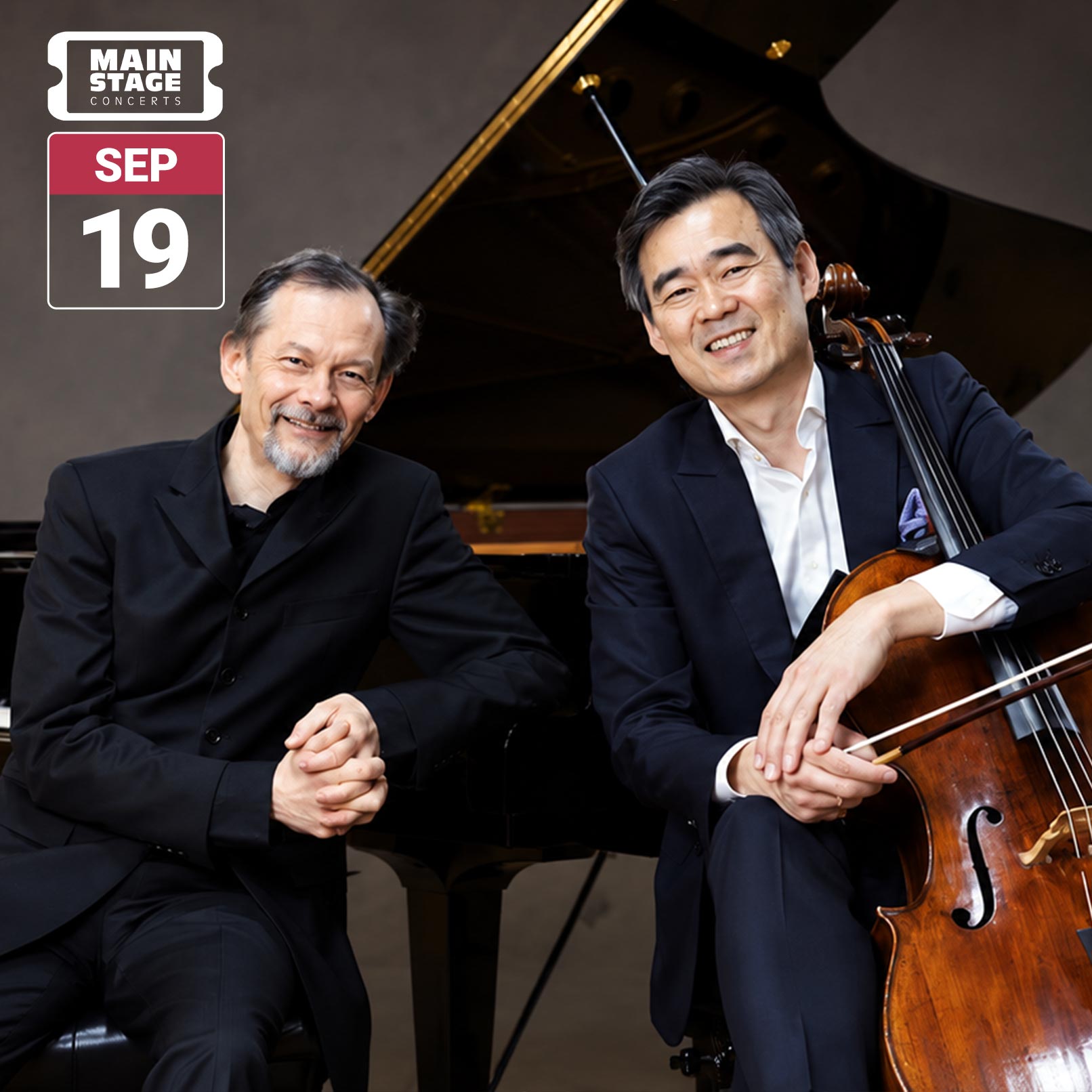
Cellist Sung-Won Yang & Pianist Enrico Pace
South Korean cellist Sung-Won Yang and Italian pianist Enrico Pace return to Halifax to open our new season with works by J.S. Bach, Brahms, Debussy, and Franck.
Saturday, September 19, 2026 • 7:30pm
Stage at St. Andrews (Halifax United Church)
Accessible Venue
This performance is made possible with the generous support of Anita Gao-Lee and Yi Lee.
Season Sponsor: NICE MOVES / Red Door Realty
Program Information
South Korean cellist Sung-Won Yang and Italian pianist Enrico Pace return to Halifax to open our new season with a program spanning three centuries of music for cello and piano. J.S. Bach’s Sonata in G minor, originally written for viola da gamba and keyboard, sits alongside Brahms’s Cello Sonata No. 1 in E minor and Debussy’s Cello Sonata, one of the composer’s final works. The program also includes César Franck’s Sonata in A major, originally written for violin and heard here in an arrangement for cello and piano. Together, these four works explore the changing relationship between the two instruments, from Bach through the Romantic music of Brahms and Franck to Debussy’s distinctive early twentieth-century sound. Sung-Won Yang performs internationally as both a soloist and chamber musician and has appeared in major halls across Europe, North America, and Asia. Enrico Pace, a GRAMMY Award-nominated pianist and major prize winner, is widely recognized for his concert and chamber music career.
Program Notes
J.S. Bach (1685-1750)
Sonata for Viola da Gamba and Keyboard No. 3 in G minor
I. Vivace
II. Adagio
III. Allegro
Johann Sebastian Bach was a prolific composer with over a thousand pieces of music to his credit, yet fewer than forty of his works were sonatas, even though the sonata had been popularized by Arcangelo Corelli and Bach’s contemporary, Antonio Vivaldi. In the mid Eighteenth Century, a sonata referred to a piece of instrumental music suitable for performance in church (sonata da chiesa) or at court (sonata da camera). Almost all sonatas during the Baroque Period were written for keyboard, either as a solo instrument or as an accompaniment with one other instrument.
Johann Bach's Sonata No. 3 for viola da gamba and harpsichord in G minor, BWV 1029 - as well as two other sonatas he arranged for the same instruments - were likely composed during Bach's later years in Leipzig — around 1730 or 1740, although the exact dates are not known. At the time, he was serving as Cantor of St. Thomas Church in Leipzig as well as holding appointments at the court of Elector Frederick Augustus in Dresden. It was a period during which Bach was moving towards more intellectually and technically ambitious works. In this piece, Bach takes the harpsichord out of the accompanying role, setting it as an equal partner in a complex web of counterpoint with the viola da gamba. The two instruments are in continuous dialogue. It features three movements that follow the typical fast–slow–fast pattern typical of Italian sonata forms. The sonata begins with a rousing allegro. After the dramatic and intricate first movement, the work moves into a gentle adagio characterized by long, expressive lines on viola da gamba. The final movement features a dance-like energy where Bach's masterful counterpoint skills are displayed in full force.
Johannes Brahms (1833-1897)
Sonata for Cello and Piano No. 1 in E minor, Op. 38
I. Allegro non troppo
II. Allegretto quasi Menuetto
III. Allegro
Johannes Brahms was a painstaking composer. He often laboured over a piece and then put it away, coming back to it later, sometimes years later. This was the case with his Sonata for Cello and Piano No. 1 in E minor. He began work on the sonata in the summer of 1862. He completed the first two movements and set it aside. During the fall of 1862, he made his first visit to Vienna. He found employment there as conductor of the Vienna Singakademie. While in that position, he programmed a fair amount of music by J. S. Bach, so it is not surprising that when he resigned from his position in June of 1864 to allow himself more time for composition, the music of Bach was top of mind. He revised his Cello Sonata and completed the third movement. He called the piece a “homage to J. S. Bach” and he borrowed themes from Bach’s Art of the Fugue for use in the opening and closing movements of the sonata.
The opening movement begins with a lyrical melody in the cello over chords in the piano, a melody that increases and fades in intensity. The melody then passes to the piano where it is further developed. The variations build a sense of drama while never losing the lyrical quality. The movement, which makes up fully one half of the sonata, ends with a quiet serenity. The second movement, as its title suggests, is modelled on the minuet, a graceful dance form of the Seventeenth Century. The music relates back to the Classical era in some of its structure and tone. The finale, another allegro – Brahms has departed from the standard fast-slow-fast pattern of earlier sonatas – has been called a fugue, and it certainly has the intricacy of a fugal pattern. Lyrical, with staccato passages, the finale builds to a satisfying climax. While essentially a composer of the Romantic Era, Brahms shows a wonderful mastery of the elements of Baroque and Classical compositional techniques.
Intermission
Claude Debussy (1862-1918)
Sonata for Cello and Piano, L. 135
I. Prologue: Lent, sostenuto e molto risoluto
II. Sérénade: Modérément animé
III. Finale: Animé, léger et nerveux
Claude Debussy was born into a family of modest means and little cultural involvement, yet he showed enough musical talent as a child that he was admitted to the Paris Conservatory as a ten year old. There he studied piano, and later, composition. As a student, he did not get on well with his composition teachers because of “his failure to follow the orthodox rules of composition”; still he won the Prix de Rome for his composition L’enfant prodigue in his final year at the Conservatory. He was open to a wide range of influences and did not find his mature style until he was in his thirties. Even then, success did not come quickly. It was not until his only opera, Pelléas et Mélisande, was performed in 1902 that Debussy became a well-known name in France and abroad.
In 1915, Debussy began work on a project, Six Sonatas for Various Instruments; it was planned as a homage to Eighteenth Century French composers, Jean-Philippe Rameau and Francois Couperin. Debussy described himself on the title pages as a French musician. He saw these compositions as an affirmation of French culture - a political statement during the World War. The Sonata for Cello and Piano was the first of the set. Debussy completed it in the summer of 1915. The opening movement is marked “slow, sustained and determined”. It begins with a melancholy song in the cello but it rises to a crisis before closing with a reverential calm. The second movement explores the full range of the cello sound and has an almost jazz-like feel. The Finale alternates wild energy with a moonlit calm. While the three movement structure may be conventional, the music itself shows Debussy still failing to follow what his teachers at the Conservatory called “the orthodox rules of composition”. He was far too original for that.
César Franck (1822-1890)
Sonata for Violin and Piano in A major (arr. for cello)
I. Allegretto ben moderato
II. Allegro III. Recitativo–Fantasia: Ben moderato
IV. Allegretto poco mosso
Eugene Ysaye, like Cesar Franck, was born in Lieges in Belgium. By the time he reached his mid-twenties he had begun to achieve fame throughout Europe as a violin virtuoso. While in Paris, he became acquainted with Franck who at the time was a Professor of Composition at the Paris Conservatory. The two became close enough that Franck composed The Sonata for Violin and Piano as a wedding gift for his young friend. The score arrived the morning of Ysaye’s wedding. After reading it through, Ysaye was sufficiently moved that he played the sonata for his guests at the wedding reception. It became a staple of his concert repertoire for the next forty years. The renowned cellist Jules Delsart, a colleague of Franck’s at the Paris Conservatory, was so moved upon hearing the Violin Sonata that he asked permission to arrange the work for cello and piano. In doing so, he left the piano part untouched and revised only the cello part. It is the only transcription that had Franck’s blessing.
The sonata was originally composed in a conventional four movement slow-quick-slow-quick pattern. Ysaye suggested that the first movement should be played at a brisker tempo, so Franck agreed to label the movement allegretto, but added the modifier “moderately”. The movement begins with a lyrical theme in the cello which is taken up by the piano; it is the thematic core of the work as a whole. The second movement opens with a wild turbulence, moves to a more calm deliberation before moving off with determined intensity. The third movement is more free form as the score marking indicates (Recitativo-Fantasia) and it is always reassuringly lyrical. The Finale recalls the opening movement with its lovely optimistic theme that is played in canon, the violin following the piano’s lead a bar later. It is no surprise, upon hearing this sonata that it is Franck's most popular work, and, in France at least, the most generally accepted work in the whole repertoire of chamber music.
Program notes written by Larry Bent
Renseignements sur le programme
Le violoncelliste sud-coréen Sung-Won Yang et le pianiste italien Enrico Pace sont de retour à Halifax pour ouvrir notre nouvelle saison avec un programme couvrant trois siècles de musique pour violoncelle et piano. La Sonate en sol mineur de J. S. Bach, composée à l’origine pour viole de gambe et clavier, côtoie la Sonate pour violoncelle no 1 en mi mineur de Brahms et la Sonate pour violoncelle de Debussy, l’une des dernières œuvres du compositeur. Le programme comprend également la Sonate en la majeur de César Franck, composée à l’origine pour violon et présentée ici dans un arrangement pour violoncelle et piano. Ensemble, ces quatre œuvres explorent l’évolution de la relation entre les deux instruments, de Bach à l’univers romantique de Brahms et de Franck, jusqu’au langage sonore si distinctif de Debussy au début du XXe siècle. Sung-Won Yang se produit sur la scène internationale comme soliste et chambriste et a joué dans de grandes salles en Europe, en Amérique du Nord et en Asie. Enrico Pace, pianiste nommé aux GRAMMY Awards et lauréat de prestigieux concours, est largement reconnu pour sa carrière de concertiste et de chambriste.
Notes de programme
J. S. Bach (1685-1750)
Sonate no 3 pour viole de gambe et clavier en sol mineur
I. Vivace
II. Adagio
III. Allegro
Johann Sebastian Bach fut un compositeur prolifique à qui l’on doit plus d’un millier d’œuvres. Pourtant, moins de quarante d’entre elles sont des sonates, bien que ce genre ait été popularisé par Arcangelo Corelli et par Antonio Vivaldi, contemporain de Bach. Au milieu du XVIIIe siècle, le terme « sonate » désignait une œuvre instrumentale destinée à être jouée à l’église (sonata da chiesa) ou à la cour (sonata da camera). À l’époque baroque, presque toutes les sonates étaient écrites pour clavier, soit comme instrument soliste, soit comme accompagnement d’un autre instrument.
La Sonate no 3 pour viole de gambe et clavecin en sol mineur, BWV 1029, de Johann Sebastian Bach, tout comme les deux autres sonates qu’il écrivit pour les mêmes instruments, date vraisemblablement des dernières années du compositeur à Leipzig, vers 1730 ou 1740, bien que les dates exactes demeurent inconnues. À cette époque, Bach occupait le poste de cantor à l’église Saint-Thomas de Leipzig et exerçait également des fonctions à la cour de l’électeur Frédéric-Auguste à Dresde. Il s’agissait d’une période où Bach se tournait vers des œuvres plus ambitieuses sur les plans intellectuel et technique.
Dans cette sonate, Bach libère le clavecin de son rôle d’accompagnement pour en faire un partenaire à part entière de la viole de gambe, au sein d’un contrepoint complexe. Les deux instruments entretiennent un dialogue continu. Les trois mouvements suivent le schéma vif-lent-vif caractéristique de la sonate italienne. La sonate s’ouvre sur un allegro entraînant. Après ce premier mouvement dramatique et complexe, l’œuvre se poursuit par un doux adagio caractérisé par les longues lignes expressives de la viole de gambe. Le dernier mouvement déploie une énergie dansante où la maîtrise du contrepoint de Bach s’exprime pleinement.
Johannes Brahms (1833-1897)
Sonate pour violoncelle et piano no 1 en mi mineur, op. 38
I. Allegro non troppo
II. Allegretto quasi Menuetto
III. Allegro
Johannes Brahms travaillait ses compositions avec une patience méticuleuse. Il lui arrivait souvent de travailler longuement à une œuvre, de la mettre de côté, puis d’y revenir, parfois plusieurs années plus tard. Ce fut le cas de sa Sonate pour violoncelle et piano no 1 en mi mineur. Il commença à y travailler durant l’été 1862. Après avoir achevé les deux premiers mouvements, il mit l’œuvre de côté.
À l’automne 1862, Brahms effectua son premier séjour à Vienne, où il obtint un poste de chef de la Singakademie de Vienne. Dans le cadre de ses fonctions, il programma de nombreuses œuvres de J. S. Bach. Il n’est donc pas étonnant que la musique de Bach ait occupé une place importante dans son esprit lorsqu’il quitta son poste en juin 1864 afin de consacrer davantage de temps à la composition. Il révisa alors sa Sonate pour violoncelle et en acheva le troisième mouvement. Brahms qualifia l’œuvre d’« hommage à J. S. Bach » et emprunta des thèmes à L’Art de la fugue de Bach pour les mouvements initial et final de la sonate.
Le premier mouvement s’ouvre sur une mélodie lyrique au violoncelle, soutenue par des accords au piano, dont l’intensité augmente puis s’estompe. La mélodie passe ensuite au piano, où elle est développée davantage. Les variations créent une tension dramatique sans jamais perdre leur caractère lyrique. Ce mouvement, qui représente à lui seul près de la moitié de la sonate, se termine dans une atmosphère de sérénité. Le deuxième mouvement, comme son titre l’indique, s’inspire du menuet, une danse gracieuse du XVIIe siècle. Par certains aspects de sa structure et de son caractère, la musique renvoie à l’époque classique.
Le finale, un autre allegro, s’écarte du schéma traditionnel vif-lent-vif des sonates antérieures. Il a parfois été qualifié de fugue et possède assurément la complexité d’une écriture fuguée. Lyrique, ponctué de passages staccato, le finale progresse vers un point culminant saisissant. Bien qu’essentiellement compositeur de l’époque romantique, Brahms y démontre une maîtrise impressionnante des techniques de composition baroques et classiques.
Entracte
Claude Debussy (1862-1918)
Sonate pour violoncelle et piano, L. 135
I. Prologue : Lent, sostenuto e molto risoluto
II. Sérénade : Modérément animé
III. Finale : Animé, léger et nerveux
Claude Debussy naquit dans une famille aux moyens modestes et peu engagée dans la vie culturelle. Il manifesta pourtant dès l’enfance un talent musical suffisant pour être admis au Conservatoire de Paris à l’âge de dix ans. Il y étudia d’abord le piano, puis la composition. Comme étudiant, il entretint des rapports difficiles avec ses professeurs de composition en raison de « son refus de suivre les règles orthodoxes de la composition ». Il remporta néanmoins le Prix de Rome pour sa composition L’Enfant prodigue au cours de sa dernière année au Conservatoire.
Debussy était ouvert à une grande diversité d’influences et ne trouva son style de maturité qu’une fois dans la trentaine. Même alors, le succès tarda à venir. Ce n’est qu’en 1902, avec la création de son unique opéra, Pelléas et Mélisande, que Debussy devint un compositeur connu en France et à l’étranger.
En 1915, Debussy entreprit un projet intitulé Six Sonates pour divers instruments, conçu comme un hommage aux compositeurs français du XVIIIe siècle Jean-Philippe Rameau et François Couperin. Sur les pages de titre, Debussy se présentait lui-même comme « musicien français ». Il considérait ces compositions comme une affirmation de la culture française, dans le contexte politique de la Première Guerre mondiale.
La Sonate pour violoncelle et piano fut la première œuvre du cycle. Debussy l’acheva durant l’été 1915. Le premier mouvement porte l’indication « lent, soutenu et très résolu ». Il s’ouvre sur un chant mélancolique du violoncelle qui gagne progressivement en intensité avant de se terminer dans un calme empreint de recueillement. Le deuxième mouvement explore toute l’étendue sonore du violoncelle et possède un caractère presque jazzé. Le finale alterne une énergie débridée et des passages d’un calme nocturne. Si la structure en trois mouvements demeure conventionnelle, la musique montre que Debussy continuait de s’affranchir de ce que ses professeurs du Conservatoire appelaient « les règles orthodoxes de la composition ». Son langage musical était beaucoup trop personnel pour s’y conformer.
César Franck (1822-1890)
Sonate pour violon et piano en la majeur (arr. pour violoncelle)
I. Allegretto ben moderato
II. Allegro
III. Recitativo–Fantasia : Ben moderato
IV. Allegretto poco mosso
Eugène Ysaÿe, comme César Franck, naquit à Liège, en Belgique. Dès le milieu de la vingtaine, il commença à se faire connaître partout en Europe comme violoniste virtuose. À Paris, il fit la connaissance de Franck, alors professeur de composition au Conservatoire de Paris. Les deux hommes devinrent suffisamment proches pour que Franck compose la Sonate pour violon et piano comme cadeau de mariage à son jeune ami.
La partition arriva le matin même du mariage d’Ysaÿe. Après l’avoir parcourue, celui-ci fut si profondément touché par l’œuvre qu’il joua la sonate pour ses invités lors de la réception. Elle devint un élément incontournable de son répertoire de concert pendant les quarante années suivantes. Le célèbre violoncelliste Jules Delsart, collègue de Franck au Conservatoire de Paris, fut lui aussi profondément touché lorsqu’il entendit la Sonate pour violon et demanda la permission d’en réaliser un arrangement pour violoncelle et piano. Il conserva intégralement la partie de piano et ne modifia que celle du violoncelle. Il s’agit de la seule transcription ayant reçu l’approbation de Franck.
La sonate fut à l’origine conçue selon le schéma traditionnel en quatre mouvements lent-vif-lent-vif. Ysaÿe suggéra de jouer le premier mouvement dans un tempo plus allant. Franck accepta donc l’indication allegretto, à laquelle il ajouta le qualificatif « modérément ». Le mouvement s’ouvre sur un thème lyrique au violoncelle, repris ensuite par le piano. Ce thème constitue le noyau musical de l’ensemble de l’œuvre.
Le deuxième mouvement s’ouvre dans une agitation fougueuse, puis évolue vers une atmosphère plus calme et réfléchie avant de repartir avec une intensité déterminée. Le troisième mouvement adopte une forme plus libre, comme l’indique la mention Recitativo–Fantasia dans la partition, tout en conservant un caractère lyrique et apaisant. Le finale rappelle le premier mouvement par son beau thème optimiste, présenté en canon, le violoncelle reprenant une mesure plus tard la ligne énoncée par le piano. À l’écoute de cette sonate, on comprend aisément pourquoi elle est devenue l’œuvre la plus populaire de Franck et, en France du moins, l’une des œuvres les plus reconnues de tout le répertoire de musique de chambre.
Notes de programme rédigées par Larry Bent
Artist Biographies
Sung-Won Yang, cello
Sung-Won Yang is a cellist of rare depth and breadth, whose artistry brings together intellectual clarity, poetic intensity, and an unwavering belief in music as a vital human force. He has appeared on many of the world’s most revered stages, including the Salle Pleyel and Théâtre des Champs-Élysées in Paris, the Concertgebouw in Amsterdam, the Musikverein in Vienna, Alice Tully Hall at Lincoln Center in New York, and Suntory Hall in Tokyo.
A long-standing recording artist with Decca/Universal Music, his discography reflects both a profound engagement with the core repertoire and a curiosity that reaches beyond it. Recent releases include Schumann’s Cello Concerto with the London Symphony Orchestra under Hans Graf (2024), and an Elgar album pairing the Cello Concerto with the Piano Quintet, released in 2025. His earlier recordings range from Bach and Beethoven to Brahms, Schumann, Messiaen, and Kodály — the latter earning both Gramophone Editor’s Choice and Critic’s Choice of the Year. In 2026, a recording of Haydn’s Cello Concertos with Thomas Zehetmair and the Orchestre National d’Auvergne Rhône‑Alpes will be released, continuing his exploration of classical clarity through a modern sensibility.
Chamber music lies at the heart of his musical life. He enjoys a long-standing partnership with pianist Enrico Pace, with whom he has recorded works by Liszt, Chopin, Beethoven, Schumann, and Brahms. He is also a founding member of Trio Owon, alongside violinist Olivier Charlier and pianist Emmanuel Strosser, an ensemble praised for its organic unity and stylistic breadth, with recordings spanning Schubert, Dvořák, Beethoven, Messiaen, Tchaikovsky, and Weinberg. His musical collaborations further include performances with artists such as Zdeněk Mácal, Miklós Perényi, Peter Eötvös, Myung‑Whun Chung, and Christoph Eschenbach.
Deeply engaged with the music of our time, Sung-Won Yang is a committed advocate for contemporary creation. He has commissioned and premiered works by composers including Peter Eötvös, Jee-Young Kim, Laurent Petitgirard, and Nicola Sani, and will soon premiere a new work dedicated to him and Enrico Pace by Eric Montalbetti. His interest in dialogue between music and history also led him, in 2016, to produce a documentary honoring young French priests martyred in 19th-century Korea — a project intertwining memory, faith, and cultural heritage.
Born in Korea, Sung-Won Yang studied at the Conservatoire National Supérieur de Musique de Paris and later served as assistant to the legendary János Starker at Indiana University. He is regularly invited to serve on juries for major international competitions, including the Banff International String Quartet Competition, the Cassadó International Cello Competition, the André Navarra International Cello Competition, and the Osaka International Music Competition.
Alongside his performing career, he is deeply invested in shaping musical life through vision and mentorship. He serves as Artistic Director of the Music in PyeongChang in Korea and the Festival Beethoven de Beaune, where his programming seeks to connect heritage and innovation while fostering genuine dialogue between artists, audiences, and society. He is a Professor at Yonsei University in Seoul and a Visiting Professor at the Royal Academy of Music.
A Chevalier des Arts et des Lettres of the French Republic and recipient of the Order of Cultural Merit from the Korean government, Sung-Won Yang remains guided by a conviction articulated by Victor Hugo: “Music expresses that which cannot be put into words and that which cannot remain silent.” Like Beethoven — a lifelong point of reference for him — he believes music speaks most powerfully where language reaches its limits.
Through his recordings, performances, festivals, and teaching, Sung-Won Yang continues to shape a musical path rooted in depth, transmission, and the quiet urgency of human expression.
Enrico Pace, piano
Born in Rimini, Enrico Pace studied with Franco Scala at the Pesaro Conservatory, where he also graduated in composition and conducting. He furthered his studies at the International Piano Academy “Incontri col Maestro” in Imola, and his invaluable mentor thereafter was Belgian teacher Jacques de Tiège.
After winning first prize at the Franz Liszt International Competition in Utrecht in 1989, Enrico Pace has performed all over the world: Concertgebouw in Amsterdam, Teatro alla Scala and Sala Verdi in Milan, Rome, Berlin, Wigmore Hall in London, Dublin, Herkulessaal in Munich, Prague, Philharmonie in Berlin and various cities in South America. He has been invited to play at numerous international festivals, including Lucerne, Salzburg, Edinburgh, La Roque d’Anthéron, Rheingau, Verbier, Schleswig-Holstein, Husum and the Brescia and Bergamo Piano Festivals.
Highly regarded as a soloist, he performs with such prestigious orchestras as the Royal Orchestra of the Concertgebouw, the Munich Philharmonic, the Bamberger Symphoniker, the BBC Philharmonic Orchestra, the Orchestra Nazionale di Santa Cecilia in Rome, the Rotterdam Philharmonic, the Dutch Radio Philharmonic Orchestra (RFO), the Netherlands Philharmonic the Orchestra del Maggio Musicale Fiorentino, the Göteborg, London and Stavanger Symphony Orchestras, the Brussels Philharmonic, the Philharmonisches Orchester Freiburg, the Rheinische Philharmonie, the Sydney and Melbourne Symphony Orchestras, the Konzerthausorchester Berlin, the MDR-Sinfonieorchester Leipzig, the Camerata Salzburg, the Warsaw Philharmonic Orchestra, the G. Verdi of Milan and the Filarmonica Toscanini of Parma.
Enrico Pace has collaborated with numerous conductors including Roberto Benzi, Gianandrea Noseda, Zoltan Kocsis, Kazimierz Kord, Mark Elder, Lawrence Foster, Vassily Sinaisky, Stanislav Skrowaczewski, Bruno Weil, Andrey Boreyko, Eliahu Inbal, Carlo Rizzi, Jan Latham-Koenig, Walter Weller and Antoni Wit.
Enrico Pace has also collaborated with such violinists as Leonidas Kavakos, Frank Peter Zimmermann, Akiko Suwanai, and Liza Ferschtman, and with cellist Sung-Won Yang, performing with them in Europe, the USA, and Asia.
Other partners in the field of chamber music include not only cellist Daniel Müller-Schott, clarinetist Sharon Kam, pianist Igor Roma and cornetist Marie Luise Neunecker, but also the Keller Quartet, RTE Vanbrugh Quartet and the Prometheus Quartet. A regular guest at chamber festivals, he has visited Delft, Moritzburg, Risør, Kuhmo, Montreux, Stresa and West Cork.
Past highlights include the Beethoven Sonatas cycle, with Leonidas Kavakos, in New York (Carnegie Hall), Athens, Florence, Milan, Amsterdam, Moscow, Tokyo, at the Salzburg Festival and Beethovenfest Bonn, as well as other performances in the United States, Europe and China. He has also performed Bach Sonatas with Frank Peter Zimmermann in New York, Amsterdam, Zurich, Frankfurt, Bamberg and Japan. With Matthias Goerne he brought Schubert’s Schwanengesang to La Scala in Milan. In Zurich, Frankfurt and Cologne he played with violist Antoine Tamestit, in Japan and at London’s Wigmore Hall with Akiko Suwanai, and in Korea and Japan with cellist Sung-Won Yang. As a soloist he has performed in such halls as the Concergebouw in Amsterdam and the Herkulessaal in Munich.
With Leonidas Kavakos and cellist Patrick Demenga he recorded Mendelssohn’s Piano Trios (Sony Classical). His recording of the complete Beethoven Sonatas for piano and violin with Leonidas Kavakos was released by Decca Classics in January 2013 and was nominated for a Grammy Award. In April 2016 Decca Classics released a CD in which the duo performs virtuosic pieces. With Frank-Peter Zimmermann he recorded Busoni’s Sonata No. 2 and J.S. Bach’s Six Sonatas for Violin and Piano 1014-1019 for Sony Classical. In 2011 the Piano Classics label released his well-known recording of Liszt’s Années de pèlerinage “Suisse” and “Italie.”
Biographies des artistes
Sung-Won Yang, violoncelle
Sung-Won Yang est un violoncelliste d’une profondeur et d’une polyvalence rares, dont l’art réunit clarté intellectuelle, intensité poétique et conviction profonde que la musique constitue une force humaine essentielle. Il s’est produit sur plusieurs des scènes les plus prestigieuses au monde, notamment à la Salle Pleyel et au Théâtre des Champs-Élysées à Paris, au Concertgebouw d’Amsterdam, au Musikverein de Vienne, à l’Alice Tully Hall du Lincoln Center à New York et au Suntory Hall de Tokyo.
Artiste de longue date chez Decca/Universal Music, il possède une discographie qui témoigne à la fois d’un engagement profond envers le grand répertoire et d’une curiosité musicale qui s’étend bien au-delà. Parmi ses parutions récentes figurent le Concerto pour violoncelle de Schumann, enregistré avec le London Symphony Orchestra sous la direction de Hans Graf (2024), ainsi qu’un album consacré à Elgar réunissant le Concerto pour violoncelle et le Quintette avec piano, paru en 2025. Ses enregistrements antérieurs couvrent un vaste répertoire allant de Bach et Beethoven à Brahms, Schumann, Messiaen et Kodály, ce dernier ayant reçu les distinctions « Editor’s Choice » et « Critic’s Choice of the Year » de Gramophone. En 2026 paraîtra un enregistrement des Concertos pour violoncelle de Haydn avec Thomas Zehetmair et l’Orchestre national d’Auvergne-Rhône-Alpes, poursuivant ainsi son exploration de la clarté classique à travers une sensibilité contemporaine.
La musique de chambre occupe une place centrale dans sa vie musicale. Il entretient depuis de nombreuses années un partenariat avec le pianiste Enrico Pace, avec qui il a enregistré des œuvres de Liszt, Chopin, Beethoven, Schumann et Brahms. Il est également membre fondateur du Trio Owon, aux côtés du violoniste Olivier Charlier et du pianiste Emmanuel Strosser. Loué pour son unité organique et l’étendue de son approche stylistique, l’ensemble a enregistré des œuvres de Schubert, Dvořák, Beethoven, Messiaen, Tchaïkovski et Weinberg. Parmi ses autres collaborations musicales figurent des prestations avec des artistes tels que Zdeněk Mácal, Miklós Perényi, Peter Eötvös, Myung-Whun Chung et Christoph Eschenbach.
Profondément engagé envers la musique de notre époque, Sung-Won Yang défend avec conviction la création contemporaine. Il a commandé et créé des œuvres de compositeurs tels que Peter Eötvös, Jee-Young Kim, Laurent Petitgirard et Nicola Sani. Il assurera prochainement la création d’une nouvelle œuvre d’Eric Montalbetti qui lui est dédiée ainsi qu’à Enrico Pace. Son intérêt pour le dialogue entre musique et histoire l’a également amené, en 2016, à produire un documentaire rendant hommage à de jeunes prêtres français martyrisés en Corée au XIXe siècle, un projet réunissant mémoire, foi et patrimoine culturel.
Né en Corée, Sung-Won Yang a étudié au Conservatoire national supérieur de musique de Paris avant de devenir l’assistant du légendaire János Starker à l’Université de l’Indiana. Il est régulièrement invité à siéger au jury de grands concours internationaux, notamment le Banff International String Quartet Competition, le Concours international de violoncelle Cassadó, le Concours international de violoncelle André Navarra et l’Osaka International Music Competition.
Parallèlement à sa carrière d’interprète, il s’investit profondément dans le développement de la vie musicale par sa vision artistique et son travail de mentorat. Il est directeur artistique de Music in PyeongChang, en Corée, et du Festival Beethoven de Beaune, où sa programmation cherche à établir des liens entre patrimoine et innovation tout en favorisant un véritable dialogue entre les artistes, le public et la société. Il est professeur à l’Université Yonsei de Séoul et professeur invité à la Royal Academy of Music.
Chevalier de l’Ordre des Arts et des Lettres de la République française et récipiendaire de l’Ordre du Mérite culturel du gouvernement coréen, Sung-Won Yang demeure guidé par cette pensée de Victor Hugo : « La musique exprime ce qui ne peut être dit et sur quoi il est impossible de rester silencieux. » À l’instar de Beethoven, qui constitue pour lui une source d’inspiration constante, il croit que la musique s’exprime avec le plus de force là où les mots atteignent leurs limites.
Par ses enregistrements, ses concerts, ses festivals et son enseignement, Sung-Won Yang poursuit un parcours musical fondé sur la profondeur, la transmission et l’urgence discrète de l’expression humaine.
Enrico Pace, piano
Né à Rimini, Enrico Pace a étudié auprès de Franco Scala au Conservatoire de Pesaro, où il a également obtenu ses diplômes en composition et en direction d’orchestre. Il a poursuivi sa formation à l’Académie internationale de piano « Incontri col Maestro » d’Imola, avant de bénéficier des précieux conseils du pédagogue belge Jacques de Tiège.
Après avoir remporté le premier prix du Concours international Franz Liszt d’Utrecht en 1989, Enrico Pace s’est produit partout dans le monde, notamment au Concertgebouw d’Amsterdam, au Teatro alla Scala et à la Sala Verdi de Milan, ainsi qu’à Rome, Berlin, au Wigmore Hall de Londres, à Dublin, à la Herkulessaal de Munich, à Prague, à la Philharmonie de Berlin et dans plusieurs villes d’Amérique du Sud. Il a été invité à de nombreux festivals internationaux, notamment ceux de Lucerne, Salzbourg, Édimbourg, La Roque-d’Anthéron, Rheingau, Verbier, Schleswig-Holstein, Husum ainsi qu’aux festivals de piano de Brescia et de Bergame.
Très apprécié comme soliste, il se produit avec de prestigieux orchestres tels que l’Orchestre royal du Concertgebouw, l’Orchestre philharmonique de Munich, les Bamberger Symphoniker, le BBC Philharmonic Orchestra, l’Orchestra dell’Accademia Nazionale di Santa Cecilia de Rome, l’Orchestre philharmonique de Rotterdam, l’Orchestre philharmonique de la Radio néerlandaise, le Netherlands Philharmonic Orchestra, l’Orchestra del Maggio Musicale Fiorentino, les orchestres symphoniques de Göteborg, de Londres et de Stavanger, le Brussels Philharmonic, le Philharmonisches Orchester Freiburg, la Rheinische Philharmonie, les orchestres symphoniques de Sydney et de Melbourne, le Konzerthausorchester Berlin, le MDR-Sinfonieorchester Leipzig, la Camerata Salzburg, l’Orchestre philharmonique de Varsovie, l’Orchestra Sinfonica di Milano Giuseppe Verdi et la Filarmonica Arturo Toscanini de Parme.
Enrico Pace a collaboré avec de nombreux chefs d’orchestre, notamment Roberto Benzi, Gianandrea Noseda, Zoltán Kocsis, Kazimierz Kord, Mark Elder, Lawrence Foster, Vassily Sinaisky, Stanisław Skrowaczewski, Bruno Weil, Andrey Boreyko, Eliahu Inbal, Carlo Rizzi, Jan Latham-Koenig, Walter Weller et Antoni Wit.
Enrico Pace a également collaboré avec des violonistes tels que Leonidas Kavakos, Frank Peter Zimmermann, Akiko Suwanai et Liza Ferschtman, ainsi qu’avec le violoncelliste Sung-Won Yang, avec qui il s’est produit en Europe, aux États-Unis et en Asie.
Parmi ses autres partenaires en musique de chambre figurent le violoncelliste Daniel Müller-Schott, la clarinettiste Sharon Kam, le pianiste Igor Roma et la corniste Marie Luise Neunecker, ainsi que le Quatuor Keller, le RTÉ Vanbrugh Quartet et le Prometheus Quartet. Invité régulier de festivals de musique de chambre, il s’est produit à Delft, Moritzburg, Risør, Kuhmo, Montreux, Stresa et West Cork.
Parmi les moments marquants de sa carrière figure l’intégrale des sonates de Beethoven avec Leonidas Kavakos, présentée à New York au Carnegie Hall, ainsi qu’à Athènes, Florence, Milan, Amsterdam, Moscou et Tokyo, au Festival de Salzbourg et au Beethovenfest de Bonn, en plus d’autres concerts aux États-Unis, en Europe et en Chine. Il a également interprété les sonates de Bach avec Frank Peter Zimmermann à New York, Amsterdam, Zurich, Francfort, Bamberg et au Japon. Avec Matthias Goerne, il a présenté le Schwanengesang de Schubert à La Scala de Milan. Il s’est produit avec l’altiste Antoine Tamestit à Zurich, Francfort et Cologne, avec Akiko Suwanai au Japon et au Wigmore Hall de Londres, ainsi qu’avec le violoncelliste Sung-Won Yang en Corée et au Japon. Comme soliste, il s’est notamment produit au Concertgebouw d’Amsterdam et à la Herkulessaal de Munich.
Avec Leonidas Kavakos et le violoncelliste Patrick Demenga, il a enregistré les Trios avec piano de Mendelssohn pour Sony Classical. Son enregistrement de l’intégrale des sonates pour piano et violon de Beethoven avec Leonidas Kavakos, paru chez Decca Classics en janvier 2013, a été nommé aux GRAMMY Awards. En avril 2016, Decca Classics a fait paraître un album du duo consacré à des pièces de virtuosité. Avec Frank Peter Zimmermann, il a enregistré la Sonate no 2 de Busoni ainsi que les Six Sonates pour violon et piano, BWV 1014-1019, de J. S. Bach pour Sony Classical. En 2011, l’étiquette Piano Classics a fait paraître son enregistrement reconnu des Années de pèlerinage de Liszt, « Suisse » et « Italie ».
Location
Stage at St. Andrews (New Name: Halifax United Church)
6036 Coburg Road • Halifax, Nova Scotia • B3H 1Y9
Frequently Asked Questions
How will I receive my tickets?
Electronic tickets are emailed immediately after purchase to the email address used at checkout. Please keep your tickets handy on your smart phone or bring a printed copy with you to the concert so we can scan them at the door. If you do not receive your tickets, please check your spam or junk folder, as ticket emails are sometimes blocked or filtered by email providers. You may also wish to search your inbox for “Cecilia Concerts” or your order confirmation. If you still cannot find your tickets, please contact the Cecilia Concerts office before the concert and we’ll be happy to help. Rest assured, if you purchased tickets, your name will also be on our guest list at the door.
What time should I arrive?
Doors open at 7:00pm, and the concert begins at 7:30pm. We recommend arriving a little early so you have time to have your ticket scanned, find a seat, and get settled before the performance begins.
Can I arrive late?
Latecomers will be seated at an appropriate break in the performance, when possible. To avoid disruption to the artists and audience, we recommend arriving before the concert begins.
How long is the concert?
The approximate running time is 1 hour and 50 minutes, including a 15-minute intermission.
What is the seating like?
Tickets are general admission. The Stage at St. Andrew’s has unassigned seating, with chairs on the main floor and pews in the balcony. Seats are available on a first-come, first-served basis. Bravo Premium subscription holders have reserved access to seating within the first five rows. Please note that the balcony is accessible by stairs only. Wheelchair-accessible seating and companion seating are available on the main floor. If you have an accessibility-related seating need, please let us know when you arrive.
Are children welcome?
Yes, children are always welcome. Please keep in mind that this is a full-length concert in a traditional concert setting. Families may wish to choose seats close to a door in case a quick exit is needed during the performance.
What should I know about concert etiquette?
If you are new to classical concerts, you are very welcome. We simply ask that audience members help create a quiet and respectful environment for the artists and those around them. Please silence your phone before the concert begins, avoid talking during the performance, and wait for pauses between pieces to move around when possible.
When should I clap?
It is always fine to clap when a full piece has ended. Some longer works have several movements, with short pauses in between, and audiences usually wait until the entire work is finished before applauding. If you are unsure, it is perfectly okay to wait and follow the rest of the audience.
Can I use my phone during the concert?
Please silence your phone before the concert begins. We ask that phones and bright screens not be used during the performance, as they can be distracting to artists and audience members.
Can I take photos or videos?
Photos are welcome before or after the concert. Unless otherwise announced, photography, audio recording, and video recording are not permitted during the performance.
What accessibility features are available?
The Stage at St. Andrews is wheelchair accessible and includes accessible washrooms with ramp access. Companion seating is available if required. If you have a specific accessibility question before attending, please contact us and we’ll be happy to help.
Is the venue scent-sensitive?
To help make the concert comfortable for everyone, we ask guests to avoid wearing strong scents or fragrances.
Is there parking or public transit nearby?
The Stage at St. Andrews is located on the corner of Robie Street and Coburg Road. There is no parkade at the venue, but street parking is available in the surrounding area. The venue is also located near major South End Halifax Transit routes.
What happens if there is a storm?
If a storm may affect a performance, ticket holders are encouraged to call the Cecilia Concerts office at 902-423-0143 for a recorded concert update. Updates will also be posted on the Cecilia Concerts website and social media channels.
What happens if a concert is changed, postponed, or cancelled?
Concert schedule changes are very rare, but storms or other unexpected circumstances may occasionally require us to make adjustments. If a concert is changed, postponed, or cancelled, ticket holders will be contacted as soon as possible with available options. Depending on the circumstances, you may choose to attend the rescheduled concert, receive a credit toward a future Cecilia Concerts performance, request a refund, or convert the value of your ticket into a charitable donation tax receipt.