


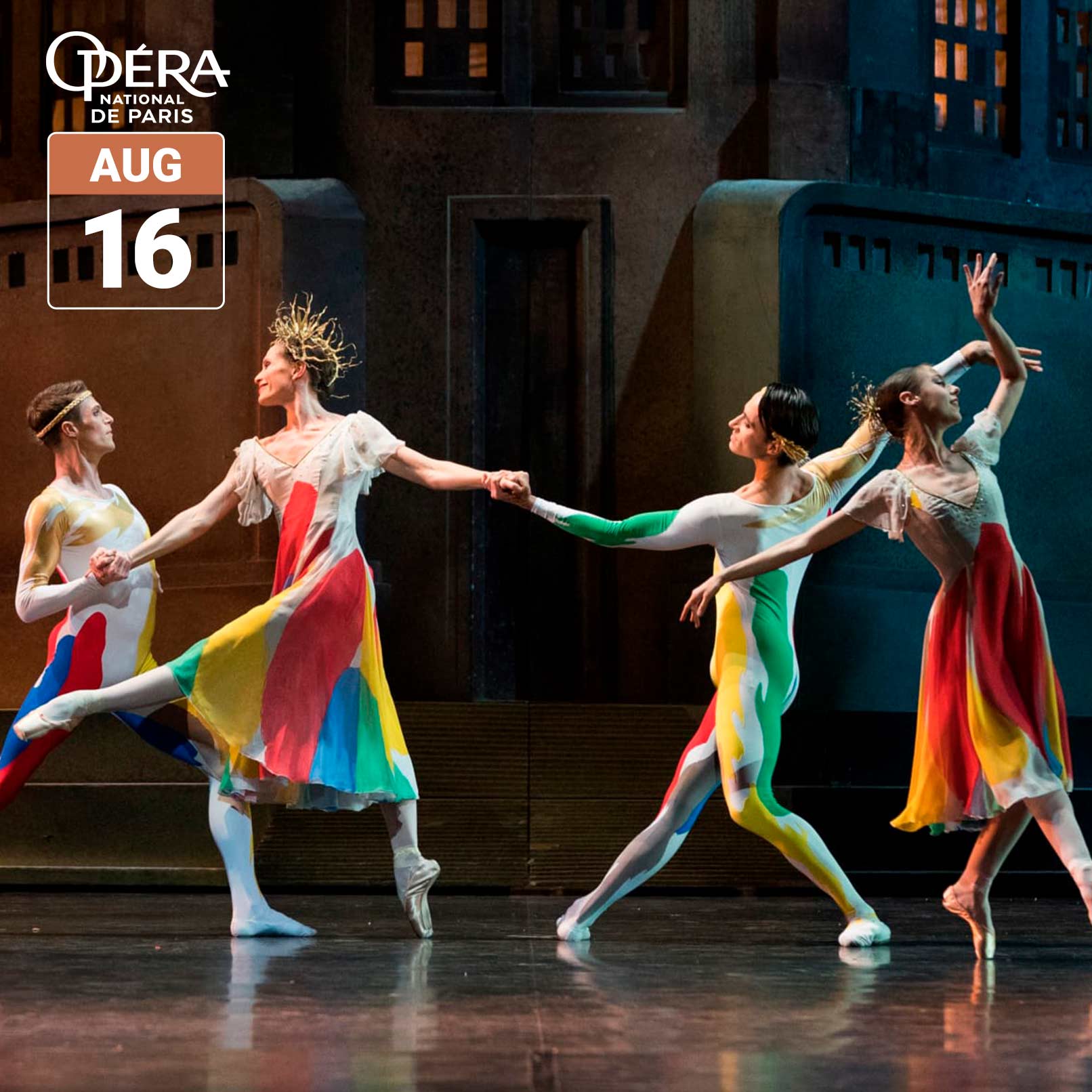
SUMMER BALLET SCREENINGS
Rudolf Nureyev's "Cinderella"
A ballet in three acts, Charles Perrault’s famous fairy tale, set to music by Sergei Prokofiev, is transported into the world of cinema, with references throughout to the heroes of American film. Rudolf Nureyev places his Cinderella under the bright lights of Hollywood. With a producer as her fairy godmother and a movie star as her Prince Charming, she escapes her difficult fate and sees her dreams come true. The story also echoes Nureyev’s own journey, from a young Tatar dancer to an international star. Through this “ballet metaphor,” the Company pays tribute to Rudolf Nureyev, who served as its director.
Sunday, August 16, 2026 • 2:00pm
Paul O'Regan Hall • Halifax Central Library
Accessible Venue
Free Event • Online Registration
Ticket Availability: Excellent

Season Sponsor: NICE MOVES / Red Door Realty
Registration
Registration for this event will open soon.
Rudolf Nureyev's "Cinderella"
Co-presented with Alliance Française Halifax, Halifax Public Libraries, and Opera de Paris
When Rudolf Nureyev created “Cinderella” on the stage of the Palais Garnier on October 25, 1986, the work was unlike anything previously seen at the Paris Opera. Unlike the great classical repertoire that the choreographer had made it his mission to revive and enrich, the story of the young orphan was new to the Palais Garnier.
Nureyev drew on Sergei Prokofiev’s score, which had been famous in Russia since 1945. He followed its structure and intentions, while offering a new reading of Charles Perrault’s tale.
Working with set designer Petrika Ionesco, he transports the story into the Hollywood world of the 1930s. Discovered by a film producer, Cinderella makes her screen debut and wins the heart of the movie star, who rescues her from poverty and places her at the top of the bill. A star is born.
This dazzling American-style rise also reflects the personal story of other artists, beginning with Nureyev himself, who followed a path somewhat similar to this modern Cinderella.
With this work, Rudolf Nureyev pays tribute to the power of cinema and performance to transform lives.
The ballet returned to the Palais Garnier in February and March 1987, March 2000, April 2005, and April 2007, and to the Opéra Bastille in November 2011.
On tour, “Cinderella” was presented in New York in 1987, in Los Angeles and Washington in 1988, and in Tokyo in 2010.
The ballet was filmed at the Bry-sur-Marne studios in November 1987, produced by SFP and NVC for La Sept and the BBC, in a version directed by Rudolf Nureyev and Colin Nears. In 2007, “Cinderella” was filmed again in a co-production by the Paris Opera and Telmondis, directed by Thomas Grimm, followed by a DVD release from Opus Arte. This production was filmed on December 28 and 31, 2018 at the Paris Opera / Opéra Bastille.
A Modern Tale
“In fact, the point is not to distort or tamper with the story of Cinderella, the story of a meeting in which the power of love breaks through apparent social barriers. Rather, the point is to transport it into a dream world, the world of the 20th century, the world of cinema. What do young girls dream of today? Being in the movies. And even though Hollywood is no longer what it once was, it remains a mythical place, an emblem that concentrates this desire for cinema. A dream factory, it is also dream material. What better setting today for Cinderella?”
-Petrika Ionesco, 1986
“When Petrika Ionesco suggested the idea of a Hollywood Cinderella, I was at first reluctant. I was afraid of distorting Perrault’s tale too much.
Should I regret that this suggestion gradually worked its way into my mind, to the point where it would not let go? I finally said yes and immediately began working on the choreography.
The period is the 1930s and 1940s. It corresponds to a moment in Prokofiev’s life when, after returning to his country, the USSR, he felt a deep nostalgia for the West. “Cinderella” is not very Russian. It is his most Western work. The music dictates the tone, but the dances sit at a distance from the setting. This sense of distance is what we wanted to capture by moving the tale into the world of cinema.
The ballet “Cinderella” became a dream of cinema. A dream of a white dress, tinted with a little pink as a tribute to innocence, and slightly silver as well, because Cinderella is a character of today. She dreams of only one thing: becoming a star. In my version of “Cinderella,” the fairy is transformed into a film producer, the only figure in modern mythology who, through the magic of his art, turns a pumpkin into the body of a car.”
-Rudolf Nureyev, October 1986
The Scenario
Confined to the house, where her alcoholic father has long since given up in the face of his tyrannical wife, Cinderella takes refuge in her dreams. Images pass through her mind, where Charlie Chaplin appears alongside King Kong.
Her two stepsisters, encouraged by an ambitious mother, attend every audition in the hope of landing a role in a film. A producer, always on the lookout for new talent, plays the part of fairy godmother when he discovers the young woman and takes her in his magnificent limousine-pumpkin to the film set. There, she makes a more than promising debut and wins over the movie star.
A romance begins, soon disturbed by Cinderella’s fears. The relentless clock seems to remind her that all of this is too beautiful to last. Afraid of suffering too much later, she chooses to flee. Deeply in love, the movie star searches everywhere to find her, thanks to the forgotten ballet slipper left behind on the set.
“In this version, the mechanics of the story have not changed. We find the two ridiculous and devilish sisters, the terrible stepmother, and the father torn between his new wife and the young girl, Cinderella, his daughter, whom he knows is mistreated and who must take refuge in dreams of a life forbidden to her in order to survive.
The whole drama of Cinderella lies in the passage of time, the fear of seeing her dream collapse and her happiness flee along with her youth. That is why she runs away at the moment when love transforms her. I myself see eternal life as the ultimate luxury.”
-Rudolf Nureyev, October 1986
The Music
“What I wanted to express above all in the music of Cinderella was the love between Cinderella and the prince, the birth and blossoming of this love, the obstacles it encounters, and finally the realization of the dream.
The fairy tale gave the composer many interesting problems: the magical atmosphere surrounding the good fairy; the twelve strange gnomes springing from the clock when it strikes midnight to warn Cinderella that it is time to return home; the scenes rushing by as the prince travels the world in search of Cinderella; and the poetry of nature personified by the four fairies symbolizing the seasons, spring, summer, autumn, winter, and their companions.
The stage directors, though, wanted the fairy tale to serve only as the framework around real characters, with human passions and weaknesses. The music has three fundamental themes, or leitmotifs, characterizing Cinderella. The first depicts her oppressed and mistreated. The second shows her as chaste, pure and thoughtful. The third, a broad theme, presents her in love and radiant with happiness.
I tried to portray the different characters: gentle and dreamy Cinderella, the timid father, the angry stepmother, the selfish sisters, and the ardent young prince, in such a way that audiences would share their joys and sorrows.”
-Sergei Prokofiev, “Cinderella,” Op. 87, 1944
Biographies
Rudolf Nureyev
Adaptation, Choreography, and Staging
Born on March 17, 1938, Rudolf Nureyev spent his childhood and youth in Ufa, capital of the Soviet Republic of Bashkiria.
After three years of study at the Vaganova Ballet Academy in Leningrad, he joined the Corps de Ballet of the Kirov in 1958, the leading dance company in the USSR. He quickly became a soloist, dancing in “Le Corsaire,” “Don Quixote,” “Swan Lake,” and “The Sleeping Beauty.”
While taking part in a Kirov tour in France, Rudolf Nureyev “chose freedom” and requested asylum on June 16, 1961 at Le Bourget Airport.
He was immediately engaged by the Ballets du Marquis de Cuevas, with whom he performed at the Théâtre des Champs-Élysées.
In 1962, Rudolf Nureyev gave his first performance of “Giselle” with Margot Fonteyn and The Royal Ballet at Covent Garden in London. He became a guest artist with the company and remained so until 1977.
His career quickly became international. He travelled the world, dancing as a guest star with all the major ballet companies in Europe and the United States and working with the great creators of his time, including George Balanchine, Martha Graham, Glen Tetley, Murray Louis, Maurice Béjart, and Roland Petit.
As a choreographer, he restaged and adapted the great ballets of Marius Petipa, including “The Sleeping Beauty,” “The Nutcracker,” “Don Quixote,” “Swan Lake,” and “Raymonda,” notably expanding the danced roles given to male performers.
As Director of Dance at the Paris Opera from 1983 to 1989, he added the great academic ballets to the Company’s repertoire in versions inspired by Marius Petipa’s original choreographies. He gave the Opera a vast classical repertoire while also inviting many choreographers to work with the Company.
He died on January 6, 1993, at the age of 54.
Sergei Prokofiev
Composer
Sergei Prokofiev was born in 1891 in what is now Ukraine, then part of the Russian Empire. His first musical teacher was his mother, a sensitive and capable pianist who introduced him to the instrument at an early age. By five, he had already written his first piece of music.
In 1904, Prokofiev entered the St. Petersburg Conservatory, where he became its youngest-ever student. He soon showed little patience for convention. While he knew the work of earlier Russian composers such as Glinka and Mussorgsky, he felt drawn to the more adventurous musical language of his own time, including the music of Reger and Scriabin.
That appetite for new sounds shaped much of his career. Prokofiev often tested the boundaries of form, harmony, rhythm, and audience expectation, earning both admiration and criticism. After ten years at the Conservatory, he travelled west in 1914, eager to understand the growing influence of Stravinsky and Diaghilev’s “Ballets Russes,” and to build his own reputation beyond Russia.
After the overthrow of Czar Nicholas II, Prokofiev returned to Petrograd in the spring of 1918. There, he introduced his “Classical Symphony,” completed the previous year. The work received a warm response. Later in 1918, he travelled to New York, where critics often viewed him through the lens of the Russian Revolution. His performances were sometimes described in harsh terms, with listeners hearing his bold style as forceful or even barbaric.
In the early 1920s, Prokofiev settled again in Paris. There he completed “Le Pas d’Acier” in 1926 for Diaghilev. When he returned to his homeland in 1927, he was celebrated as a Russian composer whose daring music had made an impact in the West.
Prokofiev soon returned to Paris, where he created “The Prodigal Son” for Diaghilev in 1929. By 1932, he was again spending significant time in the Soviet Union, and in 1936 he settled permanently in Moscow. That same year, he wrote “Peter and the Wolf,” the well-known orchestral work that introduces young listeners to the instruments of the orchestra.
The political climate soon narrowed Prokofiev’s international role. In 1939, the Soviet Union’s rapprochement with Germany weakened ties with the Allies and brought an end to his position as a cultural ambassador abroad. After Germany invaded the Soviet Union in June 1941, Stalin ordered senior cultural figures to leave Moscow. Prokofiev was among those sent to the Caucasus.
Even under the pressures of war, Prokofiev remained highly productive. Between 1940 and 1944, he completed his “Piano Sonatas Nos. 6, 7, and 8,” now often called the “war sonatas.” He also worked on “War and Peace,” his large-scale opera based on Tolstoy’s novel, completed his “Fifth Symphony” in 1944, and saw “Cinderella” premiere at the Bolshoi Theatre in 1945.
After the Second World War, Soviet cultural policy grew more severe. As the Cold War took hold, Stalin intensified the isolation of Soviet artists from the West and demanded stricter adherence to Communist ideals in culture. In 1948, Prokofiev was officially denounced for “formalism” and for music deemed too cosmopolitan. His final major work was “Symphony No. 7,” completed in 1952.
Prokofiev died on March 5, 1953, the same day as Stalin.
Artist Information
Artistic Team
Adaptation, Choreography and Staging
Rudolf Nureyev
Music
Sergei Prokofiev
Director
Isabelle Julien
Sets
Petrika Ionesco
Costumes
Hanae Mori
Lighting
Guido Levi
Cast
Cinderella
Valentine Colasante, Étoile Dancer
The Movie Star
Karl Paquette, Étoile Dancer
The Two Sisters
Ludmila Pagliero, Étoile Dancer
Dorothée Gilbert, Étoile Dancer
The Mother
Aurélien Houette, Sujet
The Producer
Alessio Carbone, Principal Dancer
The Dance Teacher
Paul Marque, Principal Dancer
Spring, Female
Marion Barbeau, Sujet
Summer, Female
Emilie Cozette, Étoile Dancer
Autumn, Female
Sae Eun Park, Principal Dancer
Winter, Female
Fanny Gorse, Sujet
With the Corps de Ballet of the Paris Opera
Pasdeloup Orchestra, Musical Direction
Vello Pähn
Location
Paul O'Regan Hall (Halifax Central Library)
5440 Spring Garden Road • Halifax, Nova Scotia • B3J 1E9
Frequently Asked Questions
Do I need to register for this screening?
This is a free event and registration is highly recommended and can be completed online on this page. Registering helps us track audience numbers and make sure we have enough space for everyone. It also allows us to send you a reminder before the screening.
How will I receive my registration confirmation?
After registering, you will receive a confirmation email at the email address used during registration. Please keep this confirmation handy on your phone or bring a printed copy with you when you arrive. If you do not receive your confirmation, please check your spam or junk folder, as registration emails are sometimes blocked or filtered by email providers. You may also wish to search your inbox for “Cecilia Concerts” or your event confirmation. If you still cannot find your confirmation, please contact the Cecilia Concerts office before the event and we’ll be happy to help. Rest assured, if you registered online, your name will also be on our guest list at the door.
What time should I arrive?
Doors open at 1:30pm, and the screening begins at 2:00pm. We recommend arriving a little early so you have time to check in, find a seat, and get settled before the screening begins.
How long is the screening?
The approximate running time is 2 hours and 9 minutes. There is no intermission.
Are there subtitles?
No. This ballet features instrumental music by Sergei Prokofiev and does not include spoken dialogue or subtitles.
Can I arrive late?
Latecomers may enter quietly after the screening has begun, when possible. To avoid disruption to other audience members, we recommend arriving before the 2:00pm start time.
What is the seating like?
Paul O’Regan Hall has unassigned theatre-style seating. Seats are available on a first-come, first-served basis. If you require companion seating or have an accessibility-related seating need, please let us know when you arrive.
Are children welcome?
Yes, children are more than welcome. Please keep in mind that this is a full-length screening in a theatre-style setting. Families may wish to choose seats close to an exit in case a quick exit is needed during the screening.
Can I use my phone during the screening?
Please silence your phone before the screening begins. We ask that phones and bright screens not be used during the screening, as they can be distracting to other audience members.
Can I take photos or videos?
Photos are welcome before or after the screening. Unless otherwise announced, photography, audio recording, and video recording are not permitted during the screening.
What accessibility features are available?
Paul O’Regan Hall is wheelchair accessible and includes accessible washrooms, a ramp, and elevator access. Companion seating is available if required. If you have a specific accessibility question before attending, please contact us and we’ll be happy to help.
Is the venue scent-sensitive?
To help make the screening comfortable for everyone, we ask guests to avoid wearing strong scents or fragrances when possible.
Is there parking or public transit nearby?
Yes. Paid underground parking is available at Halifax Central Library along with side street parking. There is parking on-site for 50 bicycles. The venue is also located on major downtown Halifax Transit routes.