


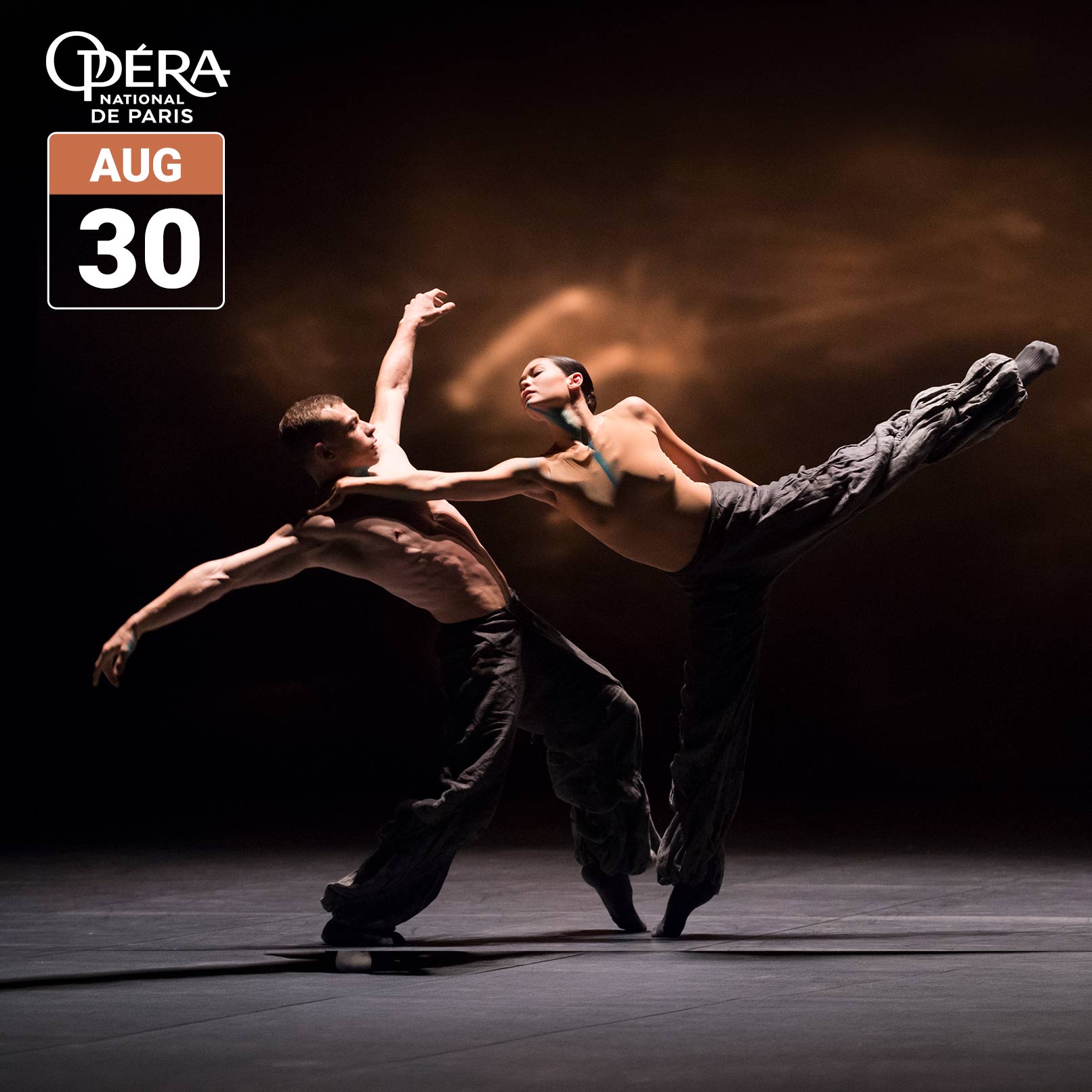
SUMMER BALLET SCREENINGS
Balanchine - Béjart - Pite
A triple bill bringing together three landmark works by choreographers George Balanchine, Maurice Béjart, and Crystal Pite. Set to music by George Gershwin, Maurice Ravel, and Max Richter’s reimagining of Vivaldi, the program moves from the wit and glamour of Manhattan with "Who Cares?" to the hypnotic force of "Boléro" and the sweeping intensity of "The Seasons’ Canon." Together, the three ballets reveal the range of modern dance, from Balanchine’s crisp classical style, to Béjart’s ritualistic sensuality, and Pite’s visceral, sculptural movement. In these Opéra national de Paris performances, the company brings each work to life with striking theatrical power, precision, and emotional depth.
Sunday, August 30, 2026 • 2:00pm
Paul O'Regan Hall • Halifax Central Library
Accessible Venue
Free Event • Online Registration
Ticket Availability: Almost Gone

Season Sponsor: NICE MOVES / Red Door Realty
Register
Balanchine - Béjart - Pite
Co-presented with Alliance Française Halifax, Halifax Public Libraries, and Opera de Paris
Balanchine/Gershwin - "Who Cares?"
About the Ballet and Production
Created for New York City Ballet in 1970, "Who Cares?" is a suite of dances set to songs by George and Ira Gershwin, including “The Man I Love,” “Embraceable You,” “’S Wonderful,” “Who Cares?,” and “I Got Rhythm.” Against the Manhattan skyline, ensembles, duets, and solo variations build toward a buoyant finale.
Balanchine did not intend the ballet as a nostalgic imitation of Broadway, Fred Astaire, or Ginger Rogers. His aim was to reveal the intelligence, melodic beauty, and rhythmic vitality of Gershwin’s music through classical ballet. The result combines the speed, clarity, and precision associated with Balanchine’s style with the confidence and urban energy of American popular song.
The ballet unfolds in two broad sections. The first places dancers in changing ensembles, while the second focuses on four principal soloists. Balanchine described the work as a meeting of classical dance and the distinctively American musical world he had admired since hearing Gershwin’s songs in Europe.
This performance was filmed at the Palais Garnier on March 7, 2023. It was produced by the Paris Opera and Telmondis, with the participation of France Télévisions and support from the French National Centre for Cinema and the Moving Image and the Orange Foundation.
About the Music
The score draws on songs written across Gershwin’s Broadway career. Hershy Kay arranged and orchestrated the selections into a continuous ballet score, preserving the direct melodic appeal of the songs while giving them orchestral colour and theatrical momentum. The sequence ranges from intimate adagios and pas de deux to brisk ensemble numbers, ending with the rhythmic drive of “I Got Rhythm.”
Composer Biography: George Gershwin
George Gershwin (1898–1937) was an American composer and pianist whose work joined popular song, Broadway theatre, jazz, and the concert tradition. Born in Brooklyn, he began his professional career as a song plugger in Tin Pan Alley and soon became one of the leading composers of American musical theatre. Many of his songs were written with lyrics by his brother, Ira Gershwin.
His major works include "Rhapsody in Blue," "An American in Paris," the Concerto in F, and the opera "Porgy and Bess". Gershwin’s songs, including “The Man I Love,” “Embraceable You,” “’S Wonderful,” and “I Got Rhythm,” became standards because of their memorable melodies, rhythmic character, and harmonic sophistication. His career ended with his death at age thirty-eight, yet his music remains central to American concert, theatre, jazz, and dance repertory.
Béjart/Ravel - "Boléro"
About the Ballet and Production
Maurice Béjart created "Boléro" in 1961 for the Ballet du XXe Siècle at the Théâtre Royal de la Monnaie in Brussels. A single performer, identified as the Melody, stands on a large round table and repeats a restrained, sensual movement phrase. Around the table, the ensemble, identified as the Rhythm, watches, responds, and gradually joins the mounting energy.
The choreography follows the score’s accumulation with strict clarity. Repetition becomes intensification. The central figure remains both isolated and connected to the surrounding group until the orchestral climax releases the full company in a final surge.
Béjart described his conception as mathematical and as “pure dance.” He rejected the familiar Spanish image attached to the music and drew instead on memories of traditional dance in Greece. The principal role has been performed by both women and men. Duska Sifnios created it, and later interpreters helped establish "Boléro" as one of Béjart’s signature works.
This performance was filmed at the Opéra Bastille during performances on May 19 and 25, 2023. The recording was co-produced by the Paris Opera, Telmondis, and NHK, with the participation of France Télévisions and support from the French National Centre for Cinema and the Moving Image, the Orange Foundation, and the Audiovisual and Digital Circle.
About the Music
Ravel composed "Boléro" in 1928 for dancer Ida Rubinstein. The score is built from a repeated snare-drum rhythm and two alternating melodic ideas. Instead of conventional thematic development, Ravel changes the orchestral colour and steadily increases the volume. The music moves through a long crescendo before a sudden harmonic shift and explosive conclusion.
Its apparent simplicity depends on exact control of pacing, balance, and instrumentation. Each new instrumental entrance changes the character of the same material. Béjart’s choreography mirrors this design by placing the unchanging Melody against an expanding and increasingly forceful Rhythm.
Composer Biography: Maurice Ravel
Maurice Ravel (1875–1937) was a French composer and pianist known for precision, colour, and exceptional command of orchestration. Born in Ciboure in the French Basque region and raised in Paris, he studied at the Paris Conservatoire. His music absorbed classical forms, French keyboard traditions, Spanish and Basque influences, and the changing musical language of the early twentieth century.
His best-known works include "Daphnis et Chloé," "La Valse," the two piano concertos, "Rapsodie espagnole," "Pavane for a Dead Princess," and his orchestration of Mussorgsky’s "Pictures at an Exhibition." Boléro became his most widely recognized composition, despite Ravel’s own emphasis on its deliberately limited musical materials. His scores remain admired for their structural control, instrumental detail, and distinctive sonorities.
Pite/Richter - "The Seasons’ Canon"
About the Ballet and Production
Crystal Pite created "The Seasons’ Canon" for the Paris Opera Ballet in 2016. The work treats the ensemble as a living landscape. Bodies gather, ripple, divide, resist, and reform, suggesting natural systems at both microscopic and monumental scales.
Pite’s movement language places individuals inside forces larger than themselves. Waves of dancers move as a single organism, then separate into distinct figures and relationships. The choreography holds opposing ideas in tension: unity and conflict, fragility and power, order and disruption.
Pite has described the ballet as a gesture of gratitude toward the immensity and complexity of the natural world. The final scene, in which a woman gradually emerges from a mass of human bodies, gives the work an image of birth, survival, and renewal without fixing it to one literal narrative.
This performance was filmed at the Palais Garnier on May 23 and 24, 2018. It was co-produced by the Paris Opera, Arte France, and Bel Air Media, with support from the French National Centre for Cinema and the Moving Image and the Orange Foundation.
About the Music
Max Richter’s "Recomposed: Vivaldi – The Four Seasons" revisits one of the most familiar works in the classical repertory. Richter retained selected fragments of Vivaldi’s concertos, removed much of the original material, and rebuilt the score through repetition, layering, altered harmonies, and a modern minimalist sense of time.
The score shifts between spacious, suspended textures and tightly packed rhythmic motion. This balance between simplicity and complexity shaped Pite’s choreography. The music offers recognizable traces of Vivaldi while creating a new structure whose pulses, loops, and surges support the ballet’s images of nature in constant transformation.
Composer Biography: Max Richter
Max Richter (born 1966) is a German-born British composer, pianist, producer, and recording artist. His music brings together classical instrumentation, minimalist procedures, electronic sound, ambient music, and influences ranging from Bach to punk. He studied at the University of Edinburgh and the Royal Academy of Music, then worked with composer Luciano Berio in Florence.
Richter first performed with the ensemble Piano Circus before developing a solo career spanning concert works, ballet, opera, film, television, theatre, installations, and albums. His projects include "Memoryhouse," "The Blue Notebooks," "Sleep," and "Recomposed: Vivaldi – The Four Seasons". His work often combines direct melodic writing with repeated patterns, recorded sound, and literary or visual ideas.
Original Composer Biography: Antonio Vivaldi
Antonio Vivaldi (1678–1741) was an Italian Baroque composer, violinist, teacher, and priest. Born in Venice, he spent much of his career associated with the Ospedale della Pietà, where he taught and wrote music for its renowned female ensemble. He composed hundreds of concertos and helped shape the fast-slow-fast concerto form.
"The Four Seasons," published in 1725 as part of The Contest Between Harmony and Invention, consists of four violin concertos linked to descriptive sonnets. The music depicts birdsong, storms, summer heat, harvest celebrations, icy winds, and winter fires. Its vivid rhythmic and instrumental imagery made it one of the most enduring works of the Baroque period and the foundation for Richter’s recomposition.
Artist Information
Balanchine/Gershwin - "Who Cares?"
Artistic Team
Choreography
George Balanchine
Music
George Gershwin
Adaptation and Orchestration
Hershy Kay
Set Design
Paul Gallis
Costume Design
Xavier Ronze
Lighting Design
Mark Stanley
Staging for the Balanchine Trust
Sandra Jennings
Screen Director
Vincent Bataillon
Dancers and Musicians
"The Man I Love"
Ludmila Pagliero, Étoile Dancer
"Embraceable You"
Laura Hecquet, Étoile Dancer
"Who Cares?"
Hannah O’Neill, Étoile Dancer
Male Soloist
Mathieu Ganio, Étoile Dancer
Company
The First Soloists and Corps de Ballet of the Paris Opera
Orchestra
Paris Opera Orchestra
Musical Direction
Mikhail Agrest
Béjart/Ravel - "Boléro"
Artistic Team
Choreography, Staging, Sets and Costumes
Maurice Béjart
Music
Maurice Ravel
Lighting Design
Dominique Roman
Screen Director
Louise Narboni
Dancers and Musicians
The Melody
Amandine Albisson, Étoile Dancer
The Rhythm
The First Soloists and Corps de Ballet of the Paris Opera
Orchestra
Paris Opera Orchestra
Musical Direction
Patrick Lange
Pite/Richter - "The Seasons’ Canon"
Cast
Choreography
Crystal Pite
Music
Max Richter and Antonio Vivaldi
Set Design
Jay Gower Taylor
Costume Design
Nancy Bryant
Lighting Design
Tom Visser
Assistant to the Choreographer
Éric Beauchesne
Screen Directors
Cédric Klapisch and Miguel Octave
Dancers and Musicians
Étoile Dancers
Laura Hecquet, Ludmila Pagliero and Alice Renavand
First Soloist
Eve Grinztajn
First Soloists
François Alu, Alessio Carbone and Vincent Chaillet
Company
The Corps de Ballet of the Paris Opera
Music
Recorded score
Location
Paul O'Regan Hall (Halifax Central Library)
5440 Spring Garden Road • Halifax, Nova Scotia • B3J 1E9
Frequently Asked Questions
Do I need to register for this screening?
This is a free event and registration is highly recommended and can be completed online on this page. Registering helps us track audience numbers and make sure we have enough space for everyone. It also allows us to send you a reminder before the screening.
How will I receive my registration confirmation?
After registering, you will receive a confirmation email at the email address used during registration. Please keep this confirmation handy on your phone or bring a printed copy with you when you arrive. If you do not receive your confirmation, please check your spam or junk folder, as registration emails are sometimes blocked or filtered by email providers. You may also wish to search your inbox for “Cecilia Concerts” or your event confirmation. If you still cannot find your confirmation, please contact the Cecilia Concerts office before the event and we’ll be happy to help. Rest assured, if you registered online, your name will also be on our guest list at the door.
What time should I arrive?
Doors open at 1:30pm, and the screening begins at 2:00pm. We recommend arriving a little early so you have time to check in, find a seat, and get settled before the screening begins.
How long is the screening?
The approximate running time is 1 hours and 35 minutes. There is no intermission.
Are there subtitles?
This ballet features music by George Gershwin, Maurice Ravel, and Max Richter. There is a brief section that contains French spoken dialogue and French subtitles. There are no English subtitles.
Can I arrive late?
Latecomers may enter quietly after the screening has begun, when possible. To avoid disruption to other audience members, we recommend arriving before the 2:00pm start time.
What is the seating like?
Paul O’Regan Hall has unassigned theatre-style seating. Seats are available on a first-come, first-served basis. If you require companion seating or have an accessibility-related seating need, please let us know when you arrive.
Are children welcome?
Yes, children are more than welcome. Please keep in mind that this is a full-length screening in a theatre-style setting. Families may wish to choose seats close to an exit in case a quick exit is needed during the screening.
Can I use my phone during the screening?
Please silence your phone before the screening begins. We ask that phones and bright screens not be used during the screening, as they can be distracting to other audience members.
Can I take photos or videos?
Photos are welcome before or after the screening. Unless otherwise announced, photography, audio recording, and video recording are not permitted during the screening.
What accessibility features are available?
Paul O’Regan Hall is wheelchair accessible and includes accessible washrooms, a ramp, and elevator access. Companion seating is available if required. If you have a specific accessibility question before attending, please contact us and we’ll be happy to help.
Is the venue scent-sensitive?
To help make the screening comfortable for everyone, we ask guests to avoid wearing strong scents or fragrances when possible.
Is there parking or public transit nearby?
Yes. Paid underground parking is available at Halifax Central Library along with side street parking. There is parking on-site for 50 bicycles. The venue is also located on major downtown Halifax Transit routes.