


DAYLIGHT CONCERTS
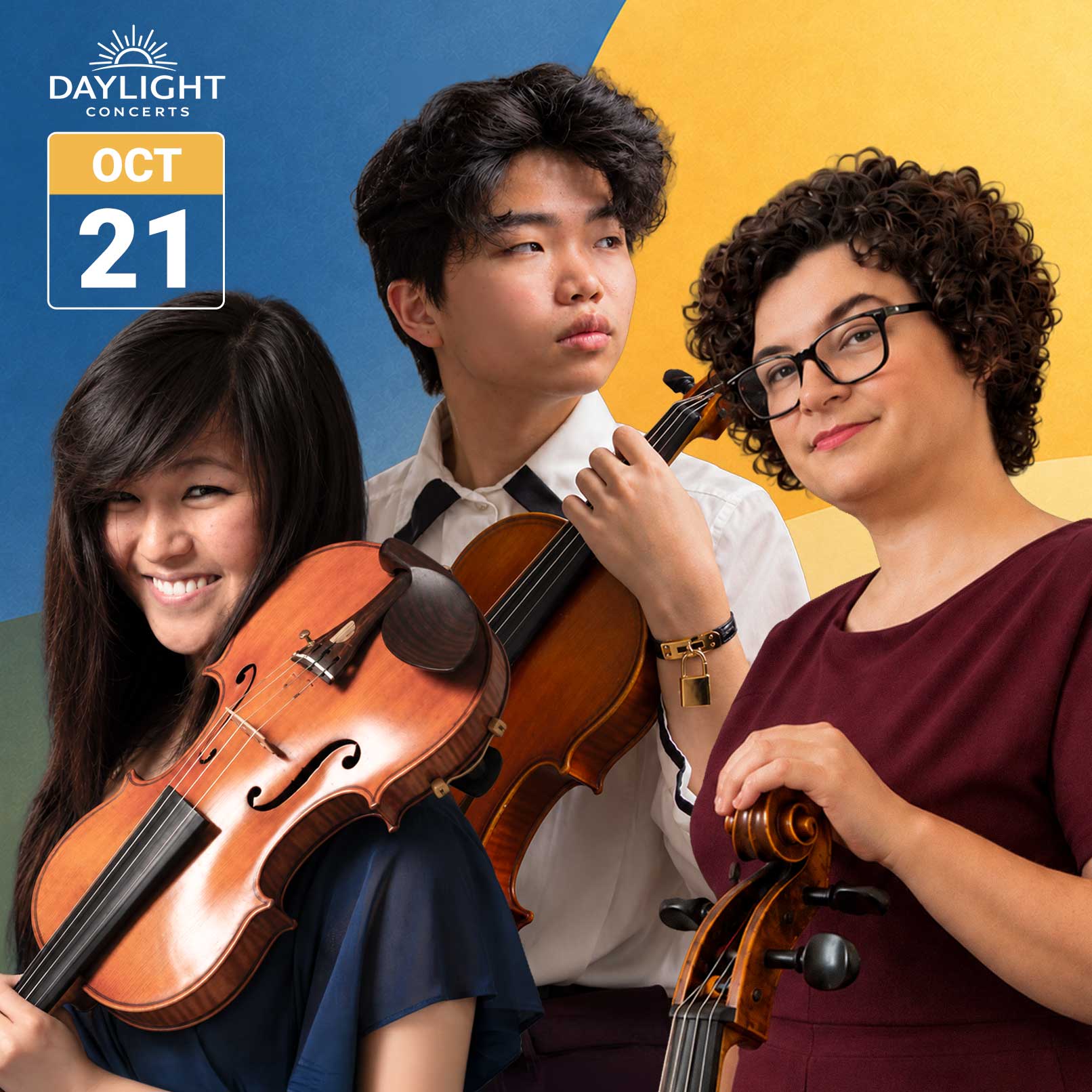
Violinist Charna Matsushige, Violist Ryan Vis, and Cellist Rachel Desoer
We are delighted to launch our new Daylight Concerts series. Designed especially with older adults in mind, but open to everyone, each concert features one hour of live acoustic music with no intermission, followed by complimentary coffee, tea, and refreshments, with time to socialize. Our first concert features violinist Charna Matsushige, violist Ryan Vis, and cellist Rachel Desoer. These accomplished chamber and orchestral musicians come together for an engaging program featuring music by Mozart, Gardel, Massenet, Dohnányi, and more.
Wednesday, October 21, 2026 • 2:00pm
Stage at St. Andrews (Halifax United Church)
Accessible Venue
Ticket Price: $20.00
Season Sponsor: NICE MOVES / Red Door Realty
The Daylight Concerts series is made possible with the generous support of the Isabel Bader Charitable Trust and the J&W Murphy Foundation.
Program Information
We launch our new Daylight Concerts series with violinist Charna Matsushige, violist Ryan Vis, and cellist Rachel Desoer. All three are accomplished chamber and orchestral musicians with strong connections to Symphony Nova Scotia. Matsushige has performed with ensembles across Canada, Vis recently joined Symphony Nova Scotia’s viola section following performances at the National Arts Centre and internationally, and Principal Cellist Desoer toured extensively as a member of the JUNO Award-nominated Cecilia String Quartet, performing at Wigmore Hall, the Concertgebouw, and Konzerthaus Berlin.
Together, they present an engagin program for string trio featuring Mozart’s "Eine kleine Nachtmusik," Gardel’s “Por una cabeza,” Massenet’s lyrical “Méditation” from "Thaïs," and Dohnányi’s Serenade in C Major, alongside a touch of familiar film music.
Created especially with older adults in mind, but open to everyone, Daylight Concerts offer welcoming weekday afternoon performances in a relaxed and accessible setting. Each concert features one hour of live acoustic music with no intermission, followed by complimentary coffee, tea, and refreshments, with time to visit and socialize. The series brings together exceptional live music and opportunities for social connection, all during the daylight hours.
Wolfgang Amadeus Mozart (1756–1791)
“Eine kleine Nachtmusik,” K. 525
I. Allegro
In August 1787, Wolfgang Amadeus Mozart was living in Vienna, where he had established himself as a freelance composer, pianist, and teacher after leaving the service of the Archbishop of Salzburg six years earlier. He was 31 years old and enjoying considerable artistic success. Earlier that year, he had travelled to Prague, where his opera “The Marriage of Figaro” had become a sensation. He was now working on “Don Giovanni,” which would premiere in Prague that October. Amid these larger projects, Mozart completed a serenade on August 10, recording it in his personal catalogue as “Eine kleine Nachtmusik,” or “A Little Night Music.”
Despite becoming one of Mozart’s most recognizable compositions, surprisingly little is known about why he wrote it. Serenades were popular in eighteenth-century Vienna, often performed at outdoor gatherings, celebrations, and social occasions. Mozart’s own catalogue lists five movements, although only four survive today. The missing movement was a second minuet and trio, and nobody knows when or why it disappeared. There is also no surviving record of a performance during Mozart’s lifetime. The work was not published until 1827, some 36 years after his death.
The opening Allegro begins with one of classical music’s most familiar melodies, a bold, ascending musical statement followed by an energetic response. Mozart develops this simple opening into a movement full of contrasting ideas, playful exchanges, and unexpected harmonic turns. Originally scored for two violins, viola, and cello, with an optional double bass doubling the cello part, the serenade is equally effective with a small string ensemble. Its apparent simplicity disguises the precision of Mozart’s writing, with every musical idea contributing to the movement’s irresistible energy.
Jules Massenet (1842–1912)
“Méditation” from “Thaïs”
Arranged for String Trio
By the 1890s, Jules Massenet was one of France’s most successful opera composers. A professor of composition at the Paris Conservatoire, he had established his reputation with operas including “Manon” (1884) and “Werther” (1892). His gift for expressive melody and his sensitivity to the emotional lives of his characters made him particularly popular with French audiences. In 1894, his opera “Thaïs” premiered at the Paris Opéra, with the celebrated American soprano Sibyl Sanderson in the title role. Massenet had developed a close artistic relationship with Sanderson, whose extraordinary vocal range inspired several of his leading operatic roles.
Set in fourth-century Egypt, “Thaïs” tells the story of a beautiful courtesan in Alexandria and Athanaël, a Christian monk determined to persuade her to abandon her worldly life. The opera explores the conflict between spiritual devotion and earthly desire. Its most famous passage, the “Méditation,” is an instrumental interlude performed between the two scenes of Act II, as Thaïs reflects on her life and considers the monk’s appeal. Although no words are sung during the passage, the music expresses her inner transformation.
Originally written for solo violin and orchestra, with harp accompaniment, the “Méditation” has become one of the most beloved pieces in the violin repertoire. Its soaring melody unfolds gradually, beginning in a mood of quiet contemplation before building to an emotional climax and returning to a peaceful conclusion. The piece is often performed independently of the opera and has been arranged for numerous instruments and ensembles. While “Thaïs” itself is performed less frequently than some of Massenet’s other operas, its “Méditation” has achieved a level of popularity far beyond the work from which it originated.
Carlos Gardel (1890–1935)
“Por una cabeza”
Arranged for String Trio
Few singers have achieved the legendary status of Carlos Gardel, whose recordings and films helped carry Argentine tango from the dance halls of Buenos Aires to audiences around the world. Widely believed to have been born in Toulouse, France, in 1890, Gardel grew up in Buenos Aires, where he became the defining voice of Argentine tango during the 1920s and 1930s. His smooth baritone, expressive phrasing, and considerable screen presence made him an international celebrity. By the early 1930s, he was appearing in Spanish-language films produced by Paramount, bringing tango to audiences throughout Latin America, Europe, and the United States.
Gardel composed “Por una cabeza” in 1935, with lyrics by his longtime collaborator Alfredo Le Pera, for the musical film “Tango Bar.” The title translates roughly as “By a Head,” a reference to horse racing, where a horse wins or loses by the narrowest of margins. In the song, a gambler compares his weakness for betting on horses with his equally troublesome weakness for romance. The clever lyrics capture the excitement, disappointment, and irresistible temptation of both pursuits. Gardel himself was an enthusiastic follower of horse racing, making the subject particularly appropriate.
Gardel never lived to see the lasting success of his final films. On June 24, 1935, only months after recording “Por una cabeza,” he died in an airplane collision in Medellín, Colombia, at the age of 44. His death prompted extraordinary public mourning, and he remains a cultural icon in Argentina and throughout Latin America. The melody found renewed international popularity through its use in films, including “Scent of a Woman” (1992), in which Al Pacino famously dances the tango. In this arrangement for string trio, the melody’s graceful elegance alternates with the rhythmic tension and passion characteristic of Argentine tango.
Klaus Badelt (b. 1967)
“He’s a Pirate” from “Pirates of the Caribbean: The Curse of the Black Pearl”
Arranged for String Trio
When “Pirates of the Caribbean: The Curse of the Black Pearl” arrived in cinemas in 2003, few anticipated that a film inspired by a Disneyland theme park attraction would become one of the year’s biggest box-office successes. Starring Johnny Depp, Orlando Bloom, and Keira Knightley, the film revived Hollywood’s swashbuckling adventure genre and launched a hugely successful franchise. Its energetic orchestral soundtrack became nearly as recognizable as its characters, particularly the main action theme, “He’s a Pirate.”
German-born composer Klaus Badelt was working with Hans Zimmer’s film music production company in California when the project came together. Zimmer, who was occupied with other film commitments, helped develop the musical themes but was unable to take on the entire score. Badelt received the principal composing credit and worked with a team of additional composers to complete the soundtrack under an exceptionally tight deadline. The resulting music became one of the most recognizable film scores of the early twenty-first century.
“He’s a Pirate” accompanies the film’s closing credits and captures the excitement of its high-seas adventures. Its driving rhythms, bold melodic gestures, and repeated musical patterns create a sense of constant forward motion. Although written for a modern film soundtrack featuring a large orchestral sound, the music draws on techniques familiar from centuries of classical composition, including repeated rhythmic figures, dramatic contrasts, and memorable themes. In this arrangement for string trio, three musicians recreate the excitement of a much larger ensemble, demonstrating how effectively the music works even without the full force of a Hollywood orchestra.
Ernő Dohnányi (1877–1960)
“Serenade in C Major for String Trio,” Op. 10
I. Marcia: Allegro
II. Romanza: Adagio non troppo, quasi andante
III. Scherzo: Vivace
IV. Tema con variazioni: Andante con moto
V. Rondo (Finale): Allegro vivace
Ernő Dohnányi was one of Hungary’s most accomplished musicians, celebrated internationally as a pianist, composer, conductor, and teacher. Born in Pozsony, then part of the Austro-Hungarian Empire and now Bratislava, Slovakia, he showed exceptional musical ability from an early age. His father, a mathematics professor and amateur cellist, encouraged his musical development. Dohnányi later studied at the Royal Hungarian Academy of Music in Budapest, where one of his fellow students was Béla Bartók. Although the two composers would eventually follow quite different musical paths, both became central figures in Hungarian musical life.
Dohnányi’s career developed rapidly. In 1895, Johannes Brahms encountered Dohnányi’s “Piano Quintet No. 1 in C minor” and was sufficiently impressed to arrange for its performance in Vienna. Three years later, Dohnányi made a successful debut as a pianist in London, beginning an international performing career that would take him across Europe and North America. Unlike Bartók, who increasingly explored Hungarian folk music and modernist techniques, Dohnányi remained closely connected to the Romantic traditions of Brahms and Schumann, combining rich harmonies and lyrical melodies with exceptional technical skill.
Dohnányi composed his “Serenade in C Major” in 1902, when he was in his mid-twenties and had already established an international reputation as a pianist and composer. The work was written for the unusual combination of violin, viola, and cello, without the second violin normally found in a string quartet. Despite the smaller ensemble, Dohnányi creates a remarkably full and varied sound, giving each instrument opportunities to lead, accompany, and engage in lively musical conversation.
The title “Serenade” recalls an eighteenth-century tradition of instrumental music intended for entertainment, often performed at social gatherings or outdoor celebrations. Mozart, whose “Eine kleine Nachtmusik” opens today’s concert, was one of the great masters of the genre. By Dohnányi’s time, the serenade had also developed into a sophisticated concert work. His five-movement composition combines the lighthearted spirit of the earlier tradition with the expressive depth and musical complexity of the Romantic era.
The opening Marcia begins with a spirited march, its confident rhythms and playful character establishing an immediately engaging atmosphere. The music is full of contrasts, alternating bold statements with more lyrical passages. Rather than maintaining a strictly military character, Dohnányi treats the march with wit and flexibility, creating a movement that feels both ceremonial and mischievous.
The second movement, Romanza, provides a striking contrast. Its gentle, singing melodies evoke the intimacy of a Romantic song, with the instruments passing expressive phrases between one another. The music gradually becomes more impassioned before returning to its opening tranquillity. Dohnányi’s gift for lyrical writing is especially evident here, as he achieves considerable emotional depth with only three instruments.
The Scherzo is one of the work’s most technically demanding movements. Fast, energetic, and rhythmically intricate, it features fugal writing, a technique in which a musical theme passes between different voices and develops through imitation. This technique was especially associated with Johann Sebastian Bach, although composers continued to explore it for centuries. Dohnányi combines the intellectual precision of counterpoint with the excitement of a lively scherzo, producing music that is both playful and brilliantly constructed.
The fourth movement, Tema con variazioni, begins with a reflective theme introduced by the viola. Dohnányi then transforms this melody through a series of variations, exploring different moods, textures, and instrumental combinations. The movement demonstrates his ability to develop a simple musical idea into something increasingly elaborate while maintaining a clear connection to the original theme.
The Finale returns to the lively spirit of the opening movement. Written as a rondo, it features a recurring principal theme interspersed with contrasting episodes. The music is full of rhythmic vitality and instrumental interplay, and Dohnányi brings back material from the opening march, giving the entire serenade a satisfying sense of unity. The work concludes with a brilliant flourish.
Although Dohnányi’s music was overshadowed for much of the twentieth century by the more experimental works of Bartók and other modernists, his “Serenade” has remained a favourite among chamber musicians. Today, it remains one of Dohnányi’s most frequently performed chamber works and an important contribution to the repertoire for violin, viola, and cello.
Renseignements sur le programme
Nous lançons notre nouvelle série Daylight Concerts en compagnie de la violoniste Charna Matsushige, de l’altiste Ryan Vis et de la violoncelliste Rachel Desoer. Tous trois sont des musiciens de chambre et d’orchestre accomplis qui entretiennent des liens étroits avec Symphony Nova Scotia. Matsushige s’est produite avec des ensembles partout au Canada, Vis s’est récemment joint à la section des altos de Symphony Nova Scotia après s’être produit au Centre national des Arts et sur la scène internationale, et Desoer, violoncelle solo de l’orchestre, a effectué de nombreuses tournées comme membre du Cecilia String Quartet, ensemble nommé aux prix JUNO, se produisant notamment au Wigmore Hall, au Concertgebouw et au Konzerthaus Berlin.
Ensemble, ils présentent un programme captivant pour trio à cordes comprenant « Eine kleine Nachtmusik » de Mozart, « Por una cabeza » de Gardel, la lyrique « Méditation » de Massenet, tirée de « Thaïs », et la Sérénade en do majeur de Dohnányi, ainsi qu’une touche de musique de film bien connue.
Conçus tout particulièrement à l’intention des personnes âgées, mais ouverts à tous, les Daylight Concerts proposent des concerts accueillants en après-midi, en semaine, dans un cadre détendu et accessible. Chaque concert comprend une heure de musique acoustique interprétée sur scène, sans entracte, suivie de café, de thé et de rafraîchissements offerts gratuitement, ainsi que d’un moment pour échanger et socialiser. La série réunit des prestations musicales exceptionnelles et des occasions de créer des liens, le tout pendant les heures de clarté.
Wolfgang Amadeus Mozart (1756–1791)
« Eine kleine Nachtmusik », K. 525
I. Allegro
En août 1787, Wolfgang Amadeus Mozart vivait à Vienne, où il s’était établi comme compositeur indépendant, pianiste et professeur après avoir quitté, six ans plus tôt, le service de l’archevêque de Salzbourg. Âgé de 31 ans, il connaissait un succès artistique considérable. Plus tôt cette année-là, il s’était rendu à Prague, où son opéra « Les Noces de Figaro » avait remporté un immense succès. Il travaillait alors à « Don Giovanni », dont la première aurait lieu à Prague en octobre. Entre ces projets d’envergure, Mozart acheva une sérénade le 10 août, qu’il inscrivit dans son catalogue personnel sous le titre « Eine kleine Nachtmusik », ou « Une petite musique de nuit ».
Bien qu’il s’agisse aujourd’hui de l’une des compositions les plus célèbres de Mozart, on sait étonnamment peu de choses sur les raisons qui l’ont amené à l’écrire. Les sérénades étaient populaires dans la Vienne du XVIIIe siècle et étaient souvent jouées lors de rassemblements en plein air, de célébrations et de réceptions. Le catalogue personnel de Mozart mentionne cinq mouvements, mais seulement quatre nous sont parvenus. Le mouvement disparu était un deuxième menuet avec trio, et personne ne sait quand ni pourquoi il a été perdu. Aucun témoignage d’une exécution de l’œuvre du vivant de Mozart n’a été conservé. Elle ne fut publiée qu’en 1827, quelque 36 ans après sa mort.
L’Allegro initial s’ouvre sur l’une des mélodies les plus familières de la musique classique, une phrase musicale ascendante et affirmée, suivie d’une réponse énergique. À partir de cette idée toute simple, Mozart construit un mouvement riche en contrastes, en échanges enjoués et en détours harmoniques inattendus. Écrite à l’origine pour deux violons, alto et violoncelle, avec une contrebasse facultative doublant la partie de violoncelle, la sérénade se prête tout aussi bien à un petit ensemble à cordes. Son apparente simplicité dissimule la précision de l’écriture de Mozart, où chaque idée musicale contribue à l’énergie irrésistible du mouvement.
Jules Massenet (1842–1912)
« Méditation » tirée de « Thaïs »
Arrangement pour trio à cordes
Dans les années 1890, Jules Massenet était l’un des compositeurs d’opéra les plus populaires de France. Professeur de composition au Conservatoire de Paris, il avait établi sa réputation grâce à des opéras comme « Manon » (1884) et « Werther » (1892). Son don pour les mélodies expressives et sa sensibilité à la vie intérieure de ses personnages lui valaient une grande popularité auprès du public français. En 1894, son opéra « Thaïs » fut créé à l’Opéra de Paris, avec la célèbre soprano américaine Sibyl Sanderson dans le rôle-titre. Massenet avait développé une étroite collaboration artistique avec Sanderson, dont l’étendue vocale exceptionnelle inspira plusieurs de ses grands rôles féminins.
Situé dans l’Égypte du IVe siècle, « Thaïs » raconte l’histoire d’une belle courtisane d’Alexandrie et d’Athanaël, un moine chrétien déterminé à la convaincre de renoncer à sa vie mondaine. L’opéra explore le conflit entre la dévotion spirituelle et les désirs terrestres. Son passage le plus célèbre, la « Méditation », est un interlude instrumental joué entre les deux tableaux du deuxième acte, alors que Thaïs réfléchit à sa vie et aux paroles du moine. Bien qu’aucune parole ne soit chantée pendant ce passage, la musique exprime sa transformation intérieure.
Écrite à l’origine pour violon solo et orchestre, avec accompagnement de harpe, la « Méditation » est devenue l’une des pièces les plus appréciées du répertoire pour violon. Sa mélodie lyrique se déploie progressivement, passant d’une contemplation paisible à un sommet d’intensité émotionnelle avant de retrouver le calme. Souvent interprétée indépendamment de l’opéra, elle a fait l’objet de nombreux arrangements pour différents instruments et ensembles. Bien que « Thaïs » soit aujourd’hui moins souvent présenté que certains autres opéras de Massenet, sa « Méditation » a acquis une popularité qui dépasse largement celle de l’œuvre dont elle est tirée.
Carlos Gardel (1890–1935)
« Por una cabeza »
Arrangement pour trio à cordes
Peu de chanteurs ont atteint le statut légendaire de Carlos Gardel, dont les enregistrements et les films ont contribué à faire connaître le tango argentin, des salles de danse de Buenos Aires jusqu’aux publics du monde entier. Considéré par de nombreux historiens comme étant né à Toulouse, en France, en 1890, Gardel a grandi à Buenos Aires, où il est devenu la voix emblématique du tango argentin dans les années 1920 et 1930. Sa voix de baryton chaleureuse, son phrasé expressif et son charisme à l’écran en ont fait une vedette internationale. Dès le début des années 1930, il jouait dans des films en espagnol produits par Paramount, faisant découvrir le tango aux publics d’Amérique latine, d’Europe et des États-Unis.
Gardel composa « Por una cabeza » en 1935, sur des paroles de son collaborateur de longue date Alfredo Le Pera, pour le film musical « Tango Bar ». Le titre signifie approximativement « D’une tête », une référence aux courses de chevaux, où la victoire ou la défaite se joue parfois par une marge infime. Dans la chanson, un parieur compare son penchant pour les courses de chevaux à sa faiblesse tout aussi tenace pour les aventures amoureuses. Les paroles pleines d’esprit évoquent l’excitation, la déception et la tentation irrésistible associées à ces deux passions. Gardel était lui-même un grand amateur de courses de chevaux, ce qui rendait le sujet particulièrement approprié.
Gardel ne vécut pas assez longtemps pour connaître le succès durable de ses derniers films. Le 24 juin 1935, quelques mois seulement après avoir enregistré « Por una cabeza », il mourut à l’âge de 44 ans dans une collision entre deux avions à Medellín, en Colombie. Sa disparition provoqua un immense deuil populaire, et il demeure une figure emblématique de la culture argentine et latino-américaine. La mélodie connut un regain de popularité internationale grâce à son utilisation au cinéma, notamment dans « Le Temps d’un week-end » (« Scent of a Woman », 1992), où Al Pacino danse un tango devenu célèbre. Dans cet arrangement pour trio à cordes, l’élégance gracieuse de la mélodie alterne avec la tension rythmique et la passion caractéristiques du tango argentin.
Klaus Badelt (né en 1967)
« He’s a Pirate » tiré de « Pirates des Caraïbes : La Malédiction du Black Pearl »
Arrangement pour trio à cordes
Lorsque « Pirates des Caraïbes : La Malédiction du Black Pearl » prit l’affiche en 2003, peu de gens s’attendaient à ce qu’un film inspiré d’une attraction du parc Disneyland devienne l’un des plus grands succès commerciaux de l’année. Mettant en vedette Johnny Depp, Orlando Bloom et Keira Knightley, le film redonna vie au genre des aventures de pirates à Hollywood et lança une franchise extrêmement populaire. Sa trame sonore orchestrale débordante d’énergie devint presque aussi reconnaissable que ses personnages, particulièrement son thème d’action principal, « He’s a Pirate ».
Le compositeur d’origine allemande Klaus Badelt travaillait pour la société de production de musique de film de Hans Zimmer, en Californie, lorsque le projet prit forme. Zimmer, occupé par d’autres engagements cinématographiques, participa à l’élaboration des thèmes musicaux, mais ne pouvait prendre en charge l’ensemble de la partition. Badelt obtint le crédit principal de composition et travailla avec une équipe d’autres compositeurs pour terminer la trame sonore dans des délais exceptionnellement serrés. La musique qui en résulta devint l’une des trames sonores de cinéma les plus reconnaissables du début du XXIe siècle.
« He’s a Pirate » accompagne le générique de fin du film et traduit toute l’excitation de ses aventures en haute mer. Ses rythmes entraînants, ses motifs mélodiques affirmés et ses figures musicales répétées créent une impression de mouvement constant. Bien qu’écrite pour une trame sonore moderne faisant appel à une sonorité orchestrale imposante, cette musique reprend des techniques familières aux compositeurs classiques depuis des siècles, notamment les figures rythmiques répétées, les contrastes dramatiques et les thèmes mémorables. Dans cet arrangement pour trio à cordes, trois musiciens recréent l’excitation d’un ensemble beaucoup plus grand, démontrant à quel point cette musique demeure efficace même sans toute la puissance d’un orchestre hollywoodien.
Ernő Dohnányi (1877–1960)
« Sérénade en do majeur pour trio à cordes », op. 10
I. Marcia : Allegro
II. Romanza : Adagio non troppo, quasi andante
III. Scherzo : Vivace
IV. Tema con variazioni : Andante con moto
V. Rondo (Finale) : Allegro vivace
Ernő Dohnányi fut l’un des musiciens hongrois les plus accomplis de son époque, reconnu internationalement comme pianiste, compositeur, chef d’orchestre et professeur. Né à Pozsony, alors dans l’Empire austro-hongrois et aujourd’hui Bratislava, en Slovaquie, il manifesta très jeune des aptitudes musicales exceptionnelles. Son père, professeur de mathématiques et violoncelliste amateur, encouragea son développement musical. Dohnányi étudia ensuite à l’Académie royale hongroise de musique de Budapest, où Béla Bartók figurait parmi ses condisciples. Bien que les deux compositeurs aient par la suite emprunté des voies musicales très différentes, ils devinrent tous deux des figures importantes de la vie musicale hongroise.
La carrière de Dohnányi prit rapidement son essor. En 1895, Johannes Brahms découvrit son « Quintette pour piano no 1 en do mineur » et fut suffisamment impressionné pour en organiser une exécution à Vienne. Trois ans plus tard, Dohnányi fit des débuts remarqués comme pianiste à Londres, amorçant une carrière internationale qui le mènerait à travers l’Europe et l’Amérique du Nord. Contrairement à Bartók, qui explora de plus en plus la musique folklorique hongroise et les techniques modernistes, Dohnányi demeura profondément attaché aux traditions romantiques de Brahms et de Schumann, alliant de riches harmonies et des mélodies lyriques à une maîtrise technique exceptionnelle.
Dohnányi composa sa « Sérénade en do majeur » en 1902, alors qu’il était dans la mi-vingtaine et jouissait déjà d’une réputation internationale comme pianiste et compositeur. L’œuvre fut écrite pour la formation inhabituelle du violon, de l’alto et du violoncelle, sans le deuxième violon que l’on retrouve normalement dans un quatuor à cordes. Malgré cet effectif réduit, Dohnányi crée une sonorité étonnamment riche et variée, donnant à chaque instrument l’occasion de mener, d’accompagner et de participer à un dialogue musical animé.
Le titre « Sérénade » rappelle une tradition de musique instrumentale du XVIIIe siècle destinée au divertissement, souvent interprétée lors de réceptions ou de célébrations en plein air. Mozart, dont « Eine kleine Nachtmusik » ouvre le concert d’aujourd’hui, était l’un des grands maîtres du genre. À l’époque de Dohnányi, la sérénade était également devenue une œuvre de concert plus élaborée. Sa composition en cinq mouvements marie l’esprit léger de cette tradition ancienne à la profondeur expressive et à la complexité musicale de l’époque romantique.
Le premier mouvement, Marcia, s’ouvre sur une marche entraînante dont les rythmes assurés et le caractère enjoué créent immédiatement une atmosphère vivante. La musique regorge de contrastes, alternant des passages affirmés et des moments plus lyriques. Plutôt que de conserver un caractère strictement militaire, Dohnányi traite la marche avec humour et souplesse, créant un mouvement à la fois cérémonieux et espiègle.
Le deuxième mouvement, Romanza, offre un contraste saisissant. Ses mélodies douces et chantantes évoquent l’intimité d’une mélodie romantique, les instruments se transmettant tour à tour des phrases expressives. La musique gagne progressivement en intensité avant de retrouver sa tranquillité initiale. Le talent de Dohnányi pour l’écriture lyrique s’y révèle particulièrement, alors qu’il parvient à créer une grande profondeur émotionnelle avec seulement trois instruments.
Le Scherzo est l’un des mouvements les plus exigeants de l’œuvre sur le plan technique. Rapide, énergique et rythmiquement complexe, il comporte une écriture fuguée, une technique dans laquelle un thème musical passe d’une voix à l’autre et se développe par imitation. Cette technique est particulièrement associée à Johann Sebastian Bach, bien que les compositeurs aient continué à l’explorer pendant des siècles. Dohnányi allie la précision intellectuelle du contrepoint à l’énergie d’un scherzo animé, créant une musique à la fois ludique et brillamment construite.
Le quatrième mouvement, Tema con variazioni, commence par un thème méditatif présenté à l’alto. Dohnányi transforme ensuite cette mélodie à travers une série de variations, explorant différentes atmosphères, textures et combinaisons instrumentales. Le mouvement témoigne de sa capacité à développer une idée musicale simple en quelque chose de toujours plus élaboré, tout en conservant un lien clair avec le thème original.
Le Finale retrouve l’esprit animé du premier mouvement. Écrit sous forme de rondo, il présente un thème principal récurrent entrecoupé d’épisodes contrastants. La musique déborde de vitalité rythmique et d’échanges entre les instruments, et Dohnányi fait réapparaître des éléments de la marche initiale, donnant à l’ensemble de la sérénade une impression d’unité particulièrement satisfaisante. L’œuvre se termine par un éclat brillant.
Bien que la musique de Dohnányi ait été éclipsée pendant une bonne partie du XXe siècle par les œuvres plus expérimentales de Bartók et d’autres modernistes, sa « Sérénade » est demeurée une œuvre appréciée des chambristes. Aujourd’hui, elle figure parmi les œuvres de musique de chambre de Dohnányi les plus souvent interprétées et constitue une contribution importante au répertoire pour violon, alto et violoncelle.
Artist Biographies
Charna Matsushige, violin
A native of Newmarket, Ontario, Charna Matsushige began studying the violin with Sonia Klimasko at age six and by her late teens continued her studies with David Zafer in Toronto. She has enjoyed playing with the Toronto Symphony Youth Orchestra, the National Youth Orchestra of Canada, the Toronto Concert Orchestra, the National Academy Orchestra, and the Kingston Symphony.
An avid chamber musician, Charna has participated in string quartet programs at the Scotia Festival of Music in Halifax and the NYU Steinhardt Intensive String Quartet Workshop in New York City. Charna received her Bachelor of Music in Performance at McGill University’s Schulich School of Music under the tutelage of Mark Fewer. In 2014, she received her Master of Music from the University of Toronto, studying with Yehonatan Berick. In addition to her role with Symphony Nova Scotia, she currently performs with the Niagara Symphony Orchestra and freelances in the Toronto and surrounding areas.
Ryan Vis, viola
Originally born in Seoul, South Korea, Ryan was adopted as a young child and grew up in New York. His path to music has been shaped by curiosity, discipline, and a love of connection – qualities that continue to guide his work on stage. He enjoys figure skating, hot pilates, cooking, and swimming, and values the balance that music and life outside music bring to one another. He shares his home with a cat named Sephora.
Ryan has appeared in a wide range of performance settings, from concert stages and recital halls to diplomatic events and special ceremonies. Recent highlights include performing at the 50th International Viola Congress in Paris, where he presented Canadian works alongside immersive visual landscapes from Canadian Geographic. He has also given a featured recital at the National Arts Centre with pianist Carson Becke, and was a finalist in the PRISMA Festival Concerto Competition.
As a chamber and orchestral musician, Ryan has performed for Prime Ministers Stephen Harper and Justin Trudeau, as well as for the Korean Cultural Centre and the Embassies of Spain, Finland, Germany, and France. He has served as Guest Principal of the Kingston Symphony and Principal of the Ottawa Pops Orchestra, and performs regularly with the Candlelight Series – appearing in more than 25 programs across Canada.
Recently appointed to the viola section of Symphony Nova Scotia, Ryan is excited for the 2026/27 season.
He holds a Master’s of Music from the University of Ottawa and a Bachelor’s degree from McGill University, having studied with Michael van der Sloot, Frédéric Lambert, and Andre Roy. Ryan performs on a viola crafted by Theo Marks.
Rachel Desoer, cello
Rachel Desoer is a Canadian cellist. She studied at the Juilliard School, Oberlin College, McGill University, and the Banff Centre. She graduated from Oberlin in 2008 with a Bachelor of Music.
Rachel was the cellist of the Cecilia String Quartet from 2010 to 2018. In this ensemble, Rachel toured extensively around the world, recorded four albums on the Analekta label, and taught chamber music at the University of Toronto.
Touring has allowed Rachel to perform at such inspiring venues as Wigmore Hall, The Concertgebouw (Amsterdam), Konzert Haus Berlin, and many more. The Cecilia Quartet also made educational programming a priority, and performed hundreds of presentations for schools. In 2014, the quartet created a concert series called Xenia Concerts specifically designed for children on the autism spectrum and their families. Exemplifying their commitment to the equal representation of women in music, Rachel spearheaded the commissioning of four string quartets by Canadian women composers in 2016.
Rachel continues to play recitals and concertos with orchestras regularly. She has worked most notably with the National Arts Centre Orchestra and the Canadian Opera Company. Two of her recordings have been nominated for JUNO Awards. Currently, Rachel is the Principal Cello of Symphony Nova Scotia.
Rachel performs on a Vuillaume cello from ca. 1850, generously loaned by the Symphony Nova Scotia Society.
Biographies des artistes
Charna Matsushige, violon
Originaire de Newmarket, en Ontario, Charna Matsushige commence l’étude du violon à l’âge de six ans auprès de Sonia Klimasko, puis poursuit sa formation à la fin de son adolescence auprès de David Zafer à Toronto. Elle a joué avec le Toronto Symphony Youth Orchestra, l’Orchestre national des jeunes du Canada, le Toronto Concert Orchestra, le National Academy Orchestra et le Kingston Symphony.
Passionnée de musique de chambre, Charna a participé à des programmes consacrés au quatuor à cordes au Scotia Festival of Music à Halifax ainsi qu’au NYU Steinhardt Intensive String Quartet Workshop à New York. Elle obtient un baccalauréat en musique, interprétation, à l’École de musique Schulich de l’Université McGill, où elle étudie auprès de Mark Fewer. En 2014, elle obtient une maîtrise en musique de l’Université de Toronto sous la direction de Yehonatan Berick. En plus de son rôle au sein de Symphony Nova Scotia, elle se produit actuellement avec le Niagara Symphony Orchestra et travaille comme musicienne pigiste à Toronto et dans les environs.
Ryan Vis, alto
Né à Séoul, en Corée du Sud, Ryan est adopté alors qu’il est encore jeune et grandit dans l’État de New York. Son parcours musical est façonné par la curiosité, la discipline et le goût des échanges, des qualités qui continuent de guider son travail sur scène. Il aime le patinage artistique, le Pilates chaud, la cuisine et la natation, et apprécie l’équilibre entre la musique et sa vie à l’extérieur de celle-ci. Il partage son quotidien avec son chat, Sephora.
Ryan s’est produit dans une grande variété de contextes, des scènes de concert et salles de récital aux événements diplomatiques et cérémonies spéciales. Parmi ses prestations récentes figure sa participation au 50e Congrès international de l’alto à Paris, où il a interprété des œuvres canadiennes accompagnées de paysages visuels immersifs de Canadian Geographic. Il a également donné un récital au Centre national des Arts avec le pianiste Carson Becke et a été finaliste au Concours de concerto du PRISMA Festival.
Comme chambriste et musicien d’orchestre, Ryan s’est produit devant les premiers ministres Stephen Harper et Justin Trudeau, ainsi que lors d’événements organisés par le Centre culturel coréen et les ambassades d’Espagne, de Finlande, d’Allemagne et de France. Il a occupé les postes d’alto solo invité du Kingston Symphony et d’alto solo de l’Ottawa Pops Orchestra. Il se produit régulièrement dans le cadre de la série Candlelight, ayant participé à plus de 25 programmes partout au Canada.
Récemment nommé à la section des altos de Symphony Nova Scotia, Ryan se réjouit de la saison 2026-2027.
Il détient une maîtrise en musique de l’Université d’Ottawa et un baccalauréat de l’Université McGill, où il a étudié auprès de Michael van der Sloot, Frédéric Lambert et André Roy. Ryan joue sur un alto fabriqué par Theo Marks.
Rachel Desoer, violoncelle
Rachel Desoer est une violoncelliste canadienne. Elle a étudié à la Juilliard School, à l’Oberlin College, à l’Université McGill et au Banff Centre. Elle obtient en 2008 un baccalauréat en musique de l’Oberlin College.
Rachel est la violoncelliste du Cecilia String Quartet de 2010 à 2018. Avec cet ensemble, elle effectue de nombreuses tournées à travers le monde, enregistre quatre albums sous étiquette Analekta et enseigne la musique de chambre à l’Université de Toronto.
Ses tournées lui permettent de se produire dans des salles prestigieuses comme le Wigmore Hall, le Concertgebouw d’Amsterdam et le Konzerthaus Berlin, entre autres. Le Cecilia String Quartet accorde également une grande importance aux activités éducatives et présente des centaines de prestations dans les écoles. En 2014, le quatuor crée Xenia Concerts, une série de concerts spécialement conçue pour les enfants autistes et leurs familles. Dans le cadre de son engagement en faveur d’une représentation équitable des femmes en musique, Rachel dirige en 2016 un projet de commande de quatre quatuors à cordes à des compositrices canadiennes.
Rachel continue de se produire régulièrement en récital et comme soliste avec orchestre. Elle collabore notamment avec l’Orchestre du Centre national des Arts et la Canadian Opera Company. Deux de ses enregistrements ont été mis en nomination aux prix JUNO. Rachel occupe actuellement le poste de violoncelle solo de Symphony Nova Scotia.
Rachel joue sur un violoncelle Vuillaume datant d’environ 1850, généreusement prêté par la Symphony Nova Scotia Society.
Location
Stage at St. Andrews (New Name: Halifax United Church)
6036 Coburg Road • Halifax, Nova Scotia • B3H 1Y9
Frequently Asked Questions
How will I receive my tickets?
Electronic tickets are emailed immediately after purchase to the email address used at checkout. Please keep your tickets handy on your smart phone or bring a printed copy with you to the concert so we can scan them at the door. If you do not receive your tickets, please check your spam or junk folder, as ticket emails are sometimes blocked or filtered by email providers. You may also wish to search your inbox for “Cecilia Concerts” or your order confirmation. If you still cannot find your tickets, please contact the Cecilia Concerts office before the concert and we’ll be happy to help. Rest assured, if you purchased tickets, your name will also be on our guest list at the door.
What time should I arrive?
Doors open at 1:30pm, and the concert begins at 2:00pm. We recommend arriving a little early so you have time to have your ticket scanned, find a seat, and get settled before the performance begins.
How long is the concert?
Daylight Concerts are approximately one hour long with no intermission. Following the performance, you’re invited to stay for complimentary coffee, tea, and refreshments, with time to visit and socialize.
Do I have to stay for the reception?
Not at all. The post-concert reception is an optional part of the Daylight Concerts experience. You’re welcome to stay for refreshments and conversation or head home following the performance.
Can I arrive late?
Latecomers will be seated at an appropriate break in the performance, when possible. Since Daylight Concerts have no intermission, we recommend arriving before the 2:00pm start time.
What is the seating like?
Tickets are general admission. The Stage at St. Andrew’s has unassigned seating, with chairs on the main floor and pews in the balcony. Seats are available on a first-come, first-served basis. Please note that the balcony is accessible by stairs only. Wheelchair-accessible seating and companion seating are available on the main floor. If you have an accessibility-related seating need, please let us know when you arrive and we’ll be happy to assist.
Are children welcome?
Yes. While Daylight Concerts have been developed especially with older adults in mind, everyone is welcome. Performances are approximately one hour long with no intermission.
What should I know about concert etiquette?
If you are new to classical concerts, you are very welcome. We simply ask that audience members help create a quiet and respectful environment for the artists and those around them. Please silence your phone before the concert begins, avoid talking during the performance, and wait for pauses between pieces to move around when possible.
When should I clap?
It is always fine to clap when a full piece has ended. Some longer works have several movements, with short pauses in between, and audiences usually wait until the entire work is finished before applauding. If you are unsure, it is perfectly okay to wait and follow the rest of the audience.
Can I use my phone during the concert?
Please silence your phone before the concert begins. We ask that phones and bright screens not be used during the performance, as they can be distracting to artists and audience members.
Can I take photos or videos?
Photos are welcome before or after the concert. Unless otherwise announced, photography, audio recording, and video recording are not permitted during the performance.
What accessibility features are available?
The Stage at St. Andrews is wheelchair accessible and includes accessible washrooms with ramp access. Companion seating is available if required. If you have a specific accessibility question before attending, please contact us and we’ll be happy to help.
Is the venue scent-sensitive?
To help make the concert comfortable for everyone, we ask guests to avoid wearing strong scents or fragrances.
Is there parking or public transit nearby?
The Stage at St. Andrews is located on the corner of Robie Street and Coburg Road. There is no parkade at the venue, but street parking is available in the surrounding area. The venue is also located near major South End Halifax Transit routes.
What happens if there is a storm?
If a storm may affect a performance, ticket holders are encouraged to call the Cecilia Concerts office at 902-423-0143 for a recorded concert update. Updates will also be posted on the Cecilia Concerts website and social media channels.
What happens if a concert is changed, postponed, or cancelled?
Concert schedule changes are very rare, but storms or other unexpected circumstances may occasionally require us to make adjustments. If a concert is changed, postponed, or cancelled, ticket holders will be contacted as soon as possible with available options. Depending on the circumstances, you may choose to attend the rescheduled concert, receive a credit toward a future Cecilia Concerts performance, request a refund, or convert the value of your ticket into a charitable donation tax receipt.