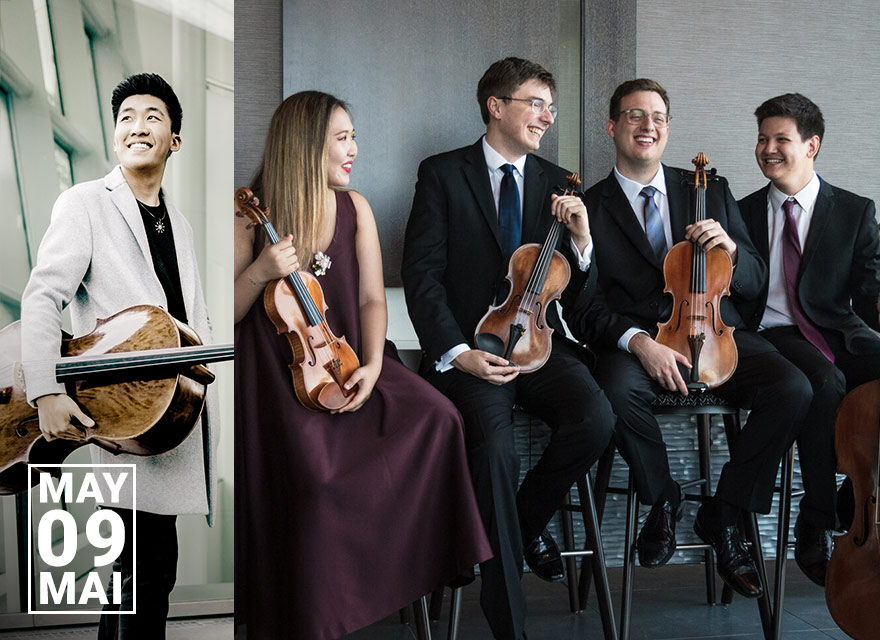
Bryan Cheng and Balourdet Quartet: heartSTRINGS!
SATURDAY, MAY 9, 2026 • 7:30PM
STAGE AT ST. ANDREWS • 6036 COBURG RD
HALIFAX, NOVA SCOTIA
WHEELCHAIR ACCESSIBLE
About this Concert
For his final residency concert of the season, our 2025/26 Musician-in-Residence cellist Bryan Cheng, joins the prize-winning Balourdet Quartet, who wowed our Halifax audience just a couple of years ago, for a captivating evening of chamber music that bridges the sensuous sound world of French Impressionism and the emotional depth of the Viennese Romantic tradition. The program features Maurice Ravel’s “String Quartet in F major,” a piece renowned for its shimmering textures, rhythmic vitality, and refined harmonic palette. Equally compelling is Franz Schubert’s “String Quintet in C major,” widely regarded as one of the greatest achievements in the chamber music repertoire. Cheng, known for his interpretive insight and expressive range, brings added resonance to Schubert’s poignant score, while the Balourdet Quartet delivers performances marked by warmth, clarity, and a deep sense of ensemble connection. Together, these five string players offer a richly layered musical experience that balances structure with spontaneity, lightness with gravity, and precision with heart. Presented with the generous support of Musician-in-Residence Presenting Partner – Lang Optometry and Eyewear. Season Sponsor: Nice Moves / Red Door Realty.
ARTISTS: Angela Bae, violin; Justin DeFilippis, violin; Benjamin Zannoni, viola; Russell Houston, cello; Bryan Cheng, cello
MAIN STAGE CONCERTS SERIES
About the Program
Maurice Ravel (1875-1937)
String Quartet in F major
I. Allegro moderato – très doux
II. Assez vif – très rythmé
III. Très lent
IV. Vif et agité
Maurice Ravel was born in the Basque region of Southwest France, near the Spanish border. His father was an engineer and inventor; his mother grew up in Madrid. Ravel showed early musical promise and was admitted to the Paris Conservatory at the age of fourteen. He won prizes for piano performance, but he was more interested in composition. Because of his progressive musical ideas, Ravel found himself constantly at odds with the school’s conservative establishment. Nevertheless, Ravel persisted, largely due to the support of his composition teacher, Gabriel Fauré. Fauré’s aim was to help students find their unique musical voice. Besides Fauré, during the 1890s he made the acquaintance of Claude Debussy and Erik Satie, both of whom were a decade or more his senior, and both of whom had an influence on his musical development.
By the turn of the century, Ravel had begun to experience some minor success as a composer with the overture, Sheherazade, and the Pavane pour une infante defunte.
The String Quartet in F Major received its first performance in 1904. Some critics were quick to point out the similarities to Debussy’s String Quartet of a decade earlier, but overall, the reception was positive and by 1914, it had received frequent performances throughout France, England and Germany. The opening movement is in traditional sonata form, based on two contrasting themes. The development section is predominantly lyrical, gaining intensity before the recapitulation. The pace then slows and the movement ends very quietly. As in Debussy's quartet, second movement opens with a pizzicato passage leading to a lyrical theme. Some commentators have noted the influence of Javanese gamelan music here. Marked “very slow” the third movement begins with a sense of mystery with the initial theme played by the viola. Overall, the music is, despite some inner tensions, quietly lyrical. In contrast to the quiet sense of loss that ends the third movement, the final movement begins with a vigorous sense of agitation, although there are brief moments of calm, including a reference to the first subject of the opening movement. The turbulence of the opening bars of the finale reasserts itself, and the work ends vigorously.
Franz Schubert (1797-1828)
String Quintet in C major, D.956
I. Allegro ma non troppo
II. Adagio
III. Scherzo. Presto – Trio. Andante sostenuto
IV. Allegretto
Franz Schubert was remarkably prolific, writing over 1,500 works during his short career. He once explained to a friend, "I compose every morning, and when one piece is done, I begin another." He wrote over 600 songs for solo voice and piano accompaniment, and he tackled a wide variety of genres, including over fifty pieces of chamber music. He had begun his musical training by studying violin with his father and by the age of ten, he was playing viola in the family string quartet, with his brothers Ferdinand and Ignaz as first and second violin and his father as the cellist. As a youth Schubert wrote fifteen string quartets for this ensemble. The String Quintet in C major,however, is the only string quintet that Schubert composed, and it was written in the fall of 1828, just months before his death at the age of 31. He submitted it to his publisher, saying that he expected rehearsals to begin in a few days. His publisher’s response was to ask if he had any more songs available. It went unpublished until 1853. Schubert never heard his masterpiece performed; it did not receive a public performance until 1850, more than twenty years after his death.
The works of Schubert’s last two years reveal a composer entering a new professional and compositional stage. His compositional style progressed rapidly throughout his life. During his early studies with Antonio Salieri, he was influenced by the works of Haydn and Mozart, and he became a great admirer of Beethoven. He spent two summers in his early twenties tutoring at the Esterhazy estate where he was exposed to Hungarian folk music. Sometimes considered by his contemporaries – and even some later critics – as a facile tune smith, Schubert, especially in his maturity, showed tremendous technical facility and sophistication. The String Quintet in C majorstands as a monument to Schubert’s genius. It is considered one of the great masterworks of the Western Classical chamber repertoire.
Schubert’s selection of the key of C major for his work may have been a gesture to the two composers that he most admired, Mozart and Beethoven, both of whom had written string quintets in that key. A significant departure, though, is that rather than add a second viola to the standard string quartet instrumentation, Schubert employs a second cello. This produces a richer, fuller tone in the lower registers. The opening allegro movement is huge, taking up more than a third of the total length of the piece, and rather than opening with a memorable well-turned melody – the kind of lyricism for which he was famous – he opens with an expansive chord and lays out harmonies without a strong rhythmic pulse. The melodic line enters later and the movement often carries a sense of conviviality, even intimacy, despite its expansive scope. The adagio begins with a sense of otherworldly tranquility, with a slow heartbeat in the cello. The movement’s B section provides a period of turbulence. The lyricism turns darker; a series of chords interrupt the melodic line as if some kind of warning is being issued, and when the tranquility of the A section returns, it is with a sense of resignation and acceptance. The mood shifts again as the scherzo is a happy, up tempo movement that somehow manages to combine a sense the carefree with a sense of grandeur. The final movement, allegretto, is an exuberant sonata-rondo, the same form that Mozart uses in the finale of his string quintet. The main theme borrows from Hungarian folk dance music, and in spite of the state of Schubert’s health, and his awareness of his own approaching death, the music is positive and life affirming, a triumph of the human spirit.
Program notes by Larry Bent
About the Artists
Balourdet Quartet
Angela Bae, violin
Justin DeFilippis, violin
Benjamin Zannoni, viola
Russell Houston, cello
The Balourdet Quartet is acclaimed for their vibrant energy and masterful blend of technical precision and emotional depth that brings a fresh perspective to both beloved classics and modern compositions. Its unique closeness and willingness to take creative risks earned it the 2024 Avery Fisher Career Grant, as well as Chamber Music America’s 2024 Cleveland Quartet Award. With more than 70 concerts per season, recent highlights include the Balourdet’s debuts at Carnegie and Wigmore Halls, and new string quartets by composers Karim Al-Zand, Paul Novak, and Nicky Sohn through grants from Chamber Music America (2021) and the Barlow Foundation (2023). They have recently been named the first ever Quartet-in-Residence at the Seattle Chamber Music Society and have recently completed residencies at Indiana University and the New England Conservatory’s Professional String Quartet Program.
Highlights of the 2025-26 season include performances at Carnegie Hall, the Freer Gallery at the Smithsonian, Boston’s Celebrity Series in Jordan Hall, and Chamber Music Houston. Recently, they have performed at the Kennedy Center, Buffalo Chamber Music, the Chamber Music Society of Detroit, and La Jolla Music Society and Rockport Music. Collaborations include violinist James Ehnes, pianists Marc-André Hamelin and Simone Dinnerstein, cellists Zuill Bailey and Astrid Schween, violist Jordan Bak, and the Dover, Pacifica, and Ying Quartets. They continue their position as String Quartet in Residence with the Chamber Orchestra of the Triangle in North Carolina where they curate the Up Close Chamber Music Series, serve as principals in the orchestra, and engage with the larger community of the Triangle region. Most recently, the Balourdet received the Chamber Music Award from the National Federation of Music Clubs for the 25-26 season and are winners of the Indiana University Jacobs School of Music’s 2025 Innovation Competition for their educational initiative Expedition Strings.
Committed to sharing their musical values with the next generation, the quartet has served regularly as faculty at the Green Mountain Chamber Music Festival, JDR Summer Music Academy, Berkshire Summer Music, and Opus Chamber Music. They have also given masterclasses and coachings at Northwestern University, University of Michigan, Rice University, Emory University, New England Conservatory Preparatory Department, Fischoff Chamber Music Academy, Upper Valley Chamber Music, and Wright State University.
The Balourdet journey began in 2018 in the mountains of New Mexico at the Taos School of Music, where violinists Justin DeFilippis, Angela Bae, and cellist Russell Houston first bonded as friends over long evenings of chamber music, luxurious Peppermint Schnapps and extravagant meals created by chef extraordinaire Antoine Balourdet, a renaissance man with an exceptional love of life and music. It was the friendships, a shared passion for music and food, and gratitude for the role the festival played in the formation of the quartet, that inspired the members to name the ensemble in Chef Balourdet’s honour.
Soon thereafter, in the heat of a waning Texas summer, Justin, Angela, and Russell joined with violist Benjamin Zannoni at Rice University, and the Balourdet Quartet was formed. Inspired by their love for the repertoire and the excitement of having found each other, the four friends found themselves playing quartets late into the night for fun. After having been together for only one year at Rice University, and a summer at the Aspen Music Festival, they took second prize at the Nielsen International String Quartet Competition, and were selected as the only quartet admitted to Boston’s historic New England Conservatory Professional String Quartet Program under the tutelage of Cleveland Quartet cellist Paul Katz.
In 2021, the Quartet won the Grand Prize at New York’s Concert Artists Guild Competition, which included joint management by Concert Artists Guild in the U.S., and Young Classical Artist’s Trust (YCAT) in the UK and Europe. In addition, the Balourdet has been prizewinners in Canada’s Banff International String Quartet Competition, the International Premio Paolo Borciani Competition in Italy, Gold Medal winners at the Fischoff National Chamber Music Competition, and Gold Medal and Audience Prizewinners at the Yellow Springs Competition.
Bryan Cheng, cello
Canadian-born, Berlin-based cellist Bryan Cheng is making international waves as one of the most compelling artists of his generation, praised for both the “incredible intensity and urgency” (Tagesspiegel) and “otherworldly intimacy” (Frankfurter Allgemeine Zeitung) of his playing.
Following historic successes as the only prizewinner of both the Queen Elisabeth and Geneva International Music Competitions in 40 years, he continues to distinguish himself with wholly committed interpretations and daringly original repertoire choices, earning “immense admiration…for his musical finesse and subtle sensitivity” (Le Devoir) from leading musicians, orchestras, festivals, and concert series worldwide.
In the 2025/26 season, he debuts with the Chamber Orchestra of Europe (Sir András Schiff), NDR Radiophilharmonie Hannover (Michael Sanderling), Musikkollegium Winterthur (Michael Sanderling), Nürnberger Symphoniker (Jonathan Darlington), Sinfonieorchester Wuppertal (Patrick Hahn), Baltimore Chamber Orchestra (Robert Moody), Orchestre symphonique de Québec (Christian Kluxen).
Furthermore, he returns to the Deutsches Symphonie-Orchester Berlin for their celebrated New Year’s concerts, Janaček Philharmonic Ostrava (Daniel Raiskin) for his Amsterdam Concertgebouw debut, National Arts Centre Orchestra Ottawa (Teddy Abrams) in a world premiere by Samy Moussa, Johannesburg Philharmonic and Winnipeg Symphony.
Some of the orchestras Bryan appeared with in recent seasons include the Deutsches Symphonie-Orchester Berlin at the Berliner Philharmonie, hr-Sinfonieorchester Frankfur (Frankfurt Radio Symphony), Bochumer Symphoniker, BBC National Orchestra of Wales, Helsinki Philharmonic, Brussels Philharmonic, Orchestre de la Suisse Romande, Antwerp Symphony Orchestra, Prague Philharmonia, Tampere Philharmonic, the Slovak Philharmonic Orchestra, Orchestre symphonique de Montréal, Orchestre Métropolitain, the Calgary Philharmonic Orchestra, the National Arts Centre Orchestra Ottawa, the National Taiwan Symphony Orchestra and the Symphony Orchestra of India. For these performances, he worked with celebrated conductors including Stéphane Denève, Louis Langrée, Martyn Brabbins, Susanna Mälkki, Alpesh Chauhan, Matthias Pintscher, Dalia Stasevska, Daniel Raiskin, Christian Arming, Yan-Pascal Tortelier, Giordano Bellincampi, Jonathan Darlington, Joshua Weilerstein, Nil Venditti and Laurence Equilbey.
In chamber music, Bryan is the 2025/26 Musician-in-Residence of Halifax’s Cecilia Concerts, curating three wide-ranging concerts featuring his closest international collaborators. He makes his Carnegie Hall Zankel debut in a Brahms piano quartet survey with Kirill Gerstein and colleagues of the Kronberg Academy; collaborates with Karen Gomyo and friends at the Louisiana Museum in Copenhagen; debuts at the Rheingau Musikfestival and Deutschlandfunk’s Raderbergkonzerte series in Cologne; returns to the Verbier Festival and Festspiele Mecklenburg-Vorpommern; embarks on a quintet tour with the vision string quartet; and performs extensively in North America, Europe, Colombia, and South Africa with his two established duos, Cheng² Duo and CelloFellos.
An accomplished chamber musician, Bryan performs extensively across the globe and has had the privilege of working with partners such as Gidon Kremer, Lars Vogt, Christian Tetzlaff, Sir András Schiff, Angela Hewitt, Till Fellner, Viviane Hagner and Antje Weithaas.
Bryan Cheng was the first cellist to be awarded the coveted Prix Yves Paternot in recognition of the Verbier Festival Academy’s most promising and accomplished musician and is the 2023 recipient of the Canada Council for the Arts’ Virginia Parker Prize, the nation’s highest honour for young musicians.
Bryan has released a trilogy of critically-acclaimed albums on German classical label audite: Russian Legends(2019), Violonchelo del fuego(2018), and Violoncelle français (2016), and his newest recital album Portrait (2023) on Centre discs, featuring commissioned works and own arrangements by composers of diverse Asian heritage, was nominated for 2 JUNO awards.
A Bachelor’s and Master’s graduate from the Universität der Künste Berlin and now enrolled in his final year at Germany’s Kronberg Academy, Bryan plays the 1696 Bonjour Stradivari cello generously on loan from the Canada Council Musical Instrument Bank.
Bryan Cheng et Quatuor Balourdet : « heartSTRINGS ! »
SAMEDI 9 MAI 2026 • 19h30
STAGE AT ST. ANDREWS • 6036 COBURG RD
HALIFAX, NOUVELLE-ÉCOSSE
ACCESSIBLE EN FAUTEUIL ROULANT
À propos de ce concert
Pour son dernier concert en résidence de la saison, notre musicien en résidence 2025/26, le violoncelliste Bryan Cheng, se joint au Quatuor Balourdet, lauréat de nombreux prix, qui a séduit le public de Halifax il y a quelques années, pour une soirée captivante de musique de chambre qui fait le pont entre l'univers sonore sensuel de l'impressionnisme français et la profondeur émotionnelle de la tradition romantique viennoise. Le programme comprend le lumineux Quatuor à cordes en fa majeur de Maurice Ravel, une œuvre réputée pour ses textures chatoyantes, sa vitalité rythmique et sa palette harmonique raffinée. Le monumental « Quintette à cordes en do majeur » de Franz Schubert, largement considéré comme l'une des plus grandes réussites du répertoire de musique de chambre - introspectif, expansif et riche en beauté lyrique - est tout aussi captivant. Cheng, connu pour sa perspicacité et sa palette expressive, apporte une résonance supplémentaire à la partition poignante de Schubert, tandis que le Quatuor Balourdet offre des interprétations marquées par la chaleur, la clarté et un profond sentiment d'appartenance à l'ensemble. Ensemble, ces cinq instrumentistes à cordes offrent une expérience musicale richement stratifiée qui équilibre structure et spontanéité, légèreté et gravité, et précision et cœur. Présenté avec le soutien généreux de Lang Optometry and Eyewear, partenaire de la résidence de musicien. Présenté avec le généreux soutien de Lang Optometry and Eyewear, partenaire de la résidence des musiciens. Sponsor de la saison : Nice Moves / Red Door Realty.
ARTISTES : Angela Bae, violon ; Justin DeFilippis, violon ; Benjamin Zannoni, alto ; Russell Houston, violoncelle ; Bryan Cheng, violoncelle
SÉRIE DE CONCERTS SUR LA SCÈNE PRINCIPALE
À propos du programme
Maurice Ravel (1875-1937)
Quatuor à cordes en fa majeur
I. Allegro moderato – très doux
II. Assez vif – très rythmé
III. Très lent
IV. Vif et agité
Maurice Ravel est né dans le Pays basque, dans le sud-ouest de la France, près de la frontière espagnole. Son père était ingénieur et inventeur, et sa mère avait grandi à Madrid. Ravel a montré très tôt des dispositions pour la musique et a été admis au Conservatoire de Paris à l’âge de quatorze ans. Il y a remporté des prix en interprétation au piano, mais il s’intéressait davantage à la composition. En raison de ses idées musicales progressistes, Ravel s’est souvent retrouvé en opposition avec l’establishment conservateur de l’école. Il a néanmoins poursuivi son chemin, en grande partie grâce au soutien de son professeur de composition, Gabriel Fauré. L’objectif de Fauré était d’aider ses élèves à trouver leur propre voix musicale. Outre Fauré, Ravel a fait la connaissance, dans les années 1890, de Claude Debussy et d’Erik Satie, tous deux ses aînés d’une décennie ou plus, et tous deux ont influencé son développement musical.
Au tournant du siècle, Ravel connaissait déjà un certain succès comme compositeur avec l’ouverture « Shéhérazade » et la « Pavane pour une infante défunte ».
Le Quatuor à cordes en fa majeur a été créé en 1904. Certains critiques ont rapidement souligné ses ressemblances avec le Quatuor à cordes de Debussy, composé une dizaine d’années plus tôt. Dans l’ensemble, l’accueil a toutefois été favorable et, dès 1914, l’œuvre avait été jouée fréquemment en France, en Angleterre et en Allemagne. Le premier mouvement adopte une forme sonate traditionnelle, fondée sur deux thèmes contrastés. La section de développement est surtout lyrique et gagne en intensité avant la réexposition. Le tempo ralentit ensuite et le mouvement se termine dans une grande douceur. Comme dans le quatuor de Debussy, le deuxième mouvement s’ouvre sur un passage en pizzicato menant à un thème lyrique. Certains commentateurs y ont relevé l’influence de la musique de gamelan javanaise. Marqué « très lent », le troisième mouvement s’ouvre dans un climat de mystère, avec le thème initial confié à l’alto. Dans l’ensemble, malgré certaines tensions intérieures, la musique demeure discrètement lyrique. En contraste avec le sentiment calme de perte qui conclut le troisième mouvement, le finale commence dans une agitation vigoureuse, bien qu’il comporte de brefs moments d’apaisement, dont un rappel du premier sujet du mouvement d’ouverture. La turbulence des premières mesures du finale reprend le dessus, et l’œuvre se termine avec vigueur.
Franz Schubert (1797-1828)
Quintette à cordes en do majeur, D. 956
I. Allegro ma non troppo
II. Adagio
III. Scherzo. Presto – Trio. Andante sostenuto
IV. Allegretto
Franz Schubert a été remarquablement prolifique, écrivant plus de 1 500 œuvres au cours de sa brève carrière. Il a un jour expliqué à un ami : « Je compose chaque matin, et lorsqu’une pièce est terminée, j’en commence une autre. » Il a écrit plus de 600 lieder pour voix seule avec accompagnement de piano et s’est aventuré dans une grande variété de genres, dont plus de cinquante œuvres de musique de chambre. Sa formation musicale avait commencé par l’étude du violon avec son père et, dès l’âge de dix ans, il jouait de l’alto dans le quatuor à cordes familial, avec ses frères Ferdinand et Ignaz aux premier et second violons, et son père au violoncelle. Dans sa jeunesse, Schubert a écrit quinze quatuors à cordes pour cet ensemble. Le Quintette à cordes en do majeur est toutefois le seul quintette à cordes qu’il ait composé. Il l’a écrit à l’automne 1828, quelques mois seulement avant sa mort à l’âge de 31 ans. Il l’a soumis à son éditeur en disant qu’il s’attendait à ce que les répétitions commencent quelques jours plus tard. Son éditeur lui a plutôt demandé s’il avait d’autres lieder disponibles. L’œuvre n’a été publiée qu’en 1853. Schubert n’a jamais entendu son chef-d’œuvre interprété. Sa première exécution publique n’a eu lieu qu’en 1850, plus de vingt ans après sa mort.
Les œuvres des deux dernières années de Schubert révèlent un compositeur qui entre dans une nouvelle étape professionnelle et musicale. Son style compositionnel a évolué rapidement tout au long de sa vie. Pendant ses premières études avec Antonio Salieri, il a été influencé par les œuvres de Haydn et de Mozart, et il est devenu un grand admirateur de Beethoven. Au début de la vingtaine, il a passé deux étés comme précepteur au domaine des Esterházy, où il a été exposé à la musique folklorique hongroise. Parfois considéré par ses contemporains, et même par certains critiques plus tardifs, comme un mélodiste facile, Schubert a pourtant démontré, surtout dans sa maturité, une maîtrise technique et une sophistication considérables. Le Quintette à cordes en do majeur demeure un monument au génie de Schubert. Il est considéré comme l’un des grands chefs-d’œuvre du répertoire de chambre classique occidental.
Le choix de la tonalité de do majeur pour cette œuvre était peut-être un hommage aux deux compositeurs qu’il admirait le plus, Mozart et Beethoven, qui avaient tous deux écrit des quintettes à cordes dans cette tonalité. Schubert s’en écarte toutefois de façon importante : plutôt que d’ajouter un second alto à l’effectif traditionnel du quatuor à cordes, il choisit un second violoncelle. Ce choix donne à l’œuvre une sonorité plus riche et plus pleine dans les registres graves. Le mouvement d’ouverture, allegro, est immense et occupe plus du tiers de la durée totale de la pièce. Plutôt que de commencer par une mélodie mémorable et finement tournée, le type de lyrisme qui a fait sa renommée, Schubert ouvre avec un accord ample et expose des harmonies sans forte pulsation rythmique. La ligne mélodique apparaît plus tard, et le mouvement porte souvent un sentiment de convivialité, voire d’intimité, malgré son ampleur. L’adagio commence dans une tranquillité presque surnaturelle, avec un lent battement de cœur au violoncelle. La section B du mouvement introduit une période de turbulence. Le lyrisme s’assombrit, une série d’accords interrompt la ligne mélodique comme si un avertissement était lancé, et lorsque la tranquillité de la section A revient, elle le fait avec un sentiment de résignation et d’acceptation. L’atmosphère change encore avec le scherzo, un mouvement joyeux et rapide qui parvient à combiner une impression d’insouciance et de grandeur. Le dernier mouvement, allegretto, est un sonata-rondo exubérant, la même forme que Mozart utilise dans le finale de son quintette à cordes. Le thème principal emprunte à la musique de danse folklorique hongroise et, malgré l’état de santé de Schubert et sa conscience de sa mort imminente, la musique demeure positive et porteuse de vie, une affirmation triomphante de l’esprit humain.
Notes de programme de Larry Bent
À propos des artistes
Quatuor Balourdet
Angela Bae, violon
Justin DeFilippis, violon
Benjamin Zannoni, alto
Russell Houston, violoncelle
Le Quatuor Balourdet est salué pour son énergie vibrante et pour sa façon magistrale d’allier précision technique et profondeur expressive, apportant un regard neuf sur les grands classiques comme sur les œuvres contemporaines. Sa complicité unique et sa volonté de prendre des risques créatifs lui ont valu l’Avery Fisher Career Grant 2024, ainsi que le Cleveland Quartet Award 2024 de Chamber Music America. Avec plus de 70 concerts par saison, ses faits saillants récents comprennent les débuts du Quatuor Balourdet au Carnegie Hall et au Wigmore Hall, ainsi que de nouveaux quatuors à cordes commandés aux compositeurs Karim Al-Zand, Paul Novak et Nicky Sohn grâce à des subventions de Chamber Music America en 2021 et de la Barlow Foundation en 2023. Le quatuor a récemment été nommé tout premier quatuor en résidence de la Seattle Chamber Music Society et a récemment terminé des résidences à l’Indiana University et au Professional String Quartet Program du New England Conservatory.
Les faits saillants de la saison 2025-2026 comprennent des concerts au Carnegie Hall, à la Freer Gallery du Smithsonian, à la Celebrity Series of Boston au Jordan Hall, ainsi qu’à Chamber Music Houston. Récemment, le quatuor s’est produit au Kennedy Center, à Buffalo Chamber Music, à la Chamber Music Society of Detroit, à la La Jolla Music Society et à Rockport Music. Ses collaborations comprennent le violoniste James Ehnes, les pianistes Marc-André Hamelin et Simone Dinnerstein, les violoncellistes Zuill Bailey et Astrid Schween, l’altiste Jordan Bak, ainsi que les quatuors Dover, Pacifica et Ying. Le Balourdet poursuit aussi son rôle de quatuor à cordes en résidence auprès du Chamber Orchestra of the Triangle, en Caroline du Nord, où il assure la direction artistique de la série Up Close Chamber Music, occupe des postes de solistes principaux au sein de l’orchestre et participe à la vie culturelle de la grande région du Triangle. Plus récemment, le Balourdet a reçu le Chamber Music Award de la National Federation of Music Clubs pour la saison 2025-2026 et a remporté le concours d’innovation 2025 de la Jacobs School of Music de l’Indiana University pour son initiative éducative Expedition Strings.
Déterminé à transmettre ses valeurs musicales à la prochaine génération, le quatuor a régulièrement enseigné au Green Mountain Chamber Music Festival, à la JDR Summer Music Academy, à Berkshire Summer Music et à Opus Chamber Music. Il a aussi donné des classes de maître et offert de l’encadrement à la Northwestern University, à l’University of Michigan, à Rice University, à Emory University, au département préparatoire du New England Conservatory, à la Fischoff Chamber Music Academy, à Upper Valley Chamber Music et à Wright State University.
L’histoire du Balourdet commence en 2018, dans les montagnes du Nouveau-Mexique, à la Taos School of Music, où les violonistes Justin DeFilippis et Angela Bae, ainsi que le violoncelliste Russell Houston, ont d’abord tissé des liens d’amitié au fil de longues soirées de musique de chambre, de luxueux Peppermint Schnapps et de repas somptueux préparés par l’extraordinaire chef Antoine Balourdet, un homme de la Renaissance animé d’un amour exceptionnel de la vie et de la musique. Ce sont ces amitiés, leur passion commune pour la musique et la cuisine, ainsi que leur reconnaissance envers le rôle joué par le festival dans la formation du quatuor, qui ont inspiré les membres à nommer l’ensemble en l’honneur du chef Balourdet.
Peu après, dans la chaleur d’un été texan qui tirait à sa fin, Justin, Angela et Russell ont été rejoints par l’altiste Benjamin Zannoni à Rice University, et le Quatuor Balourdet a vu le jour. Portés par leur amour du répertoire et par l’enthousiasme de s’être trouvés, les quatre amis se sont mis à jouer des quatuors tard dans la nuit, pour le simple plaisir. Après seulement une année ensemble à Rice University et un été à l’Aspen Music Festival, ils ont remporté le deuxième prix au Nielsen International String Quartet Competition et ont été choisis comme seul quatuor admis au réputé Professional String Quartet Program du New England Conservatory de Boston, sous la direction de Paul Katz, violoncelliste du Cleveland Quartet.
En 2021, le quatuor a remporté le Grand Prix du Concert Artists Guild Competition à New York, comprenant une représentation conjointe par Concert Artists Guild aux États-Unis et par Young Classical Artists Trust (YCAT) au Royaume-Uni et en Europe. Le Balourdet a aussi remporté des prix au Concours international de quatuors à cordes de Banff, au Concours international Premio Paolo Borciani en Italie, la médaille d’or au Fischoff National Chamber Music Competition, ainsi que la médaille d’or et le prix du public au Yellow Springs Competition.
Bryan Cheng, violoncelle
Le violoncelliste Bryan Cheng, né au Canada et établi à Berlin, s’impose sur la scène internationale comme l’un des artistes les plus marquants de sa génération. Son jeu a été salué à la fois pour son « incroyable intensité et urgence » (Tagesspiegel) et pour son « intimité surnaturelle » (Frankfurter Allgemeine Zeitung).
À la suite de réussites historiques, lui qui demeure le seul lauréat des concours internationaux Reine Élisabeth et de Genève en quarante ans, il continue de se distinguer par des interprétations d’un engagement total et des choix de répertoire d’une grande audace, suscitant « une immense admiration… pour sa finesse musicale et sa subtile sensibilité » (Le Devoir) de la part de musiciens, d’orchestres, de festivals et de séries de concerts de premier plan partout dans le monde.
Au cours de la saison 2025/26, il fait ses débuts avec le Chamber Orchestra of Europe sous la direction de Sir András Schiff, le NDR Radiophilharmonie Hannover sous la direction de Michael Sanderling, le Musikkollegium Winterthur sous la direction de Michael Sanderling, les Nürnberger Symphoniker sous la direction de Jonathan Darlington, le Sinfonieorchester Wuppertal sous la direction de Patrick Hahn, le Baltimore Chamber Orchestra sous la direction de Robert Moody, et l’Orchestre symphonique de Québec sous la direction de Christian Kluxen.
Il retourne aussi au Deutsches Symphonie-Orchester Berlin pour ses célèbres concerts du Nouvel An, au Janaček Philharmonic Ostrava sous la direction de Daniel Raiskin pour ses débuts au Concertgebouw d’Amsterdam, au National Arts Centre Orchestra d’Ottawa sous la direction de Teddy Abrams dans une création mondiale de Samy Moussa, ainsi qu’au Johannesburg Philharmonic et au Winnipeg Symphony.
Parmi les orchestres avec lesquels Bryan s’est produit au cours des dernières saisons, on compte le Deutsches Symphonie-Orchester Berlin à la Berliner Philharmonie, le hr-Sinfonieorchester Frankfurt, le Bochumer Symphoniker, le BBC National Orchestra of Wales, le Helsinki Philharmonic, le Brussels Philharmonic, l’Orchestre de la Suisse Romande, l’Antwerp Symphony Orchestra, le Prague Philharmonia, le Tampere Philharmonic, le Slovak Philharmonic Orchestra, l’Orchestre symphonique de Montréal, l’Orchestre Métropolitain, le Calgary Philharmonic Orchestra, le National Arts Centre Orchestra d’Ottawa, le National Taiwan Symphony Orchestra et le Symphony Orchestra of India. Pour ces concerts, il a travaillé avec des chefs de renom, dont Stéphane Denève, Louis Langrée, Martyn Brabbins, Susanna Mälkki, Alpesh Chauhan, Matthias Pintscher, Dalia Stasevska, Daniel Raiskin, Christian Arming, Yan-Pascal Tortelier, Giordano Bellincampi, Jonathan Darlington, Joshua Weilerstein, Nil Venditti et Laurence Equilbey.
En musique de chambre, Bryan est le musicien en résidence 2025/26 de Cecilia Concerts à Halifax, où il signe la programmation de trois concerts d’envergure mettant en vedette ses plus proches collaborateurs internationaux. Il fait ses débuts au Zankel Hall du Carnegie Hall dans une série consacrée aux quatuors avec piano de Brahms avec Kirill Gerstein et des collègues de la Kronberg Academy. Il collabore avec Karen Gomyo et ses collègues au Louisiana Museum de Copenhague, fait ses débuts au Rheingau Musikfestival et à la série Raderbergkonzerte de Deutschlandfunk à Cologne, retourne au Verbier Festival et au Festspiele Mecklenburg-Vorpommern, entreprend une tournée en quintette avec le vision string quartet, et se produit largement en Amérique du Nord, en Europe, en Colombie et en Afrique du Sud avec ses deux duos établis, Cheng² Duo et CelloFellos.
Musicien de chambre accompli, Bryan se produit abondamment à travers le monde et a eu le privilège de collaborer avec des artistes tels que Gidon Kremer, Lars Vogt, Christian Tetzlaff, Sir András Schiff, Angela Hewitt, Till Fellner, Viviane Hagner et Antje Weithaas.
Bryan Cheng a été le premier violoncelliste à recevoir le prestigieux Prix Yves Paternot, décerné au musicien le plus prometteur et accompli de la Verbier Festival Academy. Il est aussi le récipiendaire 2023 du prix Virginia Parker du Conseil des arts du Canada, la plus haute distinction au pays destinée aux jeunes musiciens.
Bryan a fait paraître une trilogie d’albums salués par la critique sur l’étiquette classique allemande audite, soit Russian Legends (2019), Violonchelo del fuego (2018) et Violoncelle français (2016). Son plus récent album de récital, Portrait (2023), paru chez Centrediscs et réunissant des œuvres commandées ainsi que ses propres arrangements de compositeurs et compositrices de divers héritages asiatiques, a été nommé pour deux prix JUNO.
Titulaire d’un baccalauréat et d’une maîtrise de la Universität der Künste Berlin, et maintenant inscrit à sa dernière année à la Kronberg Academy en Allemagne, Bryan joue sur le violoncelle Bonjour Stradivari de 1696, généreusement prêté par la Banque d’instruments de musique du Conseil des arts du Canada.