


SUMMER OPERA SCREENINGS
Giacomo Puccini's "La Bohème"
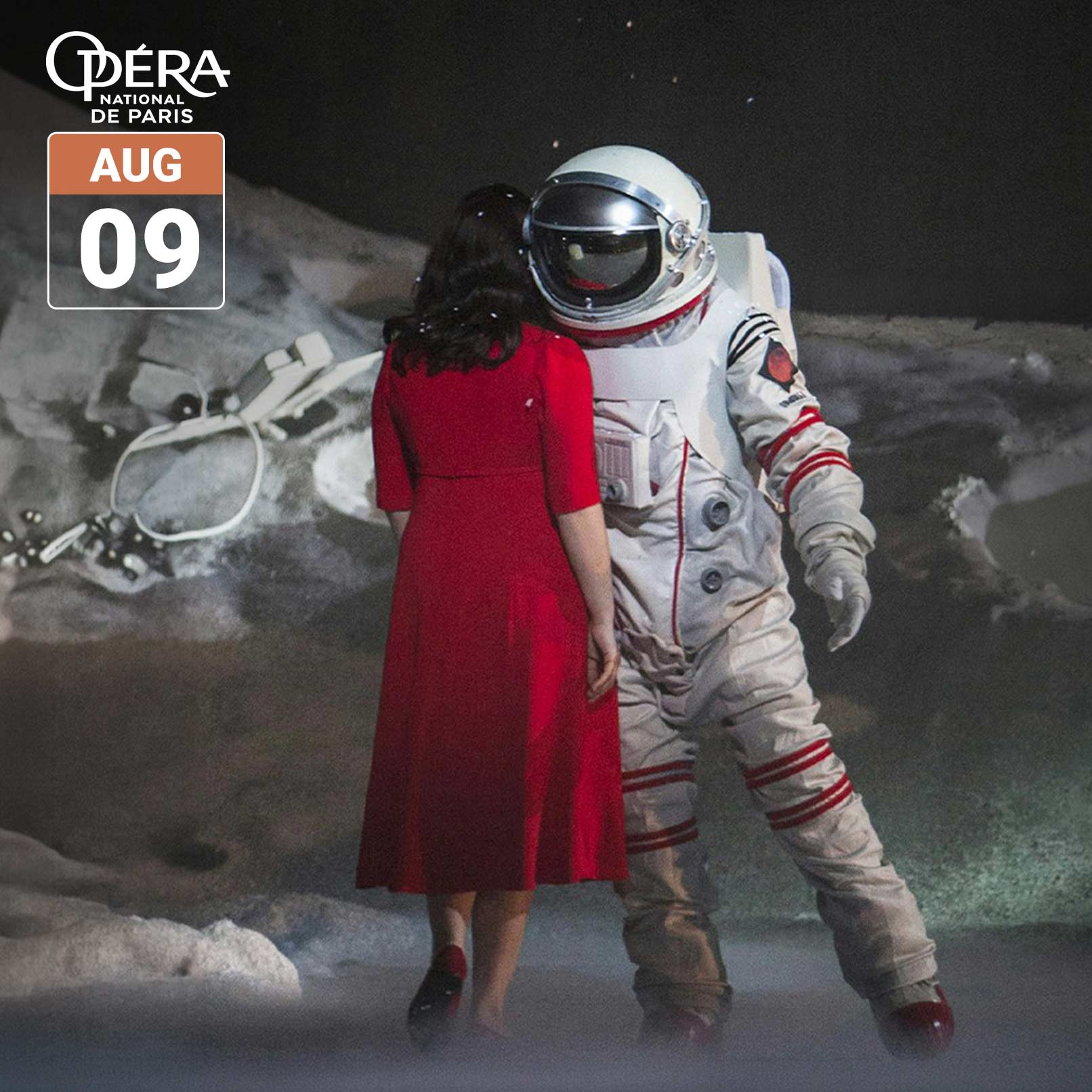
An opera in four scenes, Giacomo Puccini’s "La Bohème" draws on Henry Murger’s "Scenes of Bohemian Life" to tell the story of young artists living on the edge of poverty, hunger, and hope. Through the love between the poet Rodolfo and the fragile Mimì, Puccini gives us one of opera’s most moving portraits of youth, art, and heartbreak. In this Opéra national de Paris production, which is set in space in a distant future, director Claus Guth reimagines the drama in a hopeless future, where memory, love, and art become the characters’ final connection to life and transcendence.
Sunday, August 9, 2026 • 2:00pm
Paul O'Regan Hall • Halifax Central Library
Accessible Venue
Free Event • Online Registration
Ticket Availability: Excellent

Season Sponsor: NICE MOVES / Red Door Realty
Registration
Registration for this event will open soon.
Giacomo Puccini's "La Bohème"
Co-presented with Alliance Française Halifax, Halifax Public Libraries, and Opera de Paris
La Bohème is an opera in four scenes. The libretto adapts Murger’s Scenes of Bohemian Life, which appeared in serialized form in the Paris newspaper Le Corsaire between 1845 and 1849 and was soon staged in a dramatic version co-written with Théodore Barriere at the Théâtre des Variétés. As in the play, Puccini and his librettists, Giacosa and Illica, condensed two of Murger’s characters to create the fragile figure of Mimi, who, with her lover Rodolfo, stands at the centre of the drama. But beyond a picturesque group of characters—with the contrast between a “tragic” couple, Rodolfo/Mimi, and a “fantastical” couple, Marcello/Musetta—and a way of life that reminded him of his own conservatory years, the composer also wanted to portray a city through a thousand details and impressionistic touches. He succeeded: at the premiere, Debussy is said to have declared, “I know no one who has described the Paris of that period as well as Puccini in La Bohème.”
The ballet returned to the Palais Garnier in February and March 1987, March 2000, April 2005, and April 2007, and to the Opéra Bastille in November 2011.
On tour, “Cinderella” was presented in New York in 1987, in Los Angeles and Washington in 1988, and in Tokyo in 2010.
The opera was first performed on February 1, 1896 at the Teatro Regio in Turin, conducted by Arturo Toscanini, then twenty-eight years old. The Paris premiere, under the title La Vie de boheme and in Paul Ferrier’s French version, took place on June 13, 1898 at the Théâtre Lyrique de la Place du Châtelet, where the Opéra-Comique had taken refuge in 1887 after the fire at the Salle Favart.
The Plot
First Scene
Rodolfo, Marcello, Schaunard and Colline are together. The mood is gloomy. It is cold and there is nothing left to eat. Schaunard nevertheless finds a few scraps, and then, in a flood of words, they begin to recall memories of the good life. Having recovered their good humour, the four friends remember an evening spent in the Latin Quarter at their usual cafe. As they recall their former landlord, Benoit, he suddenly appears. They strike up a conversation with him, and then he disappears as suddenly as he came. Colline, Schaunard and Marcello leave Rodolfo alone for a moment. Mimi appears, shaken by a coughing fit. Their hands touch in the darkness. They draw closer. Rodolfo asks Mimi to stay with him.
Second Scene
Rodolfo and Marcello are overwhelmed by different sensory impressions: the crowd, the colours, the scents of the street. The atmosphere of the city invades the entire space. They find themselves in their usual cafe, with Mimi, Colline and Schaunard. In a euphoric mood, Rodolfo, very much in love with his Mimi, buys her a bonnet. Musetta, Marcello’s former lover, arrives with her new admirer Alcindoro. Marcello, captivated, cannot take his eyes from this vision. She makes Alcindoro pay the bill and returns to Marcello. An irritating military band passes by, drawing Rodolfo’s attention. Then the apparition disappears as if by enchantment.
Third Scene
Time has passed. Everything is overcome by cold, snow, emptiness and isolation. In the distance, customs officers can be heard inspecting peasants and milkmaids. One by one, the familiar characters appear. Mimi arrives and confides in Marcello: Rodolfo’s jealousy is making her life hell. Rodolfo in turn confides in Marcello and tells him the truth: Mimi has tuberculosis and is very ill. He can offer her only miserable living conditions; if they stayed together, she would die. Overwhelmed by grief, he decides to separate from her. The two lovers part, but the memory of happy days endures.
Fourth Scene
Once again, time has passed. Marcello and Rodolfo, trying to overcome their grief in order to go on living, are possessed by thoughts of love, women, good food and passionate life. Schaunard and Colline appear, and all of them enter into a grotesque game: they improvise, become excited, fight, then rise again to delight in a sumptuous meal. A bottle of water becomes champagne; a herring becomes an exquisite fish. Musetta then reappears with the dying Mimi. In sorrow, the others finally leave Rodolfo and Mimi alone. They remember their first meeting, the time of their happiness, and promise never to leave one another again. But Rodolfo must let Mimi go; he is alone.
Some Reflections on the Staging
Henry Murger’s novel Scenes of Bohemian Life, which provides the framework for Puccini’s opera, is made up of countless episodes that form less a complex narrative than a mosaic of colours, sounds and atmospheres, reflecting the spirit of a youth that wants nothing to do with obligations, feels free and independent, lives day by day in a kind of dream, and despises conventions. At the end of the novel, as an epilogue, the aging protagonists, having succeeded in life and settled into respectable existence, remember their youth as a distant dream.
This point of view lies at the heart of the opera: La Bohème is the memory of youth, of the feeling of being alive and taking pleasure in it. That is what nourishes the magic of “bohemian life,” deeply rooted in collective memory.
What if we looked at the work and the story from the same distance as the older protagonists of the novel? What if we went even further, allowing a great deal of time to pass? Not only has youth flown away, but the places have disappeared, and the people too. The famous Cafe Momus has long since vanished. Mimi is already dead and lives on only in Rodolfo’s memory. And yet the characters cling to this memory like a thread that still binds them to life. If we listen to La Bohème in this spirit, the images it evokes become entirely different.
Director Claus Guth places his four protagonists in a distant future, at the edge of their existence. At the threshold of death, they are besieged by memories: sometimes hallucinations in which desire becomes reality, sometimes cruel nightmares. The images that come to them are steeped in nostalgia, because their invocation is born from a profoundly melancholic impulse. What once was will never be again. A landscape of death stands in opposition to a landscape of life, to the vision of a bohemian Paris full of vitality.
-Yvonne Gebauer, Dramaturge
The Composer
Giacomo Puccini was born in Lucca in 1858. He came from a family of organists from Lucca; his father was a well-known theorist and teacher. In 1876, in Pisa, Puccini attended a performance of Verdi’s Aida, an experience that determined his vocation as a composer. He studied at the Milan Conservatory with, among others, Amilcare Ponchielli. On Ponchielli’s advice, he entered a composition competition launched by the publisher Sonzogno in 1883 for a one-act opera. Although he did not win the prize, Le Villi was premiered in Milan in 1884 with some success. The publisher Ricordi then commissioned a second opera, Edgar.
His third opera, Manon Lescaut, brought him recognition and initiated a fruitful collaboration with librettists Luigi Illica and Giuseppe Giacosa. Together, they wrote Puccini’s three great masterpieces: La Bohème (1896), Tosca (1900) and Madame Butterfly (1904). In 1910, La Fanciulla del West was premiered at the Metropolitan Opéra in New York. He then composed the lighter work La Rondine, which was not particularly successful at the Opéra de Monte-Carlo. Puccini’s activity slowed. A car accident left him lame for the rest of his life, and it was not until 1918 that Il Trittico (Il Tabarro, Suor Angelica and Gianni Schicchi) was premiered at the Metropolitan Opéra. He died in Brussels in 1924 from throat cancer. His final opera, Turandot, remained unfinished. The last two scenes were completed by Franco Alfano. When Toscanini premiered Turandot at La Scala in Milan on April 25, 1926, he laid down his baton at the very point where Puccini had stopped and turned to the audience: “Here the Maestro’s opera ends. He had reached this point when he died.” Puccini also wrote several religious works, including Salve regina and Messa di Gloria.
Often presented as one of the principal representatives of the verismo movement, which was an extension of naturalism in literature, Puccini nevertheless stands apart from it through the refinement of his musical writing.
Artist Information
Artistic Team
Musical Direction
Gustavo Dudamel; Manuel Lopez-Gomez
Staging
Claus Guth
Sets
Étienne Pluss
Costumes
Eva Dessecker
Lighting
Fabrice Kebour
Video
Arian Andiel
Choreography
Teresa Rotemberg
Dramaturgy
Yvonne Gebauer
Chorus Master
José Luis Basso
Orchestra and Chorus
Orchestra and Chorus of the Opéra national de Paris
Children’s Chorus
Maîtrise des Hauts-de-Seine / Children’s Chorus of the Opéra national de Paris
Cast
Mimì
Sonya Yoncheva, December 1–12; Nicole Car, December 16–31
Musetta
Aida Garifullina
Rodolfo
Atalla Ayan, December 1–16; Benjamin Bernheim, December 18–31
Marcello
Artur Ruciński
Schaunard
Alessio Arduini, December 1–21; Andrei Zhilikhovsky, December 23–31
Colline
Roberto Tagliavini
Alcindoro
Marc Labonnette
Parpignol
Antonel Boldan
Customs Sergeant
Florent Mbia
A Customs Officer
Jian-Hong Zhao
A Street Vendor
Fernando Velasquez
Location
Paul O'Regan Hall (Halifax Central Library)
5440 Spring Garden Road • Halifax, Nova Scotia • B3J 1E9
Frequently Asked Questions
Do I need to register for this screening?
This is a free event and registration is highly recommended and can be completed online on this page. Registering helps us track audience numbers and make sure we have enough space for everyone. It also allows us to send you a reminder before the screening.
How will I receive my registration confirmation?
After registering, you will receive a confirmation email at the email address used during registration. Please keep this confirmation handy on your phone or bring a printed copy with you when you arrive. If you do not receive your confirmation, please check your spam or junk folder, as registration emails are sometimes blocked or filtered by email providers. You may also wish to search your inbox for “Cecilia Concerts” or your event confirmation. If you still cannot find your confirmation, please contact the Cecilia Concerts office before the event and we’ll be happy to help. Rest assured, if you registered online, your name will also be on our guest list at the door.
What time should I arrive?
Doors open at 1:30pm, and the screening begins at 2:00pm. We recommend arriving a little early so you have time to check in, find a seat, and get settled before the screening begins.
How long is the screening?
The approximate running time is 1 hour and 59 minutes. There is no intermission.
Are there subtitles?
This opera features music by Giacomo Puccini sung in Italian with French subtitles. There are no English subtitles.
Can I arrive late?
Latecomers may enter quietly after the screening has begun, when possible. To avoid disruption to other audience members, we recommend arriving before the 2:00pm start time.
What is the seating like?
Paul O’Regan Hall has unassigned theatre-style seating. Seats are available on a first-come, first-served basis. If you require companion seating or have an accessibility-related seating need, please let us know when you arrive.
Are children welcome?
Yes, children are more than welcome. Please keep in mind that this is a full-length screening in a theatre-style setting. Families may wish to choose seats close to an exit in case a quick exit is needed during the screening.
Can I use my phone during the screening?
Please silence your phone before the screening begins. We ask that phones and bright screens not be used during the screening, as they can be distracting to other audience members.
Can I take photos or videos?
Photos are welcome before or after the screening. Unless otherwise announced, photography, audio recording, and video recording are not permitted during the screening.
What accessibility features are available?
Paul O’Regan Hall is wheelchair accessible and includes accessible washrooms, a ramp, and elevator access. Companion seating is available if required. If you have a specific accessibility question before attending, please contact us and we’ll be happy to help.
Is the venue scent-sensitive?
To help make the screening comfortable for everyone, we ask guests to avoid wearing strong scents or fragrances when possible.
Is there parking or public transit nearby?
Yes. Paid underground parking is available at Halifax Central Library along with side street parking. There is parking on-site for 50 bicycles. The venue is also located on major downtown Halifax Transit routes.