


SUMMER OPERA SCREENINGS
Giacomo Puccini's "Madame Butterfly"
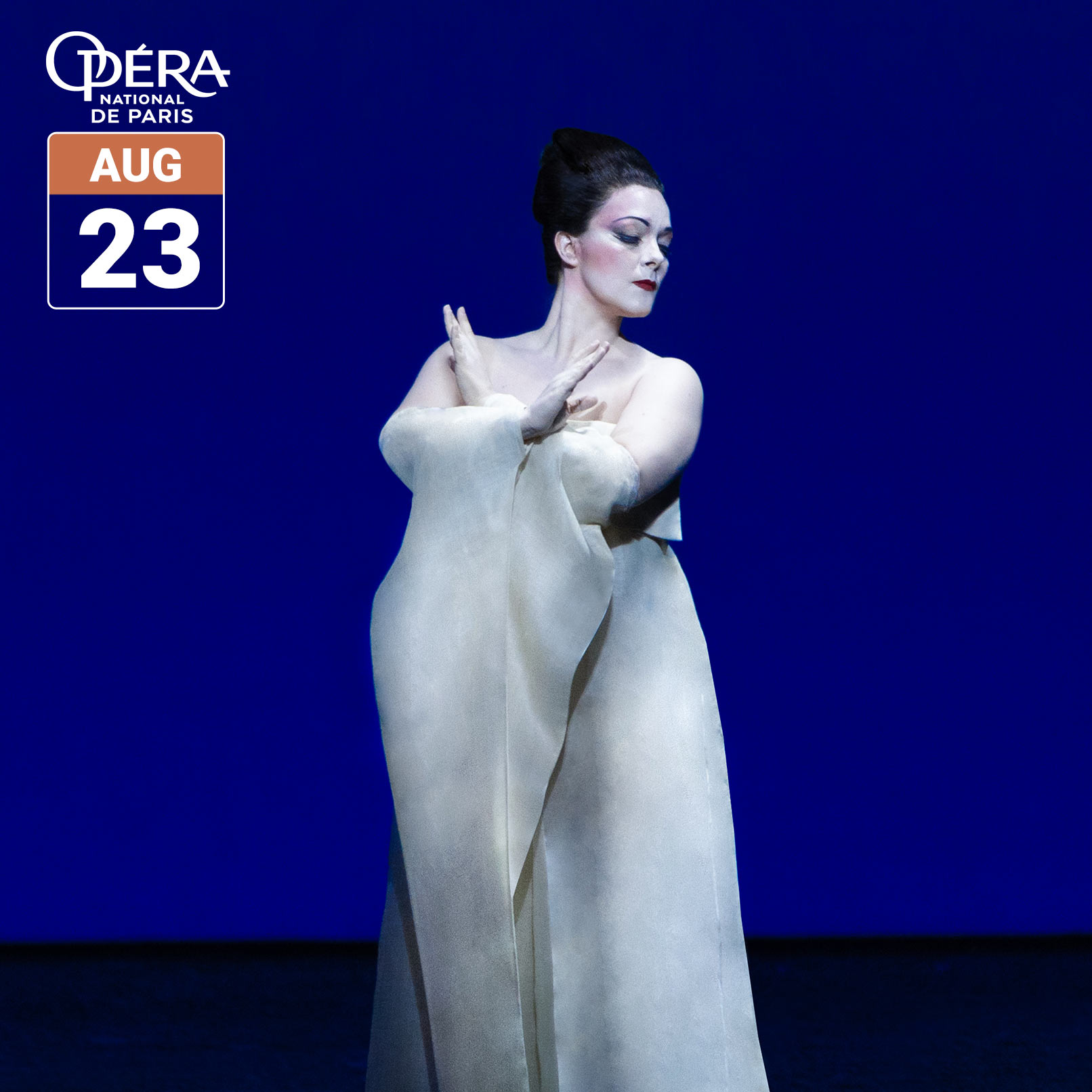
A Japanese tragedy in three acts, Giacomo Puccini’s "Madame Butterfly" tells the story of Cio-Cio-San, a young geisha who gives up her family and traditions for her love of the American naval officer Pinkerton, only to be abandoned. From this story of seduction, devotion, and betrayal, Puccini creates one of opera’s most emotionally powerful works, contrasting Pinkerton’s brutality with Butterfly’s fragile hope and ardent love. In this Opéra national de Paris production, director Robert Wilson moves away from traditional fans and cherry blossoms, using stylized movement, sculpted light, and a bare stage to let Puccini’s soaring melodic lines unfold with striking purity.
Sunday, August 23, 2026 • 2:00pm
Paul O'Regan Hall • Halifax Central Library
Accessible Venue
Free Event • Online Registration
Ticket Availability: Excellent

Season Sponsor: NICE MOVES / Red Door Realty
Registration
Registration for this event will open soon.
Giacomo Puccini's "Madame Butterfly"
Co-presented with Alliance Française Halifax, Halifax Public Libraries, and Opera de Paris
Poor Madame Butterfly! This young fifteen-year-old geisha has renounced her family and her Japanese traditions for love of an American lieutenant who abandons her.
From this classic theme of a woman seduced and abandoned, Giacomo Puccini creates an opera of lush orchestration and ardent lyricism. First performed in 1904 at La Scala in Milan, its score, nourished by Oriental colours, powerfully conveys the contrast between the brutality of the officer Pinkerton and the vulnerability of Butterfly, as fragile as the wings of a little butterfly.
For Robert Wilson, this Japanese tragedy becomes ideal ground for the expression of the formalism he embraces. Far from traditional fans or cherry blossoms, the director uses stylized acting and a bare space that allow the melodic lines to unfold in all their purity.
A coproduction of Opéra national de Paris and François Roussillon et Associés, with the participation of France Télévisions, with support from the Centre National du Cinéma et de l'image animée, the Fondation Orange, sponsor of the audiovisual broadcasts of the Opéra national de Paris, and Cercle POP. Filming date: September 28, 2024. Filming location: Opéra national de Paris / Opéra Bastille
The Plot
First Scene
The American Pinkerton is staying temporarily in Japan. To pass the time pleasantly until his departure, he plans to marry Cio-Cio-San, a young geisha who fascinates him. Goro, the marriage broker, has arranged everything. He presents Pinkerton with his future servants when the United States consul enters, the first guest at the wedding. Assuring Pinkerton that Cio-Cio-San takes their relationship very seriously, he advises him not to ruin the young girl’s life for a mere passing fancy.
The bride arrives, accompanied by five companions. Soon after, her relatives and friends arrive. Two officials declare Cio-Cio-San and Pinkerton joined in marriage.
The celebration is interrupted by Cio-Cio-San’s uncle, a bonze. He has learned that she has converted to Christianity; he banishes her from her family and society. The guests follow his example.
Now alone, Pinkerton and Cio-Cio-San confess their love and go to the bridal chamber.
Second Scene
Several years have passed. Pinkerton has long since returned to the United States. Cio-Cio-San has given birth to a son. Alone with him and her faithful servant Suzuki, she awaits her husband’s return.
The consul visits her. Pinkerton has written to him: he will soon return to Japan, accompanied by his American wife, and has asked the consul to prepare Cio-Cio-San for his arrival. But she constantly interrupts him and prevents him from giving her the news.
Yamadori, a wealthy prince, asks her to marry him. She refuses, considering herself legally married to Pinkerton.
The consul again tries to read her the letter. Cio-Cio-San understands only one thing: her husband is about to return to Japan. The consul loses patience: what if Pinkerton never came back? Cio-Cio-San is struck as if mortally wounded.
At nightfall, a cannon shot announces the arrival of Pinkerton’s ship. Wild with joy, Cio-Cio-San decorates the house with flowers and waits all night for him to come.
The next day, Pinkerton arrives at Cio-Cio-San’s home with his American wife to ask for his child, but he avoids meeting her. Alone, his two wives face each other. Finally understanding the situation, Cio-Cio-San takes her own life.
The Composer
Giacomo Puccini was born in Lucca in 1858. He came from a family of organists from Lucca; his father was a well-known theorist and teacher. In 1876, in Pisa, Puccini attended a performance of Verdi’s Aida, an experience that determined his vocation as a composer. He studied at the Milan Conservatory with, among others, Amilcare Ponchielli. On Ponchielli’s advice, he entered a composition competition launched by the publisher Sonzogno in 1883 for a one-act opera. Although he did not win the prize, Le Villi was premiered in Milan in 1884 with some success. The publisher Ricordi then commissioned a second opera, Edgar.
His third opera, Manon Lescaut, brought him recognition and initiated a fruitful collaboration with librettists Luigi Illica and Giuseppe Giacosa. Together, they wrote Puccini’s three great masterpieces: La Bohème (1896), Tosca (1900) and Madame Butterfly (1904). In 1910, La Fanciulla del West was premiered at the Metropolitan Opéra in New York. He then composed the lighter work La Rondine, which was not particularly successful at the Opéra de Monte-Carlo. Puccini’s activity slowed. A car accident left him lame for the rest of his life, and it was not until 1918 that Il Trittico (Il Tabarro, Suor Angelica and Gianni Schicchi) was premiered at the Metropolitan Opéra. He died in Brussels in 1924 from throat cancer. His final opera, Turandot, remained unfinished. The last two scenes were completed by Franco Alfano. When Toscanini premiered Turandot at La Scala in Milan on April 25, 1926, he laid down his baton at the very point where Puccini had stopped and turned to the audience: “Here the Maestro’s opera ends. He had reached this point when he died.” Puccini also wrote several religious works, including Salve regina and Messa di Gloria.
Often presented as one of the principal representatives of the verismo movement, which was an extension of naturalism in literature, Puccini nevertheless stands apart from it through the refinement of his musical writing.
Artist Information
Artistic Team
Musical Direction
Speranza Scappucci
Staging and Sets
Robert Wilson
Co-Director
Giuseppe Frigeni
Costumes
Frida Parmeggiani
Lighting
Heinrich Brunke; Robert Wilson
Lighting recreated by
A.J. Weissbard
Choreography
Suzushi Hanayagi
Dramaturgy
Holm Keller
Chorus Master
Alessandro Di Stefano
Cast
Cio-Cio-San (Madame Butterfly)
Eleonora Buratto
Suzuki
Aude Extrémo
B.F. Pinkerton
Stefan Pop
Sharpless
Christopher Maltman
Goro
Carlo Bosi
Prince Yamadori
Andres Cascante
Uncle Bonze
Vartan Gabrielian
Kate Pinkerton
Sofia Anisimova
Yakusidè
Young-Woo Kim
Imperial Commissioner
Bernard Arrieta
Registrar
Hyunsik Zee
Cio-Cio-San’s Mother
Marianne Chandelier
Aunt
Liliana Faraon
Cousin
Stéphanie Loris
Child
Daniel Hernandez Sanchez
Orchestra and Chorus
Orchestra and Chorus of the Opéra national de Paris
Location
Paul O'Regan Hall (Halifax Central Library)
5440 Spring Garden Road • Halifax, Nova Scotia • B3J 1E9
Frequently Asked Questions
Do I need to register for this screening?
This is a free event and registration is highly recommended and can be completed online on this page. Registering helps us track audience numbers and make sure we have enough space for everyone. It also allows us to send you a reminder before the screening.
How will I receive my registration confirmation?
After registering, you will receive a confirmation email at the email address used during registration. Please keep this confirmation handy on your phone or bring a printed copy with you when you arrive. If you do not receive your confirmation, please check your spam or junk folder, as registration emails are sometimes blocked or filtered by email providers. You may also wish to search your inbox for “Cecilia Concerts” or your event confirmation. If you still cannot find your confirmation, please contact the Cecilia Concerts office before the event and we’ll be happy to help. Rest assured, if you registered online, your name will also be on our guest list at the door.
What time should I arrive?
Doors open at 1:30pm, and the screening begins at 2:00pm. We recommend arriving a little early so you have time to check in, find a seat, and get settled before the screening begins.
How long is the screening?
The approximate running time is 2 hours and 30 minutes. There is no intermission.
Are there subtitles?
This opera features music by Giacomo Puccini sung in Italian with French subtitles. There are no English subtitles.
Can I arrive late?
Latecomers may enter quietly after the screening has begun, when possible. To avoid disruption to other audience members, we recommend arriving before the 2:00pm start time.
What is the seating like?
Paul O’Regan Hall has unassigned theatre-style seating. Seats are available on a first-come, first-served basis. If you require companion seating or have an accessibility-related seating need, please let us know when you arrive.
Are children welcome?
Yes, children are more than welcome. Please keep in mind that this is a full-length screening in a theatre-style setting. Families may wish to choose seats close to an exit in case a quick exit is needed during the screening.
Can I use my phone during the screening?
Please silence your phone before the screening begins. We ask that phones and bright screens not be used during the screening, as they can be distracting to other audience members.
Can I take photos or videos?
Photos are welcome before or after the screening. Unless otherwise announced, photography, audio recording, and video recording are not permitted during the screening.
What accessibility features are available?
Paul O’Regan Hall is wheelchair accessible and includes accessible washrooms, a ramp, and elevator access. Companion seating is available if required. If you have a specific accessibility question before attending, please contact us and we’ll be happy to help.
Is the venue scent-sensitive?
To help make the screening comfortable for everyone, we ask guests to avoid wearing strong scents or fragrances when possible.
Is there parking or public transit nearby?
Yes. Paid underground parking is available at Halifax Central Library along with side street parking. There is parking on-site for 50 bicycles. The venue is also located on major downtown Halifax Transit routes.