


MAIN STAGE CONCERTS
France's Trio Hélios: Beethoven, Rachmaninoff, and Shostakovich
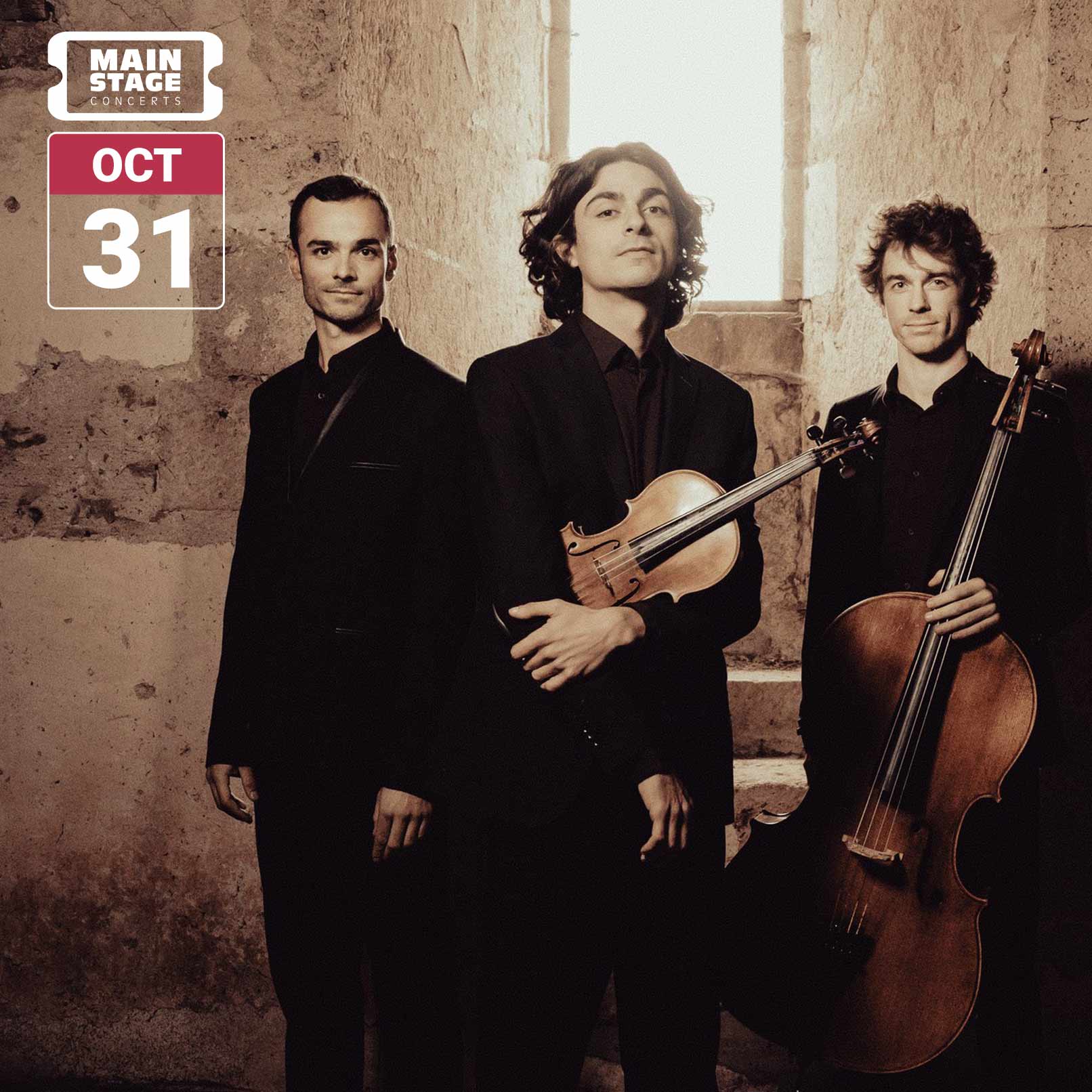
France’s Trio Hélios, featuring cellist Raphaël Jouan, pianist Alexis Gournel, and violinist Luka Ispir, brings its refinement and intensity to a powerful program of piano trios by Beethoven, Rachmaninoff, and Shostakovich.
Saturday, October 31, 2026 • 7:30pm
Stage at St. Andrews (Halifax United Church)
Accessible Venue
Ticket Availability: Good
This performance is made possible with the generous support of John Himmelman.
Co-presented with Alliance Française Halifax with additional support from SPEDIDAM. Season Sponsor: NICE MOVES / Red Door Realty.

Program Information
France’s Trio Hélios, featuring cellist Raphaël Jouan, pianist Alexis Gournel, and violinist Luka Ispir, is known for playing marked by refinement, intensity, and a strong commitment to the piano trio repertoire. The ensemble has appeared at major venues including the Philharmonie de Paris, Salle Cortot, Wigmore Hall, the Lyon Opera House, and Phoenix Hall in Osaka, as well as at leading festivals across Europe and beyond. Their Halifax program brings together three striking works for piano trio. Beethoven’s Piano Trio in D major, Op. 70, No. 1, the “Ghost,” takes its famous nickname from the haunting atmosphere of its slow movement. Rachmaninoff’s youthful Trio élégiaque No. 1 in G minor, written when the composer was just 18, unfolds in a single deeply expressive movement. Shostakovich’s Piano Trio No. 2 in E minor, Op. 67, written during the Second World War and dedicated to the memory of his close friend Ivan Sollertinsky, moves from its eerie opening through moments of fierce energy to an unforgettable finale. Trio Hélios has earned numerous international prizes and acclaim for recordings including “D’un matin de printemps” and “Bohemia,” the latter receiving a CHOC Classica. The trio is in residence at the Fondation Singer-Polignac and continues to build an international presence on today’s chamber music stage.
Program Notes
Ludwig van Beethoven (1770–1827)
Piano Trio No. 5 in D major, Op. 70, No. 1, “Ghost”
I. Allegro vivace e con brio
II. Largo assai ed espressivo
III. Presto
Why is Piano Trio No. 5 called “The Ghost”? There are two competing explanations. The first is that during the time that Beethoven composed the Trio, he was also exploring the possibility of composing an opera based on Shakespeare’s Macbeth, and the sketches that he made for the scenes featuring the three witches found their way into the slow middle movement of the Trio. The second is that Beethoven’s student, Carl Czerny, gave it the title because the second movement reminded him of the Ghost of Hamlet’s father as he appears in the opening scene of Shakespeare’s play. Either way, the title has stuck. It is appropriate; the Trio has a Shakespearean scope and grandeur. The ghostly middle movement is introduced with an eerie, sustained three notes in the strings, after which the piano responds mournfully. The strings and piano alternate this way through the introduction, thereby setting an ominous mood. There is a tension, even a sense of terror or dread, built up throughout the movement that overwhelms its brief moments of noble courage.
The first and third movements provide a polar opposite to the central Largo in terms of mood. They are both full of sweeping, exuberant grandeur with pianistic pyrotechnics. The Trio was composed in 1808, during the decade (from 1802 to 1812) termed Beethoven’s middle period. During the decade, Beethoven was coming to grips with his increasing deafness. The music written during these years is notable, not surprisingly, for its expression of heroism and struggle, as well as its monumental scale. By the end of the decade, he had moved away from the Classical models found in the works of Haydn and Mozart which had served as guides in his earlier writing. There was a new grandeur in terms of their innovation as well as in their length and intensity.
Intermission
Sergei Rachmaninoff (1873–1943)
Trio élégiaque No. 1 in G minor)
Sergei Rachmaninoff was born into the Russian aristocracy on one of his father’s estates. There was music on both sides of his family and he began to study piano with his mother as a four year old. He showed such promise that the family engaged a recent graduate of the St. Petersburg Conservatory to live with the family and tutor young Sergei in his music studies. When the family fortunes declined due to Rachmaninoff’s father’s financial incompetence, the family moved to an apartment in St. Petersburg, and ten year old Sergei entered the Conservatory there. He was not a good student; he frequently played truant, failed some courses and altered the grades on his report card. So at age twelve, his family transferred him to the Moscow Conservatory where he studied for the next seven years under stricter circumstances and with much greater success. While he was still in St. Petersburg, Rachmaninoff’s elder sister, Yelena, had introduced him to the music of Pyotr Ilyich Tchaikovsky. This music was to become a lifelong influence. It may have intensified when, in 1892, Tchaikovsky attended a performance of a one-act opera, Aleko, which Rachmaninoff had written as a composition project, and praised the young student for his work.
Rachmaninoff wrote two elegiac trios while at the Moscow Conservatory. The second, composed in late 1893, is clearly a tribute written to mourn the death of Tchaikovsky, the composer that Rachmaninoff saw as a mentor. Trio élégiaque No. 1, composed in January 1892, is a tribute in another way. It is cast in a single long movement, with pronounced similarities to the first movement of Tchaikovsky’s Piano Trio in A minor, composed in 1882. Tchaikovsky’s long first movement was called “Pezzo elegiaco” (Elegiac Piece), and like it, Rachmaninoff’s Trio élégiaque ends with a funeral march. There are other points of reference to Tchaikovsky, but the Trio’s powerful sweep, along an arc of growing animation before the sombre close, is pure Rachmaninoff.
Dmitri Shostakovich (1906–1975)
Piano Trio No. 2 in E minor, Op. 67
I. Andante – Moderato
II. Allegro con brio
III. Largo
IV. Allegretto – Adagio
In 1921, a young Dmitri Shostakovich, an aspiring pianist who had already had several compositions performed, met the nineteen year old Ivan Sollertinsky at the Petrograd Conservatory. Their friendship lasted for more than twenty years. Shostakovich later said that Sollertinsky “taught [him] to understand and love such great masters as Brahms, Mahler and Bruckner” and that he instilled in him “an interest in music … from Bach to Offenbach.” Throughout his career, Shostakovich ran in and out of favour with the Soviet authorities. During one period of denunciation during the late 1930s, fearful of arrest, he waited on the landing of his apartment each night so that when soldiers came to arrest him, they would not disturb his family. In 1936, a composers’ meeting was called in Leningrad to denounce Shostakovich’s opera Lady Macbeth of Mtsensk. Sollertinsky showed up, rose to his feet and rather than denouncing it, praised the opera instead. Two others, seeing his example, followed suit.
It is also worth noting that Sollertinsky’s last public appearance was to introduce the premiere of Shostakovich’s Eighth Symphony in Moscow. Sollertinsky died in February of 1944. Shostakovich dedicated his Piano Trio No. 2, Op. 67 (started December 1943) to his memory.
The opening movement has a neoclassical feel. The slow introduction leads to a brisker moderato section which reaches a climax before returning to a quiet close. The lively second movement, according to Sollertinsky’s sister, Ekaterina Ivanovna, appears to be “an amazingly exact portrait” of its dedicatee, while the third movement, in Passacaglia form, is a solemn dirge; the grief is palpable. The passionate fourth movement, the most famous, uses klezmer-inspired themes, a possible reference to the victims of the Holocaust, as news of the genocide was just reaching the Soviet Union at the time. The Trio was premiered in November of 1944, with Shostakovich at the piano.
Program notes written by Larry Bent
Renseignements sur le programme
Le Trio Hélios, ensemble français formé du violoncelliste Raphaël Jouan, du pianiste Alexis Gournel et du violoniste Luka Ispir, est reconnu pour son jeu raffiné et intense, ainsi que pour son engagement profond envers le répertoire pour trio avec piano. L’ensemble s’est produit dans de grandes salles, notamment à la Philharmonie de Paris, à la Salle Cortot, au Wigmore Hall, à l’Opéra de Lyon et au Phoenix Hall d’Osaka, ainsi que dans d’importants festivals en Europe et ailleurs dans le monde. Son programme à Halifax réunit trois œuvres marquantes pour trio avec piano. Le Trio avec piano no 5 en ré majeur, op. 70, no 1, « Les Esprits », de Beethoven, doit son célèbre surnom à l’atmosphère envoûtante de son mouvement lent. Le jeune Rachmaninoff n’avait que 18 ans lorsqu’il composa son Trio élégiaque no 1 en sol mineur, une œuvre profondément expressive en un seul mouvement. Le Trio avec piano no 2 en mi mineur, op. 67, de Chostakovitch, composé pendant la Seconde Guerre mondiale et dédié à la mémoire de son ami proche Ivan Sollertinski, nous mène de son ouverture inquiétante à un finale inoubliable, en passant par des moments d’une énergie saisissante. Le Trio Hélios a remporté de nombreux prix internationaux et ses enregistrements, dont « D’un matin de printemps » et « Bohemia », ont été salués par la critique, ce dernier ayant reçu un CHOC de Classica. Le trio est en résidence à la Fondation Singer-Polignac et poursuit son rayonnement international sur la scène actuelle de la musique de chambre.
Notes de programme
Ludwig van Beethoven (1770–1827)
Trio avec piano no 5 en ré majeur, op. 70, no 1, « Les Esprits »
I. Allegro vivace e con brio
II. Largo assai ed espressivo
III. Presto
Pourquoi le Trio avec piano no 5 est-il surnommé « Les Esprits »? Deux explications s’opposent. La première veut qu’au moment où Beethoven composait ce trio, il envisageait également de composer un opéra inspiré de Macbeth de Shakespeare. Les esquisses qu’il réalisa pour les scènes mettant en vedette les trois sorcières se seraient ainsi retrouvées dans le mouvement lent central du trio. Selon la seconde explication, c’est Carl Czerny, élève de Beethoven, qui lui aurait donné ce titre parce que le deuxième mouvement lui rappelait le spectre du père d’Hamlet tel qu’il apparaît dans la scène d’ouverture de la pièce de Shakespeare. Quelle que soit l’origine du surnom, celui-ci est resté. Il convient bien à l’œuvre, dont l’ampleur et la grandeur évoquent l’univers shakespearien. Le mouvement central, au caractère fantomatique, s’ouvre sur trois notes inquiétantes et soutenues aux cordes, auxquelles le piano répond d’un ton plaintif. Les cordes et le piano alternent ainsi tout au long de l’introduction, créant une atmosphère menaçante. Une tension, voire un sentiment de terreur ou d’effroi, s’intensifie au fil du mouvement et finit par submerger ses brefs moments de noble courage.
Par leur caractère, les premier et troisième mouvements sont aux antipodes du Largo central. Tous deux débordent d’une grandeur ample et exubérante, ponctuée de prouesses pianistiques. Le trio fut composé en 1808, au cours de la décennie allant de 1802 à 1812, généralement considérée comme la période médiane de Beethoven. Durant ces années, Beethoven devait composer avec une surdité de plus en plus prononcée. La musique écrite à cette époque se distingue, sans surprise, par l’expression de l’héroïsme et de la lutte, ainsi que par son ampleur monumentale. À la fin de cette décennie, Beethoven s’était éloigné des modèles classiques que lui avaient offerts les œuvres de Haydn et de Mozart et qui avaient guidé ses premières compositions. Ses œuvres acquéraient une nouvelle grandeur, tant par leur caractère novateur que par leur durée et leur intensité.
Entracte
Sergei Rachmaninoff (1873–1943)
Trio élégiaque no 1 en sol mineur
Sergei Rachmaninoff est né au sein de l’aristocratie russe, dans l’un des domaines de son père. La musique occupait une place importante dans les deux branches de sa famille et il commença l’étude du piano avec sa mère à l’âge de quatre ans. Ses dons étaient tels que sa famille engagea une jeune diplômée du Conservatoire de Saint-Pétersbourg pour vivre auprès d’elle et assurer la formation musicale du jeune Sergei. Lorsque la fortune familiale déclina en raison de la mauvaise gestion financière de son père, la famille s’installa dans un appartement à Saint-Pétersbourg et Sergei, alors âgé de dix ans, entra au Conservatoire de la ville. Il n’était pas un bon élève : il faisait souvent l’école buissonnière, échouait à certains cours et modifiait les notes de son bulletin. À l’âge de douze ans, sa famille le transféra donc au Conservatoire de Moscou, où il étudia pendant les sept années suivantes dans un cadre plus strict et avec beaucoup plus de succès. Alors qu’il vivait encore à Saint-Pétersbourg, sa sœur aînée, Yelena, lui avait fait découvrir la musique de Piotr Ilitch Tchaïkovski. Cette musique allait exercer sur lui une influence durable. Celle-ci s’est peut-être renforcée en 1892, lorsque Tchaïkovski assista à une représentation d’Aleko, opéra en un acte que Rachmaninoff avait composé dans le cadre de ses études, et félicita le jeune étudiant pour son travail.
Rachmaninoff composa deux trios élégiaques pendant ses années au Conservatoire de Moscou. Le second, composé à la fin de 1893, est manifestement un hommage à Tchaïkovski, dont Rachmaninoff pleurait la mort et qu’il considérait comme un mentor. Le Trio élégiaque no 1, composé en janvier 1892, constitue un hommage d’une autre nature. L’œuvre se déploie en un seul long mouvement et présente des ressemblances marquées avec le premier mouvement du Trio avec piano en la mineur de Tchaïkovski, composé en 1882. Le long premier mouvement de Tchaïkovski portait le titre « Pezzo elegiaco » (« Pièce élégiaque ») et, comme celui-ci, le Trio élégiaque de Rachmaninoff se termine par une marche funèbre. On y trouve d’autres références à Tchaïkovski, mais l’élan puissant de l’œuvre, qui suit une courbe d’animation croissante avant sa sombre conclusion, est du pur Rachmaninoff.
Dmitri Chostakovitch (1906–1975)
Trio avec piano no 2 en mi mineur, op. 67
I. Andante – Moderato
II. Allegro con brio
III. Largo
IV. Allegretto – Adagio
En 1921, le jeune Dmitri Chostakovitch, pianiste en devenir dont plusieurs compositions avaient déjà été interprétées, rencontra Ivan Sollertinski, alors âgé de 19 ans, au Conservatoire de Petrograd. Leur amitié dura plus de 20 ans. Chostakovitch dira plus tard que Sollertinski lui avait « appris à comprendre et à aimer de grands maîtres tels que Brahms, Mahler et Bruckner » et qu’il avait éveillé chez lui « un intérêt pour la musique […] de Bach à Offenbach ». Tout au long de sa carrière, Chostakovitch connut tour à tour les faveurs et la disgrâce des autorités soviétiques. Au cours d’une période de dénonciation, à la fin des années 1930, craignant d’être arrêté, il attendait chaque nuit sur le palier de son appartement afin que, si des soldats venaient l’arrêter, ils ne réveillent pas sa famille. En 1936, une réunion de compositeurs fut convoquée à Leningrad afin de dénoncer l’opéra Lady Macbeth de Mtsensk de Chostakovitch. Sollertinski s’y présenta, se leva et, plutôt que de condamner l’œuvre, en fit l’éloge. Deux autres personnes, suivant son exemple, firent de même.
Il convient également de souligner que la dernière apparition publique de Sollertinski fut à l’occasion de la création à Moscou de la Huitième Symphonie de Chostakovitch, qu’il présenta au public. Sollertinski mourut en février 1944. Chostakovitch dédia à sa mémoire son Trio avec piano no 2, op. 67, dont il avait entrepris la composition en décembre 1943.
Le premier mouvement présente un caractère néoclassique. La lente introduction mène à une section Moderato plus vive, qui atteint un sommet avant de revenir à une conclusion paisible. Selon Ekaterina Ivanovna, sœur de Sollertinski, le deuxième mouvement, animé, constitue « un portrait d’une exactitude étonnante » du dédicataire, tandis que le troisième mouvement, construit sous forme de passacaille, est une marche funèbre solennelle où le chagrin est palpable. Le quatrième mouvement, passionné et le plus célèbre de l’œuvre, fait appel à des thèmes d’inspiration klezmer, possiblement en référence aux victimes de l’Holocauste, alors que les nouvelles du génocide commençaient à parvenir en Union soviétique. Le Trio fut créé en novembre 1944, avec Chostakovitch au piano.
Notes de programme rédigées par Larry Bent
Artist Biographies
Luka Ispir, violin
Supported by the Rotary Club, the Gautier Capuçon Foundation, and the Safran Foundation, Luka Ispir is a laureate of several international competitions: 1st prize at the Rotary Club Soloist Prize, 3rd prize at the Moroccan Philharmonic Orchestra Competition, Grand Prize from the Safran Foundation, 2nd prize and two special prizes at the Vittorio Veneto International Competition…
At the age of 5, he began playing the violin at the Rouen Regional Conservatory. After two years at the Boulogne-Billancourt Regional Conservatory with Christophe Poiget, he was admitted at the age of 16 to the Paris National Conservatory of Music and Dance under Olivier Charlier. He continued his musical studies at the Hanns Eisler School in Berlin in Stephan Picard's class before furthering his training as an Artist in Residence at the Queen Elisabeth Music Chapel with Augustin Dumay, pursuing a Master's degree at the Lausanne University of Music with Renaud Capuçon, and completing advanced studies at the Perosi Academy with Silvia Marcovici.
In 2025, he joined the Trio Hélios, with whom he has performed at numerous festivals in France and abroad. He also participated in the creation of the Trio Philia between 2017 and 2020. Luka is regularly invited as a soloist and has performed with the Normandy Orchestra, the Appassionato Orchestra, the Bilkent Symphony Orchestra, the New Europe Orchestra, the Moroccan Philharmonic Orchestra, the Nouvelles Portées Ensemble, the Orchestra of the Accademia di La Scala in Milan, the Hagen Philharmonic Orchestra, and the Le Havre Symphony Orchestra. He has also been invited to perform at the Jaroussky Academy, the Kronberg Academy, the Auvers-sur-Oise Festival, the Salle Cortot Chamber Music Center in Paris, the Pablo Casals Festival, the Menuhin Festival, the Ravel Festival, the Evian Musical Encounters, the Opus Amadeus Festival, the Giverny Festival, and the Hague Festival.
Luka Ispir is a laureate of the Gautier Capuçon Foundation, thanks to which he recorded a duo album with his cellist brother, Léo Ispir, on the Warner Classics/Erato label. In January 2025, the Ispir brothers also recorded an album accompanied by the ORF Radio Symphony Orchestra Vienna, conducted by Howard Griffiths on the Berlin Classics label.
Luka Ispir plays a violin by the luthier Pressenda, generously loaned by the Michael Guttman Collection.
Raphaël Jouan, cello
Raphaël Jouan is a young cellist motivated by his love of sharing music. His style is characterised by his curiosity and openness : he is interested in varying repertoires, styles, and music groups. In 2018 he is nominated “Révélation Classique de l’Adami”.
He regularly gives concerts in prestigious concert halls (Philharmonie de Paris, Xinghai Concert Hall, Arsenal of Metz, Lyon Opera House, Wigmore Hall…), on the radio (France Musique), and during various festivals in France and abroad (les Folles Journées de Nantes, Varsovie, Tokyo, Le Festival des Arcs, la Roque d’Anthéron, Via Aeterna, les Rencontres Musicales d’Evian, le Festival Pablo Casals, the YMCG Festival…). He often share the stage with partners like pianist Flore Merlin, accordionist Bruno Maurice, and cellist Thibaut Reznicek.
Passionate about chamber music, Raphaël is a founding member of the Helios Trio with Luka Ispir (violin) and Alexis Gournel (piano). They won several prizes in various International Competitions (Illzach, Bellan, Lyon Chamber Music Competition, Joseph Joachim, Trondheim…). Their first album “D’un matin de printemps” is released in April 2021 for the label Mirare, with trios of St Saëns, Ravel and Lili Boulanger. Their second CD is called “Bohemia”, it presents czech composers Smetana, Novàk & Fibich and won a CHOC de Classica award. They are represented by the Claire Laballery Agency and are “Ensemble en résidence” at the Singer Polignac Foundation.
Over the years, Raphaël has become more interested about improvisation and world music. He has worked with some of the best jazz cellists and world music artists (Vincent Ségal, Mike Block, Stephan Braun and several members of the “Silk Road Ensemble”) in Germany, China and at the Global Musician Workshop in the US. He has played in several jazz clubs and festivals in France (Sunset-Sunside, Café de la Danse, Festival Jazz Contreband…)
Raphaël first completed his grades at the Metz conservatoire with Jean Adolphe, before continuing at Boulogne Billancourt where he studied under Xavier Gagnepain. He then entered in the Conservatoire Supérieur de Paris (CNSM) where he got his master degree in 2017 in the class of Michel Strauss and Guillaume Paoletti. He also studied piano with Zhu Xiao-Mei, the baroque cello with Bruno Cocset, and has been advised during master classes and academies by Gary Hoffman, Jérôme Pernoo, Jean-Guihen Queyras, Gustav Rivinius, Jens Peter Maintz, Lynn Harell, Yo-Yo Ma…
In 2017, Raphaël has been selected for the prestigious Classe d’Excellence de Violoncelle of Gautier Capuçon at the Louis Vuitton Fondation. He then finished his studies in the Artist Diploma Degree at the Paris Conservatoire and in the Soloist Master Program of the UdK in Berlin with Danjulo Ishizaka.
Raphaël plays an exceptionnal cello of Matteo Goffriller (Venise, 1700-1710), previously in the possession of Antonio Meneses, and a bow Lamy Fils, both graciously provided by the company CANIMEX INC., from Drummondville (Quebec), Canada.
His first CD, “Sérénade” (Initiale), with the pianist Flore Merlin, was released in 2020 and was critically acclaimed (Diapason, Classica, Pizzicato Award, ICMA nomination...). In 2025 he is recording a new CD for La Dolce Volta, playing as a soloist with the Orchestre National de Metz (dir. David Reiland).
Alexis Gournel, piano
Renowned for his refinement as a chamber musician, Alexis Gournel performs regularly in some of the world’s most prestigious venues, including the Salle Cortot, the Philharmonie de Paris, Wigmore Hall, and the Tokyo International Forum, as well as festivals such as La Folle Journée, the International Piano Festival of La Roque d’Anthéron, the Easter Festival of Aix-en-Provence, La Grange de Meslay, and the Rencontres Musicales d’Évian.
Founding member of the Trio Hélios in 2014, with whom he pursues an international career, he is also the pianist of the Acte Six Ensemble, contributing actively to the creation of innovative and original artistic projects. His discography includes several acclaimed recordings for Oktav Records, notably the double album Un lieu à soi (Diapason d’Or, Choc Classica), devoted to twentieth-century English music, and the triple album Musiques interdites (Diapason d’Or, 4T Télérama), which revisits works censored under the Third Reich. He has also recorded La Follia Nuova with saxophonist Antonio Garcia Jorge for IBS Classical, as well as a french mélodies album, Voir le jour, with mezzo-soprano Anaïs Bertrand for Oktav Records.
Born in Normandy, Alexis Gournel began his musical training at the Conservatoire of Caen before entering the class of Hortense Cartier-Bresson at the Conservatoire National Supérieur de Musique de Paris (CNSMDP). Holding three master’s degrees—in piano performance, chamber music, and pedagogy—he further refined his artistry through masterclasses with Zhu Xiao-Mei, Bruno Rigutto, François-René Duchâble, and Pascal Devoyon. Deeply committed to contemporary creation, he collaborates regularly with composers such as Kaija Saariaho, Nicolas Bacri, Fabien Touchard, and Tristan Murail.
About Trio Hélios
Surrounded by Chamber Music since their youngest age, Luka Ispir (violin), Raphaël Jouan (cello) and Alexis Gournel (piano) have been exploring with passion the gorgeous repertoire for piano trio.
After meeting at the Conservatoire National Supérieur in Paris, they founded the Hélios Trio in 2014. They have had the opportunity to play in different venues such as the Philharmonie de Paris, Wigmore Hall, Salle Cortot, the Phoenix Hall in Osaka... They are regularly invited to numerous festivals such as the Festival de la Roque d'Anthéron, the "Folles Journées" (Nantes, Tokyo, and Warsaw), Festival Pablo Casals in Prades, Rencontres Musicales d'Evian, Choriner Musiksommer Festival, Cecilia Concerts, Festival d'Auvers-sur-Oise… They have toured in many countries (Japan, China, Morocco, Canada, Spain, Germany, Poland, etc.). and have been broadcasted on medias such as Medici.tv and radios France Musique, Radio Classique, Musiq3 (Belgium), Kulturhaus Radio (Austria)…
Since 2016, the trio had the opportunity to perform Beethoven’s Triple Concerto several times in Paris, Rennes, Lyon and Metz, as well as during a tour in Northern Germany with the Philharmonisches Orchester Vorpommern.
Over the past years, they have gained visibility through several international prizes such as their 2nd Prize at the Lyon International Chamber Music Competition in 2018, as well as their Special Prize at the Liszt Competition and 2nd Prize at the Trondheim International Chamber Music Competition in 2019, and the KammerMusik Preis (2018), Klavierkammermusik Preis and Wiener Klassik Preis (2019) at the Isa Festival in Reichenau, Austria. In 2024, they were awarded the Kammermusikpreis Hasselburg by the Stahlberg Foundation.
Their first CD “D’un matin de printemps” was released in 2021 with the label Mirare. With an all french program (Ravel, Saint-Saêns, Boulanger), the album was critically acclaimed, and in 2023 the Trio released their second album “Bohemia”. This time with a czech program (Smetana, Novàk, Fibich) they have been awarded the CHOC Classica.
They studied at the CNSMD of Paris (Bachelor & Master’s degree then Artist Diploma) and are ECMA alumnis (European Chamber Music Academy). They have received the teachings of Johannes Meissl, Patrick Jüdt, Trio Wanderer, Hatto Beyerle, Avedis Kouyoumdjian...
The Trio is “Ensemble en résidence” at the Fondation Singer-Polignac, and is represented by the Claire Laballery Agency.
Biographies des artistes
Luka Ispir, violon
Soutenu par le Rotary Club, la Fondation Gautier Capuçon ainsi que la Fondation Safran, Luka Ispir est lauréat de plusieurs concours internationaux : 1er prix au prix Soliste du Rotary Club, 3ème prix au concours de l'orchestre Philharmonique du Maroc, Grand prix de la Fondation Safran, 2ème prix et 2 prix spéciaux au concours International Vittorio Veneto…
Âgé de 5 ans, il commence le violon au CRR de Rouen. Après deux ans passés au CRR de Boulogne Billancourt avec Christophe Poiget, il est admis à l'âge de 16 ans au Conservatoire National Supérieur de Musique et de Danse de Paris auprès d'Olivier Charlier. Il poursuit ses études musicales au sein de l’école Hanns Eisler à Berlin dans la classe de Stephan Picard avant de parfaire sa formation en tant qu'Artiste en Résidence à la Chapelle Musicale Reine Elisabeth avec Augustin Dumay, en Master à la Haute École de Lausanne avec Renaud Capuçon ainsi qu'en perfectionnement à l'académie Perosi avec Silvia Marcovici.
Chambriste recherché, il participe à la formation du Philia Trio avec lequel il se produira dans de nombreux festivals en France et à l’étranger. Luka est régulièrement invité en tant que soliste, et s’est produit avec l'orchestre de Normandie, l'orchestre Appassionato, l’orchestre de Bilkent Symphony Orchestra, l'orchestre de la Nouvelle Europe, l’orchestre philharmonique du Maroc, l'ensemble Nouvelles Portées ou encore l'orchestre de l'Académie de la Scala de Milan. Il a également été invité au sein de l'académie Jaroussky, à l'académie de Kronberg, au Festival d’Auvers sur Oise, au Centre de Musique de Chambre Salle Cortot à Paris, au Festival Pablo Casals, au Festival Menuhin, au Festival Ravel, aux Rencontres Musicales d’Evian, au Festival opus Amadeus, au Festival de Giverny ou encore au Festival de la Hague.
Luka Ispir est lauréat de la Fondation Gautier Capuçon grâce à laquelle il a enregistré un album en duo avec son frère violoncelliste Léo Ispir sous le label Warner Classics/Erato. En Janvier 2025 les frères Ispir ont également enregistré un album accompagné par le ORF Radio-Symphonieorchester Wien dirigé par Howard Griffiths.
Luka Ispir joue sur un violon du luthier Pressenda généreusement prêté par la collection de Michael Guttman.
Raphaël Jouan, violoncelle
« On découvre chez Raphaël Jouan, en plus d’une forte personnalité, une grande imagination sonore, un sens des climats poétiques variés, pour ne rien dire de son impeccable technique » (Classica, 2021)
Violoncelliste français remarqué pour son jeu engagé et raffiné, Raphaël Jouan, Révélation Classique de l’Adami, se caractérise également par son éclectisme et sa curiosité. Il explore avec autant de joie et de passion les mondes de la musique de chambre, des grands concertos, de l’improvisation, et on le retrouve sur des scènes et festivals prestigieux comme dans des cadres intimistes ou atypiques et des clubs de jazz.
Raphaël est invité à jouer dans des salles telles que la Philharmonie de Paris, le Théâtre des Bouffes du Nord, la Salle Gaveau, l’Arsenal de Metz, le Wigmore Hall, etc., sur les ondes de France Musique, Arte Concert, Medici.tv, et dans le cadre de nombreux festivals en France et à l’international (les Folles Journées, Le Festival des Arcs, La Belle Saison, les Rencontres Musicales d’Evian, le Festival Pablo Casals, etc.). Il est également très investi auprès de l’association Hors Saison Musicale qui apporte la musique en milieu rural.
Passionné de musique de chambre, activité fondamentale de sa vie musicale, il fonde en 2014 le Trio Hélios.
Parmi sa discographie, on peut également retenir les albums Facéties – en duo avec le violoncelliste Thibaut Reznicek – et Sérénade au côté de la pianiste Flore Merlin, disque salué par la critique (5 étoiles Classica, 5 Diapason, “Supersonic Award”, nomination ICMA, etc.).
Très attiré par les musiques improvisées, Raphaël se produit régulièrement dans des clubs de jazz et festivals atypiques (Uzeste Musical, Café de la Danse, Festival Jazz Contreband, Fête de l’Huma, Atelier du Plateau, Opéra Underground de Lyon, etc.), en particulier au sein de son duo avec l’accordéoniste Bruno Maurice. Leur dernier projet “Au fil du Vent” est lancé à Paris début 2025, et ils se produisent quelques mois plus tard au Sunset-Sunside au côté du violoniste Gilles Apap.
Raphaël a suivi les cursus du conservatoire de Metz avec Jean Adolphe, puis du conservatoire de Boulogne Billancourt avec Xavier Gagnepain. Il entre ensuite au Conservatoire Supérieur de Paris dans la classe de Michel Strauss et Guillaume Paoletti. Il étudie également le piano avec Zhu Xiao Mei, le violoncelle baroque avec Bruno Cocset, et reçoit les conseils de Gary Hoffman, Jérôme Pernoo, Gustav Rivinius, Jens Peter Maintz, Yo-Yo Ma, etc. À la suite de son Master, Raphaël est sélectionné pour la prestigieuse Classe d’Excellence de Gautier Capuçon à la fondation Louis Vuitton. Il se perfectionne ensuite en DAI (Diplôme d’Artiste Interprète) au CNSM ainsi qu’à la UdK de Berlin avec Danjulo Ishizaka.
Raphaël joue sur un violoncelle de Frank Ravatin, fabriqué pour lui en 2020, et sur des archets d’Alexandre Aumont (2020) et de Louis Morizot (1930) ainsi qu’un archet classique de Charles Riché (2021).
Depuis la saison 24-25, il est artiste en résidence à la Cité Musicale de Metz. Son prochain album en soliste au côté de l’Orchestre National de Metz Grand Est sous la direction de David Reiland paraît en Février 2026 chez le label La Dolce Volta.
Alexis Gournel, piano
Pianiste réputé pour ses qualités de chambriste, Alexis Gournel se produit dans des salles prestigieuses (Salle Cortot, Philharmonie de Paris, Wigmore Hall, Forum international de Tokyo) et des festivals tels que La Folle Journée, le Festival International de piano de la Roque d’Anthéron, le Festival de Pâques d’Aix-en-Provence, la Grange de Meslay, les Rencontres Musicales d’Evian...
Membre fondateur du Trio Hélios en 2014 avec lequel il mène une carrière internationale, il est également pianiste de l’ensemble Acte Six au sein duquel il prend part à la création de projets originaux. Il participe à plusieurs enregistrements pour le Label Oktav Records: le double album Un lieu à soi (Diapason d’Or, Choc Classica) qui met à l’honneur la musique anglaise du XXème siècle, ou encore le triple album Musiques Interdites (Diapason d’Or, 4T de Télérama), qui réinvestit le répertoire censuré sous le troisième Reich.Il enregistre également avec le saxophoniste Antonio Garcia Jorge, La Follia Nuova pour IBS Classical ainsi qu’un disque de mélodies françaises, Voir le jour, avec la mezzo-soprano Anaïs Bertrand pour le label Oktav Records.
Originaire de Normandie, il se forme au Conservatoire de Caen avant de rentrer dans la classe d’Hortense Cartier-Bresson au Conservatoire National Supérieur de Musique de Paris (CNSMDP). Titulaire de trois master de piano, musique de chambre et pédagogie, il s’est perfectionné sous les conseils de Zhu Xiao-Mei, Bruno Rigutto, François-René Duchâble et Pascal Devoyon lors de masterclasses. Son intérêt pour la création l’a amené à collaborer régulièrement avec des compositeurs tels que Kaija Saariaho, Nicolas Bacri, Fabien Touchard ou encore Tristan Murail.
About Trio Hélios
Le Trio Hélios voit le jour en 2014 d’une passion commune de trois amis pour l’univers éclectique du répertoire pour trio avec piano. Luka Ispir (violon), Raphaël Jouan (violoncelle) et Alexis Gournel (piano) forment un ensemble qui s’est imposé au cours des années sur les scènes françaises et internationales.
Basé à Paris, le trio se produit dans des salles prestigieuses telles que le Wigmore Hall, la Philharmonie de Paris, la salle Cortot, le Théâtre des Bouffes du Nord, le Phoenix Hall d’Osaka et est régulièrement invité dans des festivals tels que le Festival d’Auvers-sur-Oise, les Rencontres Musicales d’Evian, le Festival des Arcs, le Festival Pablo Casals de Prades, le Festival de la Roque d’Anthéron ou encore la Folle Journée de Nantes, Varsovie, et Tokyo. Ils ont tourné dans de nombreux pays (Japon, Chine, Maroc, Canada, Espagne, Allemagne, Pologne...) et leurs concerts ont été diffusés sur de nombreux médias tels que Medici.tv, France Musique, Radio Classique, Musiq3 (Belgique), Kulturhaus Radio (Austriche)…
Depuis 2016, ils ont été invités à interpréter le Triple Concerto de Beethoven à de nombreuses reprises à Paris, Rennes, Lyon et Metz, ainsi qu’en tournée en Allemagne du Nord avec le Philharmonisches Orchester Vorpommern.
Le Trio Hélios s’est illustré dans de nombreux concours internationaux : il a notamment remporté le deuxième prix du Concours International de Musique de Chambre de Trondheim (2019), le deuxième prix du Concours International de Musique de Chambre de Lyon (2018), le Kammermusikpreis du Festival ISA à Reichenau en Autriche (2019), ainsi que le Prix spécial Franz Liszt au Concours Joseph Joachim de Weimar (2019). En 2024 ils sont lauréats du Kammermusikpreis Hasselburg, de la Fondation Stahlberg.
« D’un matin de printemps », leur premier album salué par la critique regroupant des œuvres de Saint-Saëns, Ravel et Lili Boulanger paraît en 2021 chez le label Mirare. Leur deuxième album “Bohemia” associant les compositeurs tchèques Smetana, Novàk et Fibich, sort en 2023 et se voit décerner un CHOC du magazine Classica.
Diplômé du CNSMD de Paris (master & perfectionnement), le Trio Hélios a bénéficié régulièrement de conseils de personnalités telles que le Trio Wanderer, les quatuors Ebène, Talich et Modigliani, Claire Désert, François Salque ou Emmanuel Strosser. Également ensemble Alumni de l’ECMA – European Chamber Music Academy – il s’est perfectionné avec des maîtres tels que Hatto Beyerle, Johannes Meissl, Patrick Jüdt ou Avedis Kouyoumdjian.
Raphaël Jouan joue le violoncelle “ex-Meneses” de Matteo Goffriller (Venise, 1700-1710), mis gracieusement à sa disposition par la compagnie CANIMEX INC., de Drummondville (Québec), Canada.
Le Trio Hélios est représenté par l’Agence Claire Laballery. Il est également ensemble en résidence à la Fondation Singer-Polignac.
Location
Stage at St. Andrews (New Name: Halifax United Church)
6036 Coburg Road • Halifax, Nova Scotia • B3H 1Y9
Frequently Asked Questions
How will I receive my tickets?
Electronic tickets are emailed immediately after purchase to the email address used at checkout. Please keep your tickets handy on your smart phone or bring a printed copy with you to the concert so we can scan them at the door. If you do not receive your tickets, please check your spam or junk folder, as ticket emails are sometimes blocked or filtered by email providers. You may also wish to search your inbox for “Cecilia Concerts” or your order confirmation. If you still cannot find your tickets, please contact the Cecilia Concerts office before the concert and we’ll be happy to help. Rest assured, if you purchased tickets, your name will also be on our guest list at the door.
What time should I arrive?
Doors open at 7:00pm, and the concert begins at 7:30pm. We recommend arriving a little early so you have time to have your ticket scanned, find a seat, and get settled before the performance begins.
Can I arrive late?
Latecomers will be seated at an appropriate break in the performance, when possible. To avoid disruption to the artists and audience, we recommend arriving before the concert begins.
How long is the concert?
The approximate running time is 1 hour and 45 minutes, including a 15-minute intermission.
What is the seating like?
Tickets are general admission. The Stage at St. Andrew’s has unassigned seating, with chairs on the main floor and pews in the balcony. Seats are available on a first-come, first-served basis. Bravo Premium subscription holders have reserved access to seating within the first five rows. Please note that the balcony is accessible by stairs only. Wheelchair-accessible seating and companion seating are available on the main floor. If you have an accessibility-related seating need, please let us know when you arrive.
Are children welcome?
Yes, children are always welcome. Please keep in mind that this is a full-length concert in a traditional concert setting. Families may wish to choose seats close to a door in case a quick exit is needed during the performance.
What should I know about concert etiquette?
If you are new to classical concerts, you are very welcome. We simply ask that audience members help create a quiet and respectful environment for the artists and those around them. Please silence your phone before the concert begins, avoid talking during the performance, and wait for pauses between pieces to move around when possible.
When should I clap?
It is always fine to clap when a full piece has ended. Some longer works have several movements, with short pauses in between, and audiences usually wait until the entire work is finished before applauding. If you are unsure, it is perfectly okay to wait and follow the rest of the audience.
Can I use my phone during the concert?
Please silence your phone before the concert begins. We ask that phones and bright screens not be used during the performance, as they can be distracting to artists and audience members.
Can I take photos or videos?
Photos are welcome before or after the concert. Unless otherwise announced, photography, audio recording, and video recording are not permitted during the performance.
What accessibility features are available?
The Stage at St. Andrews is wheelchair accessible and includes accessible washrooms with ramp access. Companion seating is available if required. If you have a specific accessibility question before attending, please contact us and we’ll be happy to help.
Is the venue scent-sensitive?
To help make the concert comfortable for everyone, we ask guests to avoid wearing strong scents or fragrances.
Is there parking or public transit nearby?
The Stage at St. Andrews is located on the corner of Robie Street and Coburg Road. There is no parkade at the venue, but street parking is available in the surrounding area. The venue is also located near major South End Halifax Transit routes.
What happens if there is a storm?
If a storm may affect a performance, ticket holders are encouraged to call the Cecilia Concerts office at 902-423-0143 for a recorded concert update. Updates will also be posted on the Cecilia Concerts website and social media channels.
What happens if a concert is changed, postponed, or cancelled?
Concert schedule changes are very rare, but storms or other unexpected circumstances may occasionally require us to make adjustments. If a concert is changed, postponed, or cancelled, ticket holders will be contacted as soon as possible with available options. Depending on the circumstances, you may choose to attend the rescheduled concert, receive a credit toward a future Cecilia Concerts performance, request a refund, or convert the value of your ticket into a charitable donation tax receipt.